
Everyone quotes 60%. Nobody measured it.
70.6% and 35.7%—two numbers that can't both be right
There's a figure that gets quoted a lot in AI search: something like 60% of AI traffic lands in Google Analytics as direct, so a good slice of your direct bucket is really ChatGPT. It sounds about right. It matches what everybody expects to be true, and it gets passed on in good faith.
It traces back to one page, and that page withdrew it more than six months ago.
One source, and it said it was an estimate
Every version of that figure I can find traces back to a single page: The AI Traffic Attribution Crisis, written by Marco Di Cesare and published on the Loamly blog on 7 November 2025. Not a study. Not several companies pooling their numbers. And not something OpenAI or Google published about their own traffic. One post, by one founder, about the data running through his own product.
And in the original, it wasn't a measurement at all. It was an estimate, and he said so at the time.
Then, he corrected it himself, in public. But the cat was out of the bag
Open that page today, and there's a section headed 'Update Feb 2026: Real Numbers From 446,405 Visits'. Underneath it, in his own words: 'When I wrote this article in November 2025, I estimated 60% of AI traffic landed as "Direct." I now have real data. The actual number is 70.6%.'
He revised his own published number, on his own page, under his own name, and left the old figure standing where you can see what changed. Very few people do that. The figure was withdrawn by its author more than six months ago, and the withdrawal has been sitting there in public ever since.
The figure that travelled, and the one underneath it
Now look at what the replacement is made of. The line under the headline sells the update as 'Real data from 446K visits'. The table below sets out the working: 6,015 AI visits arrived with a visible referrer, 14,413 arrived without one. Then the line that matters: '14,413 out of 20,428 total AI visits arrive without referrer headers. That is 70.6%, not 60%.'
So the 446,405 is the whole database. The AI sample inside it is 20,428—around 20 times smaller, and the only part of the data the percentage actually describes. Both numbers sit on the page, one under the other, and the page is straight about both. Only one of them makes it into the headline.
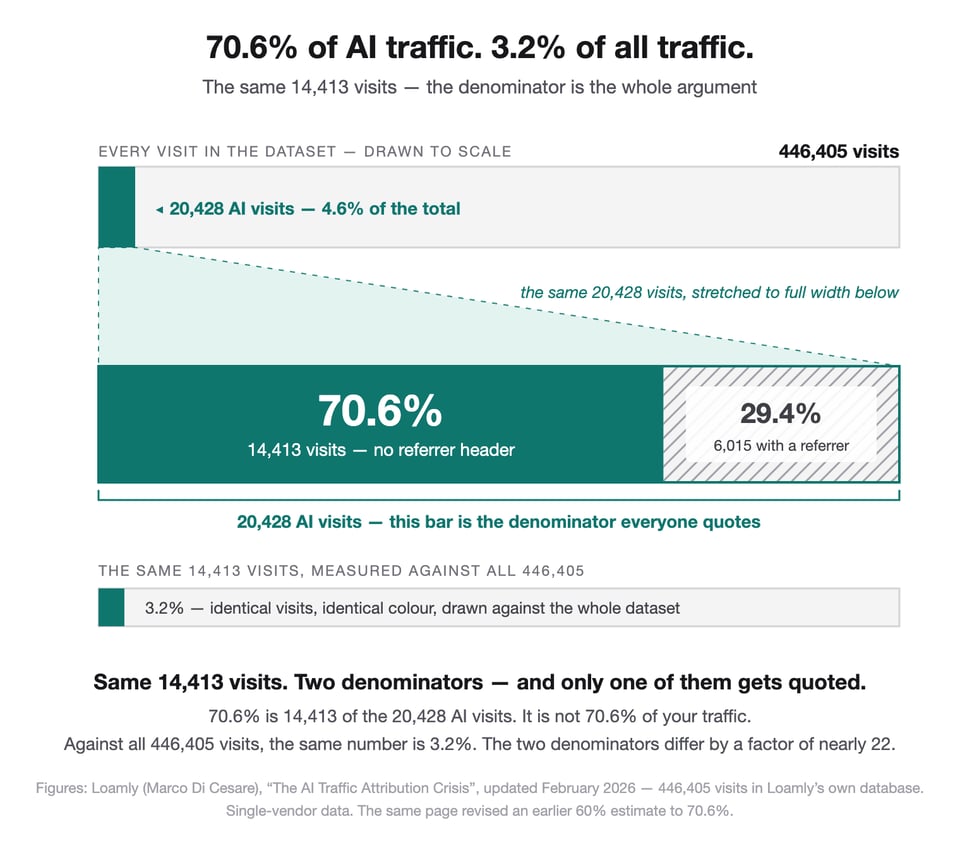
Remember 70.6%.
Two vendors, and they disagree by a factor of two
There is a second measurement, and it doesn't agree. Clickport ran the same test on its own customers a couple of months later, in a 30-day snapshot saved on 23 April 2026 'across Clickport customer sites': '35.7% of recognized AI Search sessions had no recorded referrer.' Clickport publishes the percentage without the count, so there's no arithmetic to check underneath it. What it does publish is the size of the slice: 'Recognized AI Search made up 0.7% of all recorded sessions in that snapshot.'
That's 70.6% and 35.7%, two months apart, on definitions that broadly overlap. Neither reconciles the other. And neither is looking at a random sample of the web—each is looking at the sites that bought its product. That isn't a criticism of either of them. It's what first-party analytics data is.
The most useful thing anyone has published is a silence
Patrick Stox took the mechanism apart, platform by platform, on the Ahrefs blog: ChatGPT (free and paid), web search, Deep Research, Gemini, AI Mode, Copilot on the web and on Windows, Perplexity, Claude, Grok, DeepSeek, Meta AI, Mistral. Ahrefs runs its own web analytics product and had every commercial reason to put a headline percentage on the front of that work. He published no loss rate at all. Semrush wrote up the attribution gap in May this year and gave no figure either.
Two of the organisations best placed to put a number on this have declined to. As far as I can see, that's the most honest thing anyone has published on the subject.
And the number answers a question nobody asked it
There's one more problem, and it's the one that matters most—especially if the figure is one you've passed on yourself, which is easily done. None of these numbers measures the thing they get quoted for.
Here is what was actually counted. Take the visits Loamly had already identified as coming from AI—20,428 of them. Of those, 14,413 had no referrer attached. That's the 70.6%. It is a share of AI visits and nothing else, and those 20,428 AI visits are 4.6% of the 446,405 in the database they came out of.
Here is what people hear when the number gets repeated: 70% of the traffic sitting in my direct bucket is really AI.
Same figure, different question, different denominator. The first counts AI visits and asks how many lost their referrer. The second counts direct visits and asks how many are AI. Nobody has measured the second, and it is nothing like 70%. Your direct bucket is mostly genuine direct traffic—bookmarks, typed URLs, links opened out of email clients, everything analytics has never been able to see. AI sessions do land in it. They also land in Referral and in Unassigned.
So when someone tells you 70% of your direct traffic is AI, that is not what anybody measured.
What survives all of this
But take the percentages away and something solid is still standing. The reasons AI clicks lose their referrer are documented, reproducible, and have nothing to do with anyone's sales pitch.
- Links built to suppress it. Stox found that 'An in-content link in my paid account of ChatGPT has a noreferrer attribute on the link', and that the same kind of link in a free account 'did not have the noreferrer attribute. It's tracked properly.' Same product, different tier, different attribution—and nothing a publisher can do about either.
- Apps and the browsers built into them, which I'd expect to be the biggest of these by some way. Tap a link inside an AI app—ChatGPT on your phone, or a desktop app like Perplexity's—and the page opens in a browser window inside the app itself. That window has no referrer to hand over. Stox on Perplexity: 'Their website seemed to send referrers on everything.' And then: 'Their desktop app doesn't seem to send referrers on anything.'
- AI browsers, which are new, break it differently again. MarTech tested how GA4 records the current crop and found that ChatGPT Atlas strips the referrer on links opened inside the ChatGPT interface, while passing chatgpt.com when it's driven as an ordinary browser. Atlas also keeps its cookies apart from your main browser profile, so a returning visitor is counted as a new one—an attribution problem with nothing to do with referrers at all.
- Copy, paste and retype. No referrer by construction. Unmeasurable, and it always will be.
The share of AI use happening inside apps and AI browsers, rather than on a website in an ordinary browser tab, is going up—and those are exactly the places that drop the referrer. Any figure gathered in 2025 is describing a different product from the one your customers are using now.
What I'd do instead of quoting a number
Measure it on the site in front of you. Four things, roughly in this order.
- Look for utm_source=chatgpt.com. ChatGPT tags the links it puts into its citations, and that tag survives referrer loss completely. Check that a CDN rule or a redirect isn't stripping it before GA4 ever sees it.
- Build a custom channel group that matches on source and ignores medium. It pulls your chatgpt.com sessions back together out of Referral, Unassigned and GA4's own AI Assistant channel, and it applies to your history as well as to this month. It recovers nothing that arrived with no referrer at all, so don't expect it to close the gap. Itamar Blauer has published the build.
- Read your landing pages. Deep, unguessable URLs arriving as direct, with no internal page in front of them, are a signature of an AI referral. A signature, not a measurement, and worth treating as exactly that.
- Put 'how did you hear about us' on your forms. It's the only one of these that catches copy-paste and app traffic, and it's the least fashionable thing on the list.
What I'd take away
Before you use a percentage, ask what was counted and out of what. Both numbers in this piece survive the first question and change shape under the second.
And when a number does turn out to be wrong, the useful response isn't to stop trusting numbers. It's to notice that the correction was there all along, published freely by the person with the least to gain from publishing it, and that it sat in public for six months while the old number kept travelling.
One related read, if it's useful: Three things moved Search Console numbers in August, and only one of them was real. Same problem, in a report you open every week.
Thanks for reading
David
If you want to talk about what your AI traffic is actually doing, please contact me at [email protected].
Every passage quoted in this issue was on the page it's credited to on 10 September 2026. If one has changed by the time you get there, check its date before you use anything from it.
