
Closing the gap between cited and recommended
AI Search: What gets you named?
Last time, I showed you how an AI Assistant can build its whole answer from your content and still tell the buyer to choose somebody else. That's the difference between being cited and being recommended, and I promised more on how to close it.
I have to raise my hands right now. I don't have a proven method for you, and as far as I can see, nobody does—anyone who says otherwise is almost certainly putting their opinion ahead of the evidence. But I do have the most useful research I've read recently about what separates brands that get named from brands that only get quoted.
Depth gets you named. Spread gets you quoted
Kevin Indig ran a study on Semrush's AI Visibility Toolkit data—1,094 categories, tracked from January to June this year, US ChatGPT only—looking at how a brand's topical focus changes the way the model treats it.
In categories a long way from a brand's core expertise, 50% of its appearances were citations, but only 25% actually named the brand. But, in categories close to the core, the figures were 74% and 44%.
So the model will quote you on almost anything—if your content helps the answer it's building, it gets used. But it mostly puts a name forward where the brand has built genuine depth.
Picture a company that sells commercial coffee machines and publishes on everything from hybrid working to descaling a bean-to-cup machine. Its annual survey on why staff come into the office props up plenty of AI answers about workplace culture, and it gets the footnotes to show for it. But ask the model to recommend a coffee machine for a 200-person office, and the depth of the core content decides whether the company's own brand comes up.
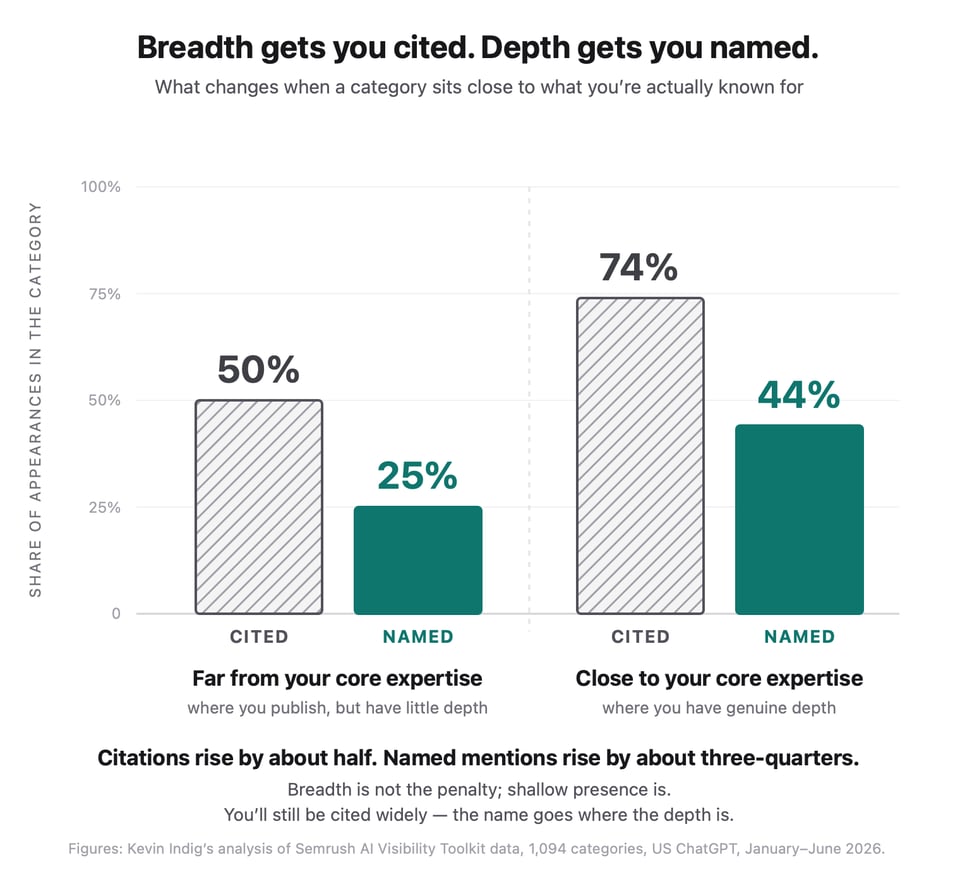
The second finding is the one I'd act on. Breadth without depth costs you named mentions. In Indig's own words: 'the "spread too thin" penalty is really a penalty for shallow presence, not for breadth itself.'
And what counts as depth here? In the study, it's whether a brand keeps appearing as the question gets asked in different ways—five phrasings of the same buying prompt rather than one. Shallow presence is having a page that happens to match one version of the question. Depth is being useful no matter how the question is phrased.
The limits, before you touch your content plan
Indig is honest about the limits, which is rarer in this field than it should be. The effect sizes are small. And he thinks writing style, overall brand authority and what third parties say about you probably outweigh topical authority altogether. My gut feeling is he's right.
There's a floor in the data too: higher-stakes categories—legal, healthcare—barely rewarded depth at all when it came to naming brands. Some fields hold a higher bar for recommending anyone.
So treat this as a direction, not a dial. It does point the opposite way from most content plans I've seen, which still reward publishing something thin in every category a keyword tool can suggest.
What you can do now
You don't need a tool to start. Ask an AI Assistant the buying question in the category you care about, a few different ways, and read what it actually says—whether you're the source or the choice. Then put that against an honest map of where your content is deep and where it's merely present. I'd expect the two to line up more often than not, and the thin spots to be where you're doing the homework for someone else's sale.
If you want to go further than a read-through, start where a recommendation is worth money—the categories where the model naming you is, in effect, the sale. Count how often you're named there, separately from how often you're merely cited, so you know which of the two you're actually short of. Then deepen one category at a time, answering the buying questions properly rather than adding another thin page, and watch whether the named mentions move.
More on this as the picture gets clearer.
Thanks for reading
David
If you want to talk about getting recommended in AI Search, please contact me at [email protected].
