
Cited by AI isn't the same as being recommended
AI Search: Awareness or sales? Here's a distinction that's quietly costing brands business, and as far as I can see, almost nobody is measuring it: being cited by an AI search engine is not the same as being recommended by one.
It's been a few months—how did that happen? I've spent a good chunk of them buried in AI-visibility work and developing an in-house tool that does precisely what I want it to do. When you've read to the end, you'll see why.
I've come back with the single most useful thing I've learned.
Are you being cited or recommended?
Here's a distinction that's quietly costing brands business, and as far as I can see, almost nobody is measuring it: being cited by an AI search engine is not the same as being recommended by one.
They can look identical from a distance. They are not.
So let me be plain about the two words, because this whole newsletter turns on the difference between them.
A citation is when the AI uses you as a source. It has read your page, it leans on your content to build its answer, and it credits you—often with a footnote or a link back. It's the AI saying, in effect, "here's where I got this."
A recommendation is when the AI names you as the answer. Not the source of the facts—the thing the buyer should actually go and choose. It's the AI saying, "this is the one for you."
You can have either without the other. But it's the second one that pays your invoices.
Two answers. And they're totally different
Watch an AI Assistant help someone choose a product in your category. It will draw on your content, quote your data and link to you as a source. You are the reference the whole answer is built on.
And then, in the same breath, it recommends someone else. The name it actually tells the buyer to pick is your competitor's.
It's easier to see than to describe. Here's the shape a typical answer takes—not from any one assistant, just the pattern they all fall into:
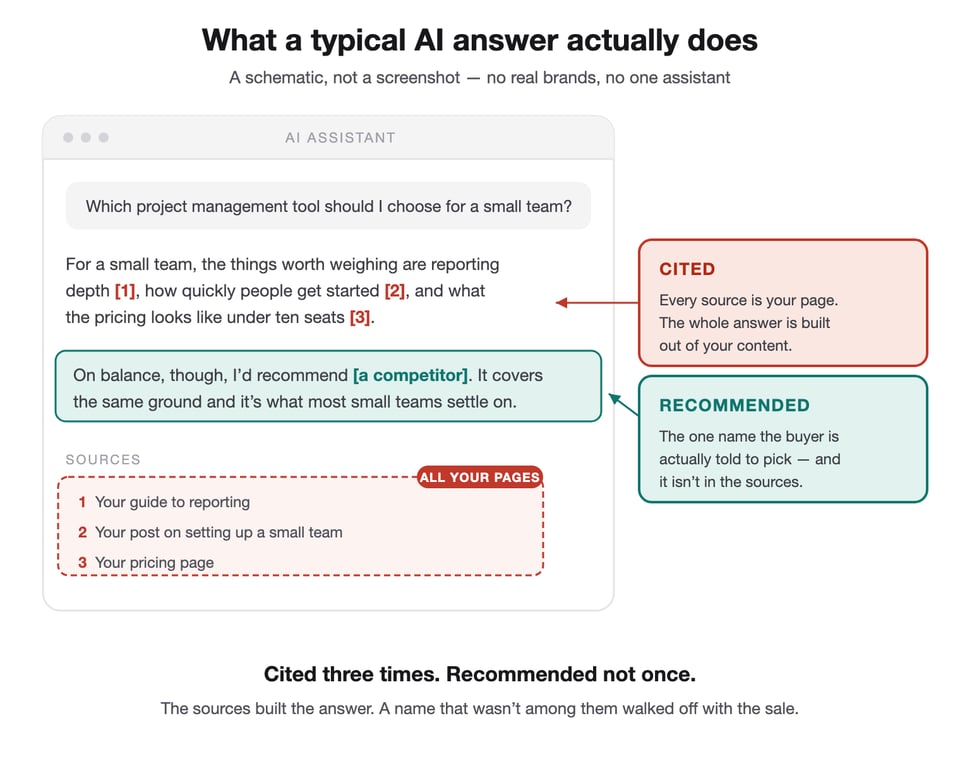
You were the homework. They got the sale.
I've now seen this happen enough times to stop being surprised by it. A brand can be the source everyone's answer stands on and never once be the name the model puts forward.
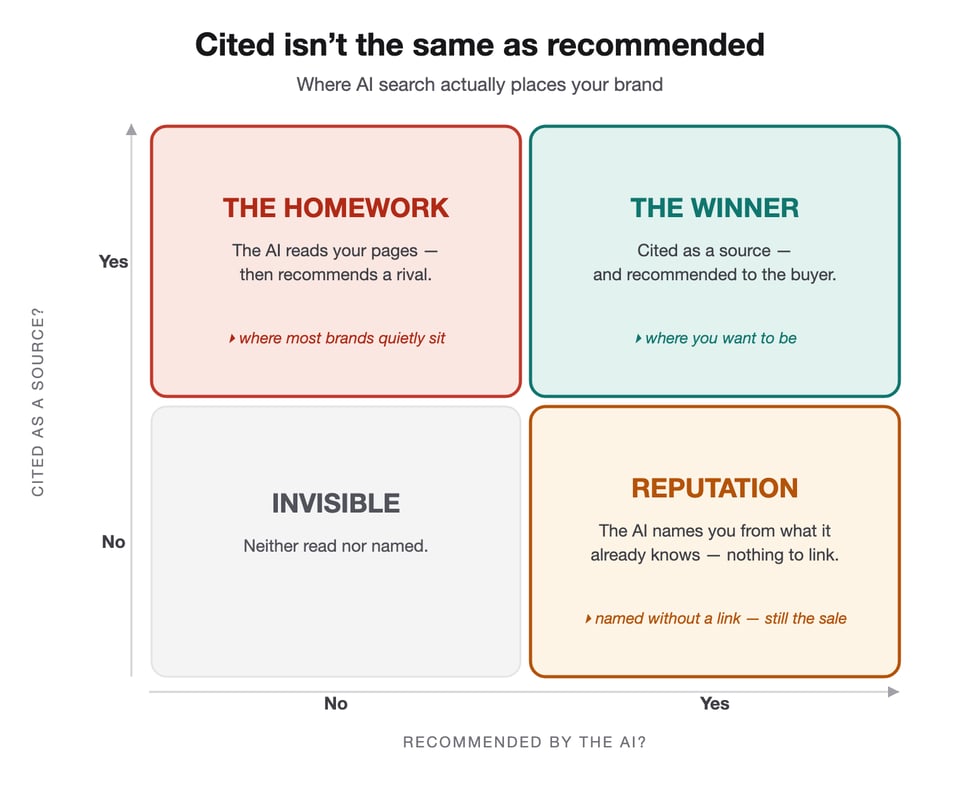
Those are really only two of the four places you can land—cited and recommended, cited but not, recommended but not, or neither. I've drawn them as a simple map in the diagram below.
Why the tools go wrong
The "AI visibility" tools I've looked at count mentions. They tot up citations, give you a score, and call it visibility. It looks reassuring. Your number is going up, so things must be going well.
But because a citation and a recommendation are two different things, a tool that counts them together can't tell you how many times you're being recommended. Worse, a citation dressed up in confident language from an AI Assistant reads like a recommendation when it's nothing of the kind.
So your score climbs while your sales don't. That gap—between looking visible and being chosen—is exactly where you could be losing, and a mention-counter is not built to see it.
What you should actually measure
Measure recommendation-share separately from citation-share. Keep them in two baskets and never let anyone merge them back into one comforting number.
Do it across more than one AI surface, because they don't agree with each other—being the pick on one tells you little about the next.
And read what the model actually said. Not the score, the sentence. An automated tally will tell you that you appeared; only the words tell you whether you were the source or the choice. That reading is where the real answer lives, and it's the step most people skip because it doesn't scale neatly.
The question to take away
Stop asking "am I mentioned?" It's the easy question, and the tools are only too pleased to answer it for you.
Ask "am I recommended?" It's harder to measure, less flattering and the one that decides whether any of this is worth doing.
The gap between the two is where you're quietly losing. My gut feeling is most brands have never once looked at it.
More on this next time.
Thanks for reading
David
Want to know more? Have some comments? Contact me at [email protected]
