
Human content wins. The data proves it.
Here's the number that matters — human-written content is eight times more likely to rank at position one on Google than AI-generated content.
Semrush analysed 42,000 blog posts across 20,000 keywords. At the top position, 80% of pages are human-written. Just 9% are AI-generated.
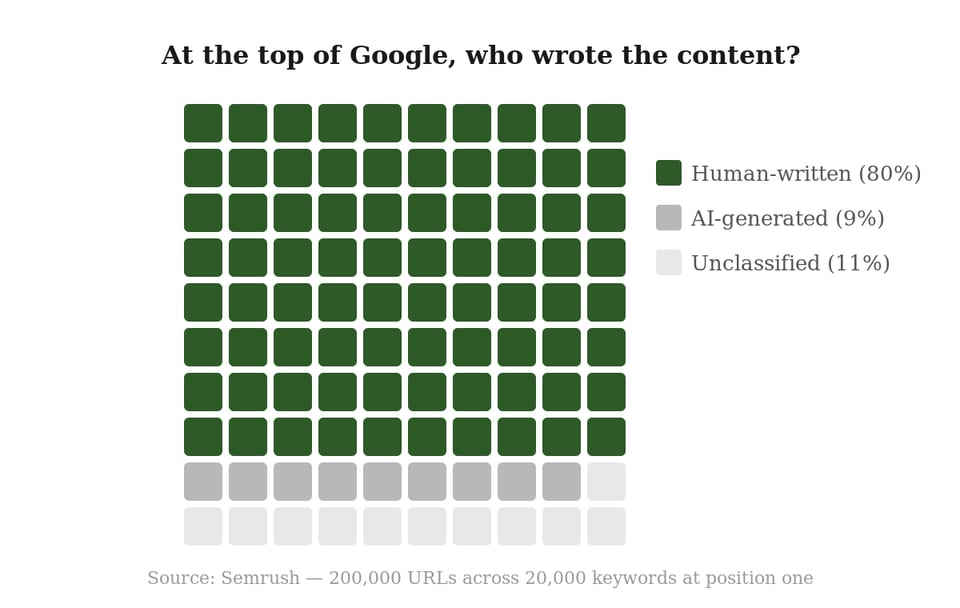
None of this surprises me. I've been writing professionally since the 1980s, and I use AI in my work — but I've never handed the writing over to it. There's a reason for that, and now there's data to back it up.
The interesting part is the gap
72% of SEO professionals believe AI content performs as well as human-written content in search. The ranking data says they're wrong — at least where it matters most.
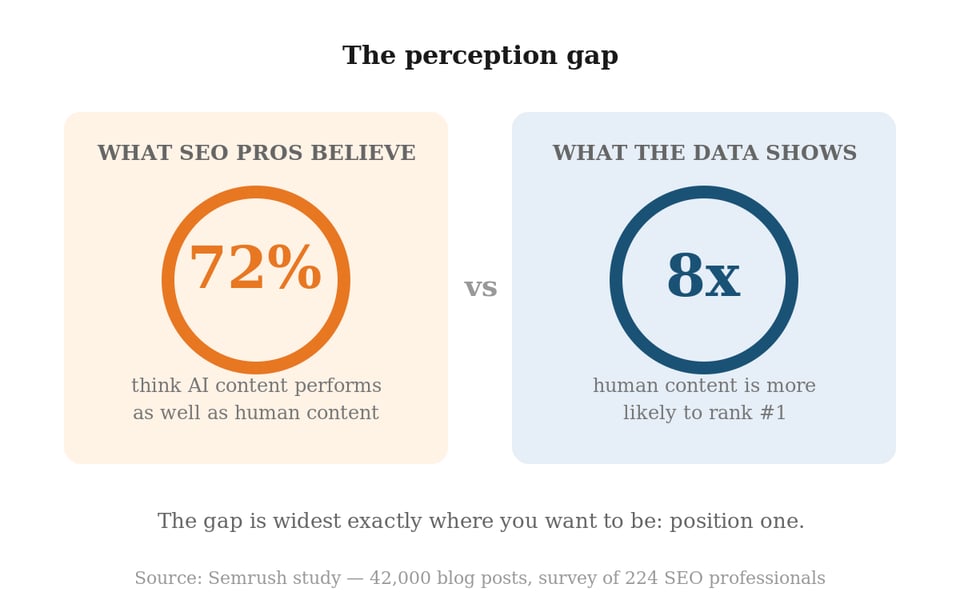
The gap is widest exactly where you want to be: position one. Further down the page, it narrows. From position five onwards, AI content holds its own. So if you're benchmarking against "ranking on page one," AI content looks fine. It's only when you ask, "Where on page one?" that the picture changes.
What the data is actually telling us
Google has gone on record saying it doesn't care whether you use AI for your content. It cares purely about the quality of the resultant content. And that's why pure AI content fails at the high jump.
The ranking advantage of human content comes from what human writers bring that AI doesn't: original perspective, expert judgment, genuine insight and a sense of life. Things you can't generate by asking a language model to summarise what's already been written.
Where AI excels in content
Speed is where AI genuinely helps. I don't have research with actual timings to hand, but according to Semrush, 70% of content teams say faster production is the main benefit. Only 19% say it improves quality. That's the honest answer — AI accelerates the process. It doesn't automatically improve the output.
And, that's only sometimes giving faster production. Sometimes I find the benefit is in depth and discovery. Research and quickly working with reams of research is where it wins out.
You can use AI to vastly improve the knowledge base of any blog post or page, but it takes time to fact-check, and you can lose any advantage in production speed. But, in the right (human) hands, that richness of background can lead to a winning post.
What this means in practice
Use AI for the things it's good at — research, structuring, getting a first draft ready faster than you could from scratch. Then do the work that actually counts—fact-checking, rewriting, bringing your own experience and judgment to bear.
The content ranking at position one isn't produced without AI. It's produced without handing the job over to AI and washing your hands of it.
I've been working this way in my own writing workflow. What ends up on the page is mine — shaped by my experience, checked against what I know, written in a voice a language model can't replicate.
That's not a philosophical position, or even a copywriter's opposition to progress. According to the data, humanity gives you a competitive advantage.
Best
David [email protected]
Want to know how to use AI for true ROI in your content production?
Book a Free Consultation to start the process
Editorial note: The Semrush study analysed 42,000 blog posts from 200,000 URLs across 20,000 keywords (November 2025)—AI detection via GPTZero. While GPTZero is widely used for identifying AI-generated content, no automated tool is perfect. Its classifications are based on probability, and some posts may be incorrectly tagged as human or AI-generated. The study also includes a survey of 224 SEO professionals. Source: semrush.com
