
AI found your page. Then it forgot about you
Found by AI isn't the same as being cited
In August, I wrote about the gap between being cited by an AI Assistant and being recommended by one. There's another gap, further back. An AI Assistant can find your page, read some of it and leave you out of the answer altogether.
Nothing in the answer itself tells you that happened.
Found, read, credited
OpenAI's own documentation for developers using its web search tool confirms the gap. It describes two separate lists: the sources the model consulted, and the citations in its answer, which 'show only the most relevant references'. The first list is often longer than the second.
That's the version developers build with rather than the ChatGPT app, so it doesn't tell you how big the gap is. It tells you the gap is there by design.
So when your name isn't in an answer, there are two quite different explanations. As Search Engine Watch put it: 'an absent link cannot tell you whether ChatGPT missed your work or found it and moved on.'
It helps to think of it as three steps. Usually, the AI finds your page, reads some of it and then decides whether to credit it. A citation count only sees the last one.
One answer, 223 pages
Earlier this month, Metehan Yeşilyurt, a researcher at Peec AI, described the data ChatGPT sent to his browser while it wrote a single answer. The question was about the best AI visibility tools, which is what Peec AI sells. By his account, ChatGPT fetched content from 223 web addresses, and the finished answer carried 16 citations.
It's one answer to one question. Search Engine Watch, which reviewed the screenshots, says it 'has not independently reproduced the capture or examined the full dataset.' I'd treat it as an example of the gap, not a measure of it.
A bigger study, pointing the same way
RESONEO captured 1,200 ChatGPT answers in July, and its co-founder, Olivier de Segonzac, wrote up what they found. Across all of them, ChatGPT's source lists carried 61,332 entries, and the same page can turn up in more than one answer. Only 5,032 became the lead source behind a citation.
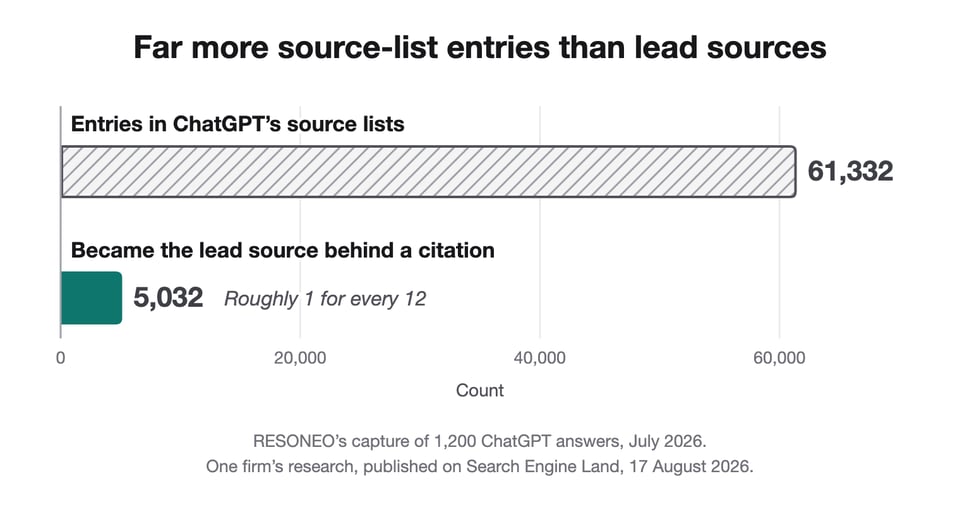
That's roughly one for every 12. It's his own consultancy's research, on its own tools, and he says so. But it's 1,200 answers rather than one, and as he puts it: 'Being retrieved and being cited are two different markets.'
What 'read' actually means
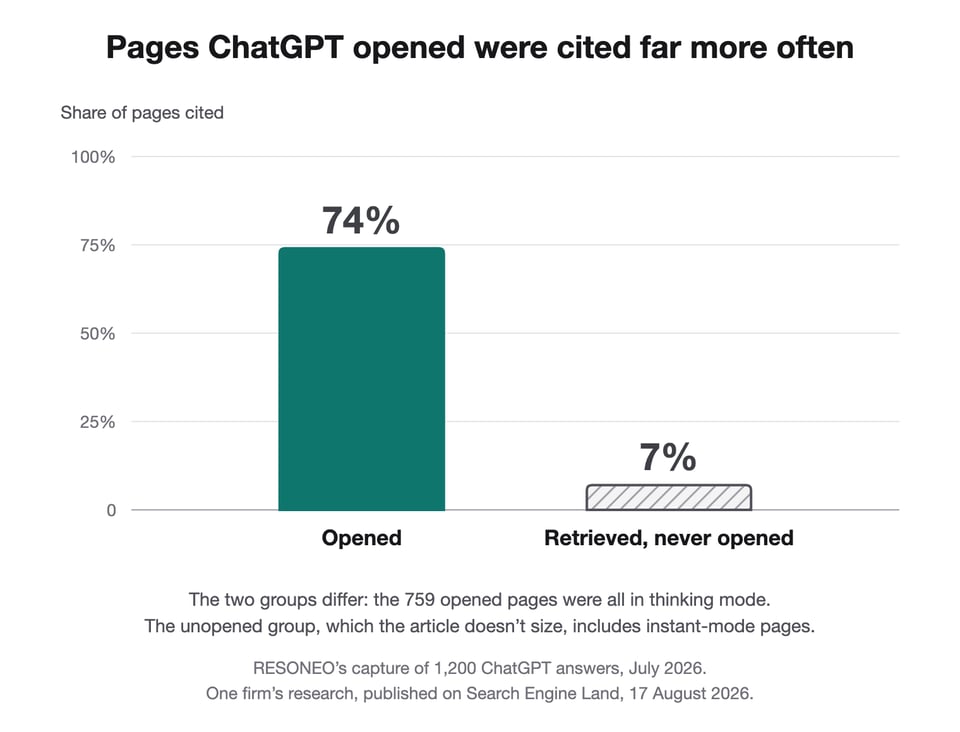
Pages ChatGPT opened did far better. In RESONEO's data, a page it opened was cited 74% of the time. A page it retrieved but never opened was cited 7% of the time.
The two groups aren't like for like, though. All 759 opened pages came from ChatGPT's slower thinking mode, which in July only paying users had. The unopened group, which the article doesn't size, also takes in pages from its quick answers, what ChatGPT calls instant mode. So the figures show which pages ChatGPT favoured, not that being opened is what got a page cited.
In July, instant mode was all free users got. In 93% of the instant answers RESONEO captured, ChatGPT opened no page at all. It worked from the page title and a snippet of about 200 characters, a couple of lines taken from your main heading and whatever sits around it. That can be a category label, a byline, a date or, in one case they measured, nothing but a table of contents.
So, in July at least, most of ChatGPT's quick answers weren't reading your page. Since August, free users can also press Think, which in RESONEO's August tests more than doubled the number of web addresses ChatGPT retrieved.
What you're likely to be sold
Two things, mostly.
The first is a dashboard that counts how often you're cited. It's useful, as far as it goes. But a count of citations only sees the last of those three steps. Ask whether the tool also records the sources an answer listed without citing. If it doesn't, it can't tell you whether you were found and passed over or never found at all, and that's what you'd need to know before spending anything on a fix.
The second is a rewrite: break every page into short, self-contained passages, because that's the size ChatGPT is said to read. The same researcher reported pages being split into passages of about 170 words, and a number like that is easy to build a rewrite around. Search Engine Watch calls it 'an observation attributed to the researcher, not evidence that publishers should rewrite every section to that length.'
RESONEO, with far more data behind it, says the same of its own findings: 'don't rebuild your site around a quirk.' One field its research used disappeared from ChatGPT's data overnight in July.
What I'd do instead
-
Find out whether ChatGPT is opening your pages. Ask whoever runs your website to look in the server logs for ChatGPT-User, the name ChatGPT's page-fetching robot gives itself. That's RESONEO's suggestion, and it's evidence you own, not a score somebody else calculated. But a quiet log doesn't mean you're unread. Quick answers mostly work from a snippet stored earlier, without visiting your site, and ChatGPT shares one fetched copy of a page among many users. And on a hosted platform, there may be no server logs to look at, though some, Wix for one, show ChatGPT's visits in their own analytics.
-
Look at the top of your key pages the way ChatGPT's quick answers do. Your page title, the one that shows in the browser tab, then the first 200 characters or so around your main heading. If that space is taken up by a date, a category label or a table of contents, move them down and put the sentence that says what you do in their place. It's a small change and an easy one to undo. Don't expect it to show straight away: ChatGPT keeps the snippet it cut until the page is next crawled, and nobody outside OpenAI knows when that will be.
-
Stop at the top of the page. Don't split every page into 170-word passages on one researcher's observation. Or rebuild your site around one study, come to that. That's why the change above is a small one. RESONEO again: 'The 200-character snippet probably won't last long. The need to be the best answer will.'
What I'd take away
Before you pay for a fix, ask which step it fixes: being found, being read or being credited. Everything a citation count measures happens at the last one.
Thanks for reading
David
If you want to talk about what AI search is actually doing with your website, please contact me at [email protected].
Every passage quoted in this issue was on the page it's credited to on 18 September 2026.
