
Devoted to Beauty, Yielded to Limits
A diminished future is not our only option
Eight years ago, in the heat of mid-summer, our family of four drove from our home in Chicago to an island just north of Seattle for a five-week stay. We’d planned stops along the way in some beautiful places but first we needed to escape the monotony of the Midwest and the Plains. Or so I thought.
“I prize the hiddenness of Dakota, and have grown protective of the silence here,” writes Kathleen Norris in her memoir of life in that region. This hidden silence was evident even from the confines of our car, packed tight with camping gear and books and squirmy children, speeding west on I-90. Vast is too small a word; the skyline stretched taut in all directions before falling away. Never, not even from a craggy mountaintop perch in the California Sierras or their ancient relatives in Appalachia, have I so keenly sensed the precarity of our hold on this spinning terrestrial sphere.
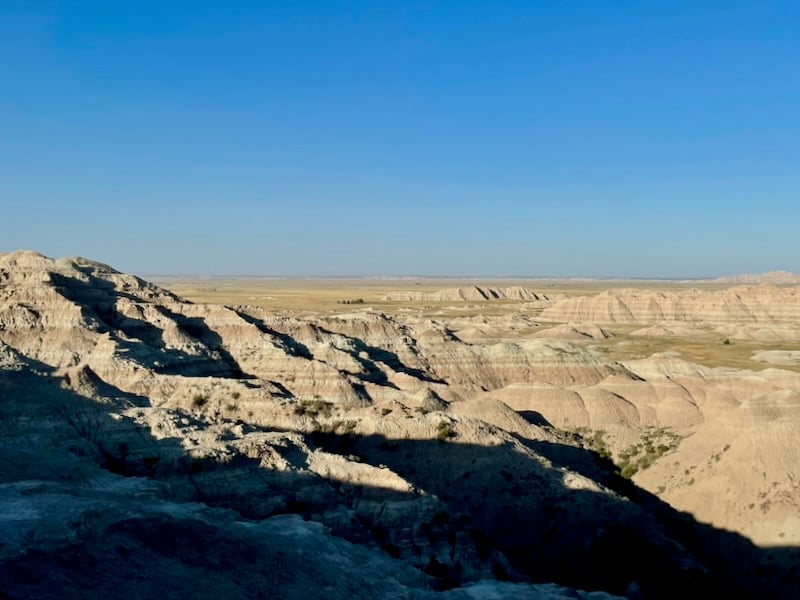
And then another revelation: the Badlands. If South Dakota made us susceptible to being flung into orbit, now it seemed we had landed on the moon. Grassland, pasture, and hectares of crops gave way to canyons and crags. Everything appeared ancient, as though the landscape through which we’d been driving for hours had quickly been aged by a few millennia. In the Dakota plains, air-conditioning spilling from dashboard vents and John Prine’s gravely voice serenading us from the stereo, we time-traveled.
When we finally arrived in the Black Hills, two days after leaving our apartment near Lake Michigan, we had been prepared, I think, to absorb the beauty of the place: streams, reservoirs, and forests; formations and stratification of rock, a land of fossils and dinosaur bones. We swam in the lake near our campsite before going to bed and after waking up. One strenuous hike led to panoramic views and another took us into the thumping heart of a summer thunderstorm; lightening and hail chased us down the creek-crossing trail to the shelter of our car.
We visited some spectacular places that summer – Yosemite, Mount St. Helens, Glacier, the San Juan Islands – but every time I talk about those first days of our trip it is the unexpected beauty I remember. It was just so beautiful.
—
This summer, for the second time, I drove across South Dakota. I was alone and this time, heading toward a quiet week in the Black Hills with some friends, I knew what to expect. Instead of dreading that long, straight, hot stretch of interstate, I was looking forward to it. I’d loaded my phone with a few audio books and podcasts and somewhere between Sioux Falls and Rapid City I listened as a well-known environmental activist was interviewed by a sympathetic host. Imagining the aesthetics of the future environmental movement, the activist said, “One of the things that a progressive political aesthetic is going to look like in the years ahead is… solar punk. It’s going to be people with… solar panels everywhere. Exactly right. It’s going to be beautiful.”
It so happened that as the activist was describing his vision of a solar punk future, I was driving through a wind farm. Massive windmills covered the landscape, their blades slowly spinning in the persistent prairie wind. Either these behemoths had been erected since my last drive through the state or, more likely, my memory had unconsciously erased their presence. But now, considering the assertion about the beauty of places covered in solar panels and wind farms, I couldn’t stop looking at the spinning metal which interrupted the landscape of my memory. Is this beautiful?
My guess is that the activist and host don’t think hillsides covered in silicon and steel are more beautiful than ones that are not. Rather, their claims of beauty are accounting for our insatiable demands for energy. Given our rates of consumption, windmills and solar panels are far more beautiful than aquifers destroyed by fracking, mountaintops obliterated for coal, and carbon dioxide pumped into the atmosphere. Their belief about the beauty of these clean technologies rests on the assumption that we can either maintain our old understanding of what makes a landscape beautiful – a well-managed wilderness, healthy agricultural land, a humane neighborhood – while continuing to plummet toward ecological collapse, or we can adjust those beliefs, come to see the beauty of “solar punk”, and save ourselves.
The wind farms in South Dakota and here in my own state of Illinois are efficient and may be necessary. But are they beautiful?
--
A few weeks after returning from the Black Hills, I volunteered to drive 90 minutes to a farm south of Chicago to pick up an order of meat and eggs we share with some of our neighbors. For the past twenty years, once a month, someone from the neighborhood has been driving down to this small family farm to collect dozens and dozens of eggs and tasty cuts of grass-fed, free-to-roam beef and pork. With a rare Sunday morning free and having never made the drive myself, I was glad for the chance to finally visit the farm.
After about 45 minutes of interstate, I exited east and made my way toward the Iroquois River. There, along a bend in the river and down a short gravel driveway, is where I met Diann. More than a few years older than me, Diann and her husband have been farming for their entire marriage. They both come from agrarian families and the land they farm is within walking distance of the farm Diann’s husband grew up on. Having just spent an hour and a half driving though acres of mono-crops – mostly corn and soybeans to my inexpert eyes – Diann’s farm seemed like an anomaly. She pointed first to the more than 40 acres they keep in timber where, given the summer heat, the cows and pigs were currently sheltering. There is also a large garden and a protected hillside for the chickens to lay the eggs whose rich orange yolks our family loves.
In the shed which holds the meat freezers, Diann showed me photos of the draft horses the family used until recently to till and plant their fields. We talked for an hour and more than once Diann explained that most of their farming practices and innovations have been born of necessity. “It’s all we could afford,” she said.
Unspoken was the fact that many of her neighbors, facing the same economic barriers, chose differently: larger equipment for more acreage (and less diversity) made possible by an endless cycle of credit and debt. My friend who pastors in an agricultural community near Iowa tells me stories about the funerals he’s officiated of the farmers who, completely diminished by their deficits, have quietly ended their own lives.
For whatever reason, Diann and her family decided to accept the limitations of what they could afford and the farm she and I admired that Sunday morning was the result. As we talked, her eldest son arrived in his pick-up truck towing a couple of used grain trailers he’d just purchased inexpensively near Wisconsin. Grinning, Diann explained how these would be adapted as shelters for the hogs. “It’s all we can afford,” coming from this farmer, sounded less like a lament than it did a choice for sanity, creativity, and, to my eyes, beauty.
--
If the environmental activist and radio host assumed we need to choose between beauty and salvation, they also assumed, with good reason, that our culture’s commitment to consumption and growth knows no end. Most of us have now experienced, at varying levels of personal loss, the increasing toll of climate change. Just this week I waited anxiously for a friend in Washington to reply to my texts asking whether his home had survived the wildfires. Despite the undeniable costs of our extractive way of life, we continue to build our lives and societies on the logic of destruction.
In this way, those who claim that we need to lower our standards about what makes our places beautiful are just being realistic. Why would any even halfway alert person think that the scorched-earth practices of economic growth which have defined the past few hundred years will be abandoned any time soon? Despite the way each latest climate catastrophe is described as a “wake-up call,” we’ve definitively proven that there is no call so dramatic or destructive as to wake us up from our consumerist slumber.
Think, to take one example, of the mad race to construct artificial intelligence data centers around the country. Though AI experts largely agree that the development of these unpredictable technologies should be dramatically slowed down, though the utopian claims about the possibilities of AI are still largely unrealized, though the displacement of workers by AI has already begun, though AI companies are building their data centers under the cloak of legally-enforced secrecy despite opposition from elected officials and those they represent, and though the natural resource demanded by these centers threaten to destabilize local communities and their ecosystems– despite these and other reasons to impose limits on AI development, unfettered competition continues to reign.
The promise of development built on guaranteed destruction is absurd. Given it’s old pedigree in this country, I’m tempted to describe this logic as the purest form of the American Way of Life. It’s no wonder the experts tell us that beauty must be diminished; it’s clear that our destructive appetites won’t be.
But then I think about Diann and her family and their farm and my cynicism slows. Their witness forces me to question the assumption that we must choose between beauty and salvation, that we cannot imagine a vision for cultural health other than parasitic growth. I’m privileged to know a few other farmers like Diann, and what they share in common is a deep regard for the limitations of their land. These caretakers understand Wendell Berry’s claim that “there is a limit beyond which a farm outgrows the attention, affection, and care of a single owner” not to be a challenge forcibly transcended but a reality graciously accepted. I think about a friend who is slowly bringing some degraded Midwestern acreage back to health who describes walking the land with a friend, realizing that it will take some time to discern with the land what is required for its healing. The limits of Tiffany’s place will define its flourishing.
--
Having been told that our survival demands acceptance of a less beautiful world – landscapes littered with technologies which allow our selfishness to run wild – I find myself wanting to double-down on beauty. And what becomes evident after turning away from promises and pragmatism of the techno-utopians is that there are still those who know how to find beauty amidst the boundaries of creaturely life. The vulnerable and verdant places cared for by Diann and Tiffany betray the lies that beauty must be exchanged for security, that we cannot choose a more creative, sane, and beautiful way to live.
Most of us, though, having lived so long immersed in the rationale of extraction and domination, struggle to see the beauty found within limitations. Speeding down the interstate, surrounded by farmland, we struggle to differentiate between industrial farming propped up by pesticides and fossil fuels, and a diversified and self-sustaining farm which, by honoring its inherent limitations, is preserved rather than abused by its owners. Or, having lost the specifying language of nature, we are happy to see trees being planted along our urban streets without noticing what kind of trees they are and whether they will support native populations of insects and pollinators.
“Beauty,” according to the concert pianist and scholar Mia Chung, “is extremely costly. To create beauty exacts a very high price for both the person who creates but even for the viewer, the recipient, because you have to strain to understand, to absorb and fully comprehend what the statement of beauty is.” Chung’s observation about the challenge of beauty might make us think about the attention required to apprehend a painting or piece of music but it also applies to our sense of the natural world. Formed by marketing and propaganda thinly disguised as beauty, we’ve lost the eye to spot the real thing when it shows up along a carefully tended hedgerow or the wrinkled crow’s feet marking a loved one’s face. Our technological teachers have so successfully schooled us on the language of efficiency that we find ourselves without the vocabulary necessary to describe the splendor which only reveals itself in the presence of prolonged attention.
And so we are vulnerable to the experts who confidently tell us that the future demands of us compromises in the present. Having already lost the ability to see and name what is majestic and mysterious in this world, we don’t realize the beauty our compromises extinguish. If the plains of middle-America are just flyover country, than what does it matter if we optimize that emptiness with miles of windmills? If we cannot distinguish between agribusiness and care-taking, then what does it matter that our policies are driving generational farmers to despair? If a neighborhood is only the “inner city” or “under-resourced” or a “ghetto,” then what does it matter who is displaced by gentrification and economic development?
Beauty which is true to itself, which does not demand the annihilation of anything else for its own existence, can only be found amidst the limitations which characterize all creaturely life. Will we strain to understand?
--
The route to the farm in central Illinois took me along Route 24. The highway between Crescent City and Watseka parallels the railroad tracks where, I noticed, a median has been set aside for prairie habitat. I could have easily overlooked the bluestem, milkweed, and other native plants hurrying past the car except for the monarch butterfly that flashed from the roadside a few feet above my head. While most of the drive had taken me through agricultural country, pesticides left much of it a biodiversity wasteland; not a single insect had met its untimely end on my windshield. Now, suddenly, there were signs of life.
The space between the tracks and the highway wasn’t large, but the preserve stretched for a few miles. Bound by ribbons of steel and asphalt, the serpentine remnant testified to the oceans of tall grass whose roots once protected depths of rich and vital topsoil. The prairie has long been plowed under and the topsoil blown and washed away, but here, for whatever reason, a decision was made to to repair one little stretch of wounded land by accepting its limits. The flashes of yellows and blues from the wildflowers were beautiful. So too the insects that had found a home in this unexpected habitat and the birds who could find sustenance in otherwise barren terrain.
What will it take to wake up to the presence of beauty? It will involve, I’m convinced, a healthy skepticism directed at the well-meaning experts who tell us that a beautiful world is a privilege we can no longer afford. Our skepticism will extend to the promises of technological salvation, recognizing that such promises extend the trajectory of the manipulative control over nature which has led to so much loss.
More difficult is the need to be reacquainted with our own boundaries. By this I don’t mean the abstract limits of being human; all but the most demented of the tech-utopians can agree about the goodness of our shared limitations. No, what will be demanded of us if we are to re-learn how to see, honor, and nurture beauty in our home places is that we personally refuse the constant contemporary temptations to live mostly as consumers, hoarders, or thieves.
We do this most simply by refusing to participate in cultures and economies of exploitation. None of us can do this perfectly, of course; extractive capitalism is a web connecting most everything we touch. But we are not helpless and each of us can re-discover the joy of saying no! to cultures of domination and death.
I have a friend who tends a large suburban garden. As summer passes, she gathers her impressive harvest onto her front steps for neighbors to purchase inexpensively. Her life is no less busy or stressful than her neighbors, but she’s chosen to make space for this act of nurture and hospitality. She’s refused possibilities which would pull her away from her place and people so that she might be known as the neighborhood gardener.
I know a couple whose combined salaries make possible a life of safety and affluence where they could escape the evidence of the repercussions of their extravagant consumption. Instead, they’ve chosen a life of neighborliness beneath their financial means. They spend, drive, and travel far less than their peers. By their faithful presence, they quietly nourish the tender roots of reconciliation in a community long savaged by systems of racial exploitation.
Then there is my wife, who tends three urban gardens each summer, two which teach children about the sources of their food and the enjoyment of a fresh, unprocessed diet. This is the same woman who loves a good thrift store, finds new homes for our children’s outgrown clothes and books, happily shares our apartment’s one bathroom with her husband and two sons, and juggles her calendar so that we can remain the one-car family we’ve been for twenty-six years.
The healing of our beautiful world will need more than second-hand shopping, downwardly mobile neighborliness, and community gardens but it will certainly not ask less of us. Yielded to our limits, we rejoice in what is truly beautiful while remembering why the beautiful deserves our repentance into the good confines of our humanity. Likewise, we’ll find ourselves reacting to the pillage and plunder which hide behind our culture of ceaseless accumulation with appropriate revulsion. Joy and disgust – raw emotions, unmediated by the boosters of a future diminished by covetousness and greed – these will be the signs nudging our desires to the forgotten medians, marginal farms, and exploited neighborhoods where beauty can still be learned.


