
Attending to the Soil of Ministry
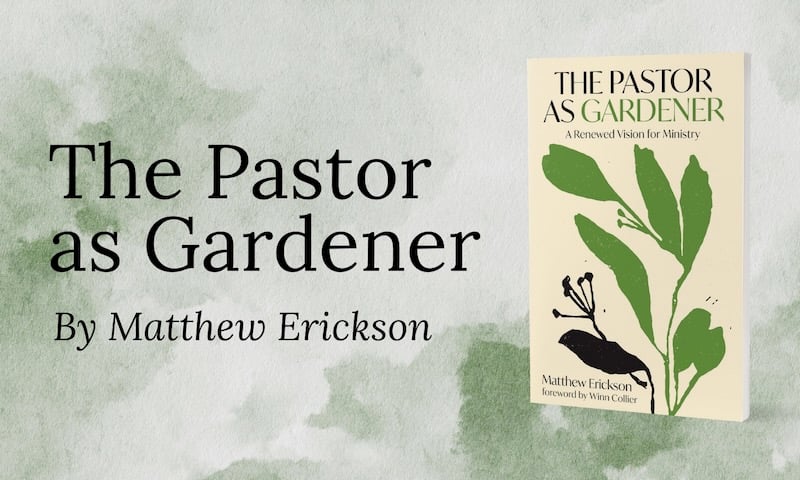
During my sabbatical, I’m featuring a few adaptations from books that I believe will be interesting to readers of this newsletter. Today I’m happy to feature an excerpt from Matthew Erickson’s new book, The Pastor as Gardener.
When Assyria’s fierce forces ravaged the northern kingdom of Israel, King Ahaz of Judah and his advisors sought protection from surrounding nations, particularly Egypt. But Isaiah the prophet’s voice rang out against Ahaz’s guidance, roundly denouncing the turn toward Egypt as a lack of faith. They needed to return to God, along with some solid, homegrown wisdom that Isaiah found in the image of a farmer.
Listen and hear my voice;
pay attention and hear what I say.
When a farmer plows for planting, does he plow continually?
Does he keep on breaking up and working the soil?...
His God instructs him
and teaches him the right way. (Isaiah 28:23, 24, 26)
The leaders of God’s people, drunk on power and prestige, needed to get in touch with grounded wisdom again, and the unassuming farmer points the way. In our own day, we need to get in touch with the grounded wisdom illuminated by Isaiah. We, too, have lost our way, growing out of touch with the wisdom of God imbued in the soil and deep work within it.
Considering the soil of ministry means we must attend to the sense of place. The place in which we live and minister is unique from any other place, shaping what we love and long for. Fruitful ministry takes account of the uniqueness of place at various levels, including geography, history, economics, politics, and more. Echoing Isaiah’s words about God teaching the farmer “the right way,” ministry rooted in God’s wisdom fits the work to the place in ways that are good and whole. So much contemporary writing on ministry instead offers generalized solutions to generalized problems, or extrapolates specific solutions to specific places as if they somehow indiscriminately apply to all places. We need another sort of attention if our ministry is going to bear fruit: patient attention to the soil of place.
We learn the geography of the place where we minister, in terms of how the unique, literal geography shapes the lives of those with whom we minister. Do rivers, plains, or mountains dominate the landscape? We study the history of the place, exploring how past events shape present realities. What wounds fester or secrets lie undisclosed within the soil we cultivate? We consider the politics and economics, both those at city hall and those discussed on the street. Patient attention to these and other factors helps us begin to understand the uniqueness of the place in which we minister, as well as the unique shape of ministry required within it.
Since 2010 I have served as pastor on the north side of Milwaukee, Wisconsin. On April 30, 2014, Dontre Hamilton, a black man with a history of mental illness, was shot fourteen times by a white officer of the Milwaukee Police Department. Amid the pain surging through the community, I reached out to a friend, Bishop Walter Harvey, asking about his experience as an African American man in light of these events. Bishop Harvey shared his experiences with me, and, as our conversation continued, we realized other ministers might benefit from similar conversations. Milwaukee is known as one of the most segregated cities in the United States, and, as Dr. King once said, the hour of worship on Sunday is one of the most segregated hours of the week. These conversational gatherings gained momentum, leading to the formation of a group dedicated to helping pastors work together across racial divides in our city. Two years later, when twenty-three-year-old Sylville Smith was fatally shot by police, three days of riots broke out in Milwaukee. Bishop Harvey convened pastors to call our churches to action, presence, and prayer in the community. One night as we walked the neighborhood, a group of young men came to welcome but also challenge us about where we had been in the days and years before the riots. It was a life-changing experience for many of us, bringing deeper connection with the real lives of our place.
The farmer of Isaiah’s prophetic oracle attends to the unique soil in which the work of farming takes place. The prophet asks, “When a farmer plows for planting, does he plow continually? Does he keep on breaking up and working the soil?” (Isa. 28:24)
The farmer’s approach to soil work matches what is appropriate for that specific area, drawing close to the soil, getting hands dirty, and knowing the nature of the crops.
Pastors in this current day must likewise bring attentiveness to the soil of ministry and the plants—both individual disciples and the local congregation—that God is growing within that soil. This attentiveness gathers the stories of places and people, treating them with personal care and tempered wisdom. Wendell Berry writes: “The standard of the exploiter is efficiency; the standard of the nurturer is care. The exploiter’s goal is money, profit; the nurturer’s goal is health—his land’s health, his own, his family’s, his community’s, his country’s.” (Wendell Berry, The Unsettling of America: Culture and Agriculture). The pastor-gardener does not exploit but nurtures the soil of ministry, applying the standard of care and the goal of health to both place and people.
Matthew Evans, a former chef turned small farmer, describes how soil quality dramatically influences the flavors of our food. “What I discovered is that the almost intangible quality of the ingredients that my palate could taste represented the soul of the grower. And the soul of the grower is expressed in their treatment of soil.” (Matthew Evans, Soil: The Incredible Story of What Keeps the Earth, and Us, Healthy) It is just a short leap from Evans’s description of the grower to that of the pastor working within the soil of ministry. Perhaps we could even say, “The soul of the pastor is expressed in their treatment of the soil in which pastoral ministry occurs.” Those who minister with careful attention to the soil of ministry will find, as Isaiah writes, “His God instructs him and teaches him the right way.” (28:26)
Matthew Erickson is the Senior Pastor at Eastbrook Church in Milwaukee, WI. He is married to Kelly, a spiritual director, and together they are the parents of three grown children. Matt is the author of The Pastor as Gardener (Eerdmans, March 2026). He also hosts the "Field Notes for Pastors” podcast and writes regularly at Substack.
The View From Here

We’re just back from a wonderful week in Hawaii with some family friends. The Big Island more than lived up to its reputation for beauty and adventure. We snorkeled a bunch, rode some waves, hiked to beautiful beaches, and I got a morning to go birding in the hills outside of Kailua-Kona. Maybe the most surprising experience of our trip was arriving at the southernmost part of the U.S. Everything about the landscape there is intense– the heat, wind, waves. And just incredibly beautiful.


