
The Queer Representation Question and Kitsch
Mo Drammeh
The mainstream queer novel is often one beaten into submission. On the increasingly rare occasion that a queer novel survives the journey from being an idea in the mind of the author to a traditionally published product sitting on shelves, it is not rare that it survives just barely. There is a lack which pervades the work from top to bottom. These are books which feel almost scared of their readers, and which endlessly subordinate their characters, their settings, their language and syntax to those readers. It desperately wants to make large political statements about the world in which it was written, desperately wants to speak truth to power, but it can’t. It self censors and flinches away from incisive critique. The political remains on the periphery — the queer novel cannot bear to see its face again, and so it must only allude to it through strained allegory and flaccid slogans. The center isn’t holding. But why?
As we begin to delve into that ‘why,’ I think it is fair to say as well that the larger push to create a persistent and long lasting space for diverse fiction has been at least a partial failure. This may seem like a harsh diagnosis, but under any definition of diversity, I fail to see how the current conditions would constitute ‘success.’ A few months ago, Talia Bhatt wrote an article in The Verge about the prevalence of spaces for self publishing among trans women online. How did these spaces come to be, you ask? Well, in part, out of the fact that the traditional publishing industry will simply not take their books. In the article, author M. Zakharuk explains the cycle of revise & resubmits which authors of transfeminine and lesbian fiction often find themselves in:
“Our stories simply don’t get published… It’s quite common to give high-quality lesbian and transfem manuscripts an R&R—that’s ‘revise and resubmit’—and when they resubmit, do it again, and again, hoping the author gives up and you never have to explain yourself.”
Diverse fiction, as a metatextual formal project, is supposed to facilitate an egalitarian environment in which the medium can be pushed forwards by giving artists from all backgrounds opportunities to put their art into the world and enrich literature by sharing their unique and previously unseen perspectives. If some queer people can participate in this project and others can’t, though, the project ceases to have any real meaning, and becomes (or reveals itself to be) a mere marketing category for the few whose experiences proved serendipitous enough for wide readership. In A Room of One’s Own, Virginia Woolf wrote of Shakespeare’s sister, a playwright of equal talent denied the opportunity to put her masterpieces out into the world. Diverse fiction as praxis is the project to give her an ink and quill; its failure means that she experiences all the same injustices except she’s a trans woman this time. Literature is worse off for it.
It remains true that good and even great queer fiction is still being published. But the degree to which that fiction gets the spotlight is shrinking. Sales in queer lit for children are down, and acquisitions for queer lit across genres seems to have depressed as observed by many people across publishing. The tenuous foothold queer literature managed to gain in culture over the last few years is now unstable due to a deluge of book bans and legislative pressure from reactionaries leaving publishing houses skittish. Imagine, then, the types of constraints that naturally form around the rare author whose queer novel manages to slip through the cracks of an institution already reticent to support queer fiction in the first place. It will be risk averse, commercial, and ultimately inoffensive. It’ll be kitsch — the author cannot afford to make it anything else.
Whenever you use a word like ‘kitsch’ someone usually objects. I’ve chosen this terminology very intentionally, and the reasoning behind its use here gets to our larger point, so I’d like to begin by responding to this objection. To begin with we have to define what kitsch even is. In philosopher Tomas Kulka’s book Kitsch and Art, he lays out the three criteria which makes art ‘kitsch:’ art which A.) deals heavily in stock emotion, B.) depicts objects and themes which are very easily identified and understood, and C.) do not endeavor to raise questions about or otherwise change our perceptions of those depicted objects or themes. Kulka further explains:
“Pure kitsch is never ironic, ambiguous, troubling, or innovative. Kitsch art is popular art ... and nearly all popular art is kitsch. Our mass-market culture is so thoroughly imbued with kitsch, it's the only kind of art many people ever experience. […] Kitsch art is not bad art. It's commercial art. Art designed to be sold, easily and in quantity. And the bigger the audience, the kitschier it's gonna get. Kitsch is a risk-reduction strategy, time-tested and good for business.”
What I’d like to emphasize in this definition is Kulka’s positioning of kitsch as not just an aesthetic category but an intentional financial strategy — in this sense, it is, as Kulka states directly here, more or less just another way of referring to commercial art, or any works which primarily seek to reach mass audiences especially at the cost of any other artistic ambition.
When people object to the use of ‘kitsch’ as a term, it is generally due to a belief that the user’s objection to ‘kitsch’ is on the grounds of a classist disdain for any and all art enjoyed by the lowest common denominator, i.e. the working class. If it is enjoyed by the working class, though, it is only because most people are simply working class. Kitsch is not for just anyone: it’s for everyone. The fact that kitsch is mediocre is not because of the fact that everyday people like it; it’s because of the role that kitsch fills within the media ecosystem.
The political association I think of when I think of kitsch is not a class one, but an ideological one: conservatism. This is true in the sense of the United States’ Republican Party, in that almost all prominent conservative art is kitsch. Call of Duty. Sound of Freedom. Yellowstone. God’s Not Dead. None of these works would do you the disservice of ever genuinely challenging your presumed bloodthirsty beliefs — at most you will see a charcuterie of strained and muddled ‘ethical dillemas’ and allusions to our protagonist ‘having done wrong’ in ways he will never actually face any meaningful consequences for. Here, they literally do the work of advancing reactionary narratives about topics ranging from Western intervention in the Middle East to green energy to trans rights. But this is only a narrow slice of what kitsch has to offer, as not all kitsch explicitly proselytizes conservative ideology. Most commercial art is merely formally conservative; it starts at the accessible, uncomplicated style already deemed most acceptable by capital, and refuses to venture out beyond it. All our assumptions about the way the medium works are left perfectly encased in amber. The novel is new, but you’ve read it before, and you’ve been reading it for quite some time now.
In order to estimate how much money a book will make, the easiest proxy you can use is another similar book. If the book landscape is too formally diverse, and all or most comparisons between books by different authors are largely non-starters, this becomes exponentially more difficult. As such, when it’s time to acquire a new novel, the books that end up actually getting selected for publication end up largely being ones which are similar to other books which already exist. This is the risk-reduction strategy at play; why take a massive swing when you can accrue smaller, more predictable gains? It’s the reason the industry has a habit of hyperfixating on individual genres or subgenres at a time and then moving elsewhere once readers become sick of the oversaturation — if it ain’t broke, don’t fix it. When a work is making bank, you’re going to try to do it again, and again, and again until it stops working. But when the onus is on repetition, when it is popular to focus on what already works, we must ask: in a deeply reactionary culture such as ours in the West, what does it mean for most art’s highest ambition to be agreeing with us?
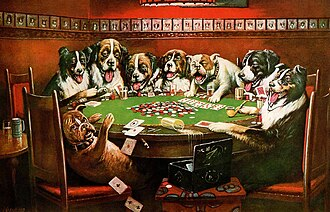
Althusser considers literature to be a “cultural ideological state apparatus:” a means by which the most powerful institutions in our society and its constituent members — politicians, owners of major media corporations, and their donors & shareholders — reproduce their ideology. Althusser might say that your first thought when you think of kitsch should not be Dogs Playing Poker, but rather Peter Thiel. It is for the working class in much the same way a cyanide capsule is intended for human digestion. It is a means of controlling culture. If this sounds like too hyperbolic of a condemnation, ask yourself the question, with it in mind that most of the art we see is commercial, and that art which has ambitions beyond commercial success is usually forced into that ambition regardless: what politics does kitsch actually inherit? What beliefs seep into texts which are compelled into electing to do and say only that which already lies comfortably within the bounds of the stylistic and, inevitably, political Overton window? The problem with kitsch is not simply that it is artistically deficient; the problem is that it is tacit propaganda for the current state of things. When things are quiet, and the contradictions of modern life are not so readily visible, for a certain type of advantaged Western consumer interested in certain types of art, this will be less acutely felt. But in a tense cultural atmosphere which has veered towards fascism? When — if — a queer manuscript actually reaches publication, the scope of what it can say or do is far narrower. Queer fiction queers the medium, troubles it, takes it in a different direction, if not through more complex formal means, at the very least by engaging in the effort to address the gap in literature where queer people always should have been. If it is truly ‘good representation,’ it is bad propaganda, and thus a tension forms between the art and the art ecosystem. Kitsch is a risk reduction strategy. What do you think happens when publishing queer fiction becomes a risk?
Answer: the queer novel, and the queer novelist, are constrained from all directions. Limited in its capacity to experiment with form, limited in its capacity to represent its subject, limited in its capacity to even exist, the novel’s every detail is ultimately, inevitably, subject to veto by actors outside of itself and whose interests often run directly contrary to its own. The market has read over your effort to assert your humanity and your right to exist, and it has a lot of notes asking about your target demographic and how much market share they should expect out of it. You have set out to authentically represent the queer experience; the market will do its best job to make you fail. Your attempts to render the difficulties and struggles and uncertainties of queerness are rendered as exuberant, unnecessary stylistic flourishes. Perhaps you knew this would happen and intended to minimize your vision in those respects. What you failed to account for is that, in a world where authors are increasingly expected to be brands unto themselves, you, yourself, could also be rendered an unnecessary stylistic flourish in your decision to live life as no one but yourself. The colonial, assimilationist function of capital weighs like a nightmare on the brains of the living.
As readers, shaped by these conditions, we come to expect the assimilated narrative, and then reify assimilation in our expectation. When we finally do find the queer novel, we import a set of values, assumptions and preferences which are ultimately antithetical to the project of queer fiction. We become Medusas ossifying the medium in our culturally programmed inability to meet the project where it is, and we reach a stage of failure.
The way that mass entertainment works is largely, in effect, as an epistemic violence machine. I do not know that I have a straightforward solution in the short term — in the long term, we would be able to alleviate the problem in a lasting and holistic manner only by totally restructuring society in such a way that queer art could be made without being held hostage by the profit incentive, and queer people’s safety and security was supported by infrastructure which does not currently exist. It is contained only in the future we should all be fighting for. We must demand that all of our queer siblings, here and in the Global South are finally given the opportunity to reach one another, to reach themselves, to be finally given the right they have always deserved to have sovereignty over their own stories. And as we do, as readers, we must deconstruct and subvert the preexisting preferences we come to texts with and critically analyze the way that books come to us. We must not take for granted that the way that traditional publishing works actually results in a diverse literary environment. We must, in our approach to reading queer fiction, queer our reading in and of itself, and seek to question: who really gets to speak in traditional publishing? Who doesn’t?
Once we have done that, we must finally seek out with genuine curiosity, wherever we can, the stories we have previously not been able to see, including those listed in Bhatt’s article and many of those on the Transfeminine Review’s recommendation list. What we can do as readers is merely what any good reader does — read to find something new.
-
Wow, what a fantastic read! The clear defining of "kitsch" really opened my eyes to a great source of frustration I have with many popular movies, etc., that try to "push limits" without doing any heavy lifting. I was curious, though, how you would say colonialism specifically factored into this debate about Queer media? I do not doubt that it is connected (as are most things), but I'd like to hear how you'd put it. Congratulations on another great post!

Add a comment: