
The Take Industrial Complex
Mo Drammeh
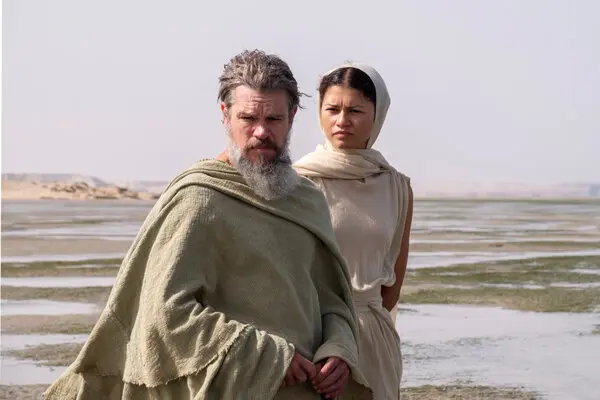
This essay is not about Christopher Nolan’s The Odyssey. I have not seen the film and do not particularly care to. Naturally, this puts me in a strange place to discuss Emily Wilson’s critical review of Christopher Nolan’s The Odyssey, ‘An Uncomplicated Man.’ Much of the discourse surrounding it does (ostensibly) center around statements made about the quality of the film, but I cannot speak to my experience of the veracity of those statements, on the obvious grounds that I, again, have not seen it. Had I seen it, even then I imagine I would generally be disinterested in that kind of commentary; I do not intend this to be a space for art criticism so much as criticism of art’s paratext. Simply being that paratext is insufficiently contrarian for my desires at this point in time.
For this reason, this essay is not about Emily Wilson’s review, either. I will defend it at some points, where I find it appropriate, and criticize it at others, but only as an exercise in structuring and articulating an argument rather than as a Correct or Incorrect evaluation of The Odyssey (2026). What I am interested in is using the discourse surrounding Wilson’s essay as a glimpse into the way discourse works online more broadly, and I chose it out of a fascination with how much discourse has and continues to occur, and how many arguments, premises, counterpoints, and assertions have been made based on things that Wilson does not say in that relatively short essay.
Arguments both in her defense and in critique of the essay (though, to be frank, it seems the latter a bit more frequently than the former, if only due to the spontaneously critical nature of social media discourse,) will very often elide paragraphs directly addressing the subject of said arguments, or otherwise pertain to things entirely unattached to the arguments therein. Very often, you will read responses to the essay which hyperfocuses on individual phrases, single paragraphs, or even the base premise, in seeming ignorance of the essay’s actual content, such that you begin to wonder if the person making this response actually did read the essay at all!
But to get there, we must establish the context. Emily Wilson, most well known for her 2017 translation of Homer’s Odyssey, published her review of Nolan’s The Odyssey (2026) on the 27th of July. She argues that the women & people of color are largely reduced to supporting roles which exist with little interiority and only to ballast Matt Damon’s Odysseus, that the artistic vision guiding the film is confused and, where it does actually exist in any meaningful sense, is ultimately conservative, and that the film overall scrapes away any sense of human experience in its transformation of the text into a summer Hollywood blockbuster. This has resulted in a larger discussion of the film with many either coming to agree or disagree with her points. The article was designed in a laboratory to be as polarizing as possible, and so I do not particularly fault anyone for falling on either side; one can very reasonably end up being for or against the essay for good reason. This does not mean the people who do end up on either side do end up there for good reason.
At the outset, in the critical camp, there exist some arguments which very post-modernist-ly deconstruct the notion that counterarguments should acknowledge the arguments they mean to counter. Many people were aghast at the very idea that such a scathing review could be put in print. The essay was decried as mean-spirited, nasty, and cruel — many questioned whether it was even appropriate for someone of Wilson’s stature to conduct themselves this way in the public eye at all. After Nolan gave her so many book sales! Was it jealousy, perhaps — the bitter shrew launching a cynical attack, knowing that Nolan has easily surpassed her own pitiful endeavors, hoping to steal away his success?
I could put things in perspective in that, whereas Wilson is an admittedly fairly notable classicist engaging in film criticism in a time where film criticism has perhaps never been quite as institutionally diminished, The Odyssey is projected to have one of the best weekends for an R-rated film, ever, and was directed by one of the most commercially successful filmmakers, ever, and as such acting as if Wilson is punching down here is categorically absurd; I could say that, what with art criticism being an art form, the point is to express oneself, which, if one doesn’t like a piece of art, will naturally include some degree of polemicizing, and that passion driven by a strong disdain for a piece of art is no less artistically valid than passion driven by great appreciation; and I could say that, given that Wilson goes on to accuse Nolan’s Odyssey of being male centered, ambiently racist, and a dumbed down version of the text that is a significant part of her life’s work, which was also filmed on the occupied Western Sahara, it would actually be proportional for her to speak in such condemnatory terms. But all of this would be secondary to the fact that this argument has absolutely nothing to do with the essay and is an attempt to dismiss Wilson based on what I am having great difficulty seeing as much more than common misogyny. It is a counterpoint which counters nothing.
When arguments actually do target the content, they do not always fare much better at good faith engagement. “Wilson must just hate the idea of the Odyssey being adapted” is a common one; it would sure be a shame if there were three paragraphs dedicated to preempting this particular point, listing adaptations Wilson did like in both print and film, & stipulating that Wilson had problems with the film on its own terms, those being the third, fourth and fifth of the essay:
“The Homeric epic was already an adaptation. The poem used a relatively new technology – the written alphabet – to rework existing mythical traditions, reshaping the story of a veteran’s homecoming to resonate with the complex concerns of Greek-speakers in the archaic period, an era of migration, colonisation and urbanisation…”
“Adaptations needn’t and shouldn’t follow the original with anything like the exactitude of a translation. Some of the best radically transform or resist the source material, providing what Harold Bloom called ‘strong misreadings’ of their ancestors. The most memorable creative responses to The Odyssey – such as Euripides’ Helen, Virgil’s Aeneid, Milton’s Paradise Lost, Joyce’s Ulysses, Walcott’s Omeros, Atwood’s Penelopiad, Madeline Miller’s Circe or Lisa Peterson’s play set in a modern migrant camp – reconsider the poem’s structure, narrative and values[…] But there is no restraint in Nolan’s version of The Odyssey: every second is jam-packed with incident, lights and noise, and nothing is ever at a human scale.”
“…The film has none of the stylish sparseness of Uberto Pasolini’s The Return (2024), starring a scarred, desperate, mostly naked Ralph Fiennes, conflicted about his homecoming to a convincingly unhappy Juliet Binoche. Lacking the budget for gods or special effects, that film invited us to wonder what remains of The Odyssey and its hero when stripped down to the sinews and the hungry heart…”
Even some of the strongest criticisms don’t truly address what Wilson is saying, though I can’t always fault her critics for this. There is one highly scrutinized paragraph in her essay which I would call, at best, tone deaf, in which she details a perceived problem with the way the roles for people of color were written in the film:
The race-neutral casting of Nolan’s Odyssey was inevitably deplored in some quarters. But there is nothing progressive about it. Most of the non-white actors – Zendaya, Lupita Nyong’o, Himesh Patel, Corey Antonio Hawkins, Travis Scott – play versions of the Black best friend, whose only role in the drama is to provide aid to the white protagonist.
This is simply a really bad way of articulating this argument. The reference to the filmic “Black best friend” trope is used in a metaphorical, general, metatextual sense in which all of these characters are merely instruments upon which the writer plays for the sake of developing the protagonist, and are denied their own interiority, but the trope is generally understood as having a very specific and discrete meaning of an actually specifically Black character (which Himesh Patel is notably not) who is actually specifically the friend of the white lead, the locus of their diegetic existence being said lead. Largely because of this, very little of the discourse surrounding this specific excerpt does satisfactorily address the former claim which Wilson actually means to make, and more generally is concerned with either litigating whether or not it counts as The Trope, or the (mis?)interpretation 1 that when Wilson says that these actors “play versions of the Black best friend,” she means to literally criticize their performances, despite the arguments she makes to flesh out her point entirely having to do with the way the characters are written in the screenplay. The enormity of this semantic mistake has unfortunately overshadowed the content it was made in service to.
Wilson’s defenders, then, are perhaps not teed up a home run, but on the whole, can at least make it to second base. There’s the casual misogyny, the ignorance of the actual content, and they even have some latitude for discussion with the more damning arguments. And many indeed have pointed out the dysfunctional manner in which this all occurred. There’s just one problem: some of them are still commenting out of ignorance.
Some of these people just haven’t looked at the stuff they’re talking about. I’ve seen one post defending Wilson’s essay, saying that they “suspected” that many of her arguments about the film were correct. “Suspected.” Huh. Strange choice of words, no? Suspect, derived from the Latin ‘suspicere,’ which then progressed into ‘suspectus’ — ‘mistrusted’! But no trust would be necessary, had you seen the film! Which this poster hadn’t, as they admit as a prefix to the rest of their post, thus rendering the entire exercise totally incoherent and bizarre. It’s small, but it truly does bother me: why comment on the quality of a film that, I cannot stress enough, you literally haven’t seen?
It’s not an entirely isolated incident, either. Some people with whom I’d generally feel inclined to agree seem to trip over their own feet when it comes to identifying those things in the review which require our much beloved buzzword “media literacy.” Fundamental misinterpretations of her arguments, followed by passionate defenses of those arguments she, in fact, did not make; saying she ‘never said X’ when she said X for several paragraphs and in fact X was quite an important throughline for her argumentation; etc. It’s like they have read the review, but only in a dream. They notice the digressive nature of many of their counterparts’ arguments, but ultimately find themselves participating in similar digressions because it is evidently so baked into the way discourse takes place that they don’t even notice it. The specific prefix of admitting you haven’t really engaged with the subject of debate is a common one you’ll recognize if you’re fluent in a certain dialect of Twitter ironyposting, as I unfortunately am: “i haven’t seen this yet but it seems like[…]”, “Don’t care about [X] but…”, or rarer, the full on statement of a belief in the first post followed up by the reply with an addendum of “I haven’t watched/read/listened to this yet but…”
What drives this behavior? Why do people argue so passionately about an essay from which they have only read screencapped paragraphs and a film from which they’ve only watched the trailer?
The answer, I think, has to do with the places where we’re having these discussions. It’s all on social media — “discourse” in my view (though this very well may just be a self report) is, effectively, a term which refers to series of posts replying to one another. In the past, ‘art discourse’ would have taken place between cultural professionals at various institutions, and the ability to participate was thusly gatekept to people in the legacy media circuit and its surrounding ecosystem, and in that sense, the move of public intellectual discourse to social media is, in all fairness, a nominally democratizing one.
The problem is that social media itself is not exactly built to handle discourse involving lengthy and involved argumentation. Twitter and all derivatives, as has already been discussed to death, use character limits to impose a focus on short form content. TikTok and Instagram Reels do nominally allow for longer videos, being 60 and 10 minutes respectively, but those longer videos experience less algorithmic promotion than their shorter contemporaries — the latter plainly states that they have a strict 3 minute cut-off for promotion in their Help Center. Restraints have been systematically designed to put limits on the forms discourse can actually take to maximize digestibility. Why? Because the goal is not discourse; discourse is merely instrumental to the real, final goal, which is retention. The more time you spend on the app, the more reels you scroll through, the more value you generate via impressions, which can then be used to sell ad space. Short form content is quick, easy to make, and gratifying — it keeps people’s eyes on the screen, and it’s reproducible. The stuff makes money. People often say that social media is or has ‘ruined’ our attention spans. This couldn’t be further from the truth. We pay attention to social media for hours at a time. Our attention has simply been reappropriated, isolated to the apps, and subsequently, monetized.
The ‘social media is a bad platform for discourse’ drum banging admittedly stopped being novel or interesting circa 2018, but I feel like as it faded from the public consciousness, the way in which that is actually true faded with it. Simply put; the discourse cycle does not sufficiently incentivize actually engaging with the subject itself. The discourse cycle is attractive because it allows the individual user to satiate their desire to engage with the feedback loop of social media, and any engagement with the subject of the discourse is merely instrumental to engaging in the discourse itself. It’s people watching films and spending half the runtime thinking about what their Letterboxd review will be.
Further, these discourses are time-sensitive; even as I write this, it’s hardly been a week, and people very well may have moved on. (I think people are mad at Hank Green for something he did, now?) You have to be quick — get those posts out, now, now, now! You absolutely don’t have time to sit with a piece of art and turn it over in your mind over the course of a few weeks (or, God forbid, months,) and as such the incentive structure prioritizes not the best takes, but the first ones.
The inevitable consequence of this is that if and when full engagement with the subject is not ‘necessary,’ users will simply forego it. You put a tweet out about the review; you’ve only read a screenshot of a paragraph. You put a tweet out about the film; you’ve only seen a trailer and a few brief clips. Narratives take root based on minimal information and continuously reproduce themselves as they interact with a mass of people bottlenecked into engaging primarily with those narratives. People seem generally optimistic to see that any form of serious art criticism being interacted with in the public eye. And yes, I can’t pretend that I don’t like to see people seriously engaging with art and art criticism under any pretense. But, at risk of being accused of cynicism; to what end? The old mode of discourse did not actually empower the majority of people to act as participants; but just as the current mode facilitates their participation, it also sabotages it, and traps it in a hall of mirrors where it can hear only the echoes of its own voice and see only its own reflection recursively displayed before itself. If our desire is to have more people engage in these kinds of discussions, we must first acknowledge that the manner in which these discussions are had is ultimately broken, and only when steps are made towards repairing that can the damage be undone.
Perhaps I ought to end this by taking a page out of Wilson’s book, kind of jarringly transitioning into a more positive tone,2 and stating that, in spite of the nature of the responses therein, it is good to have culture at large engaging with artistic criticism especially in a time where we are increasingly deprived of it, which could very well be a net positive, with the resultant discourse being necessary growing pains which might ultimately facilitate a move in a more intellectually engaged direction. But if this is what that is going to look like, it’d probably be better for my cortisol levels if I sit that whole process out. Oh, God; I just imagined what would happen if an Andrea Long Chu review ever broke containment. Sorry, excuse me: I’m having a migraine, and I need to go lay down for a while.
I do sustain that Wilson’s actual intent here is to refer to this metaphorical interpretation of the “Black best friend” trope, and while that much can be surmised from the essay, I hesitate to say that those that do not do so ‘misinterpret’ the essay as that puts the onus on the reader to pick up Wilson’s mistake rather than on Wilson to, well, have not made it ↩
This joke only really works if you’ve read the original essay. You’ve read it, right? ↩

Add a comment: