Maybe we should all go offline
Getting back to paper, pen, and handwritten letters.
I’ve started handwriting letters again. Paper, pen, envelope, stamp – when everything is assembled on the (physical) desktop, I slowly put together a message that I could have dashed off, electronically, in seconds. Then comes the walk to the post office, as there is no way to mail out from my Manhattan apartment building.
Carrying an envelope to the post office feels subversive, like I’m part of some underground network hidden from the rest of the world. And in a way, that’s true. Most of the people I pass on the sidewalk don’t notice me at all. They are instead gazing down at glowing rectangles in their hand as they walk, sometimes as they cross the street, paying attention only to the digital feeds that dominate and manipulate the “discourse” these days. It all reminds me how antiquated my errand is.
I take comfort in knowing that I’m not alone in my old-fashioned ways. A few days ago I came across a blog post that consisted of scanned images of a typewritten letter. The post is called I Am Retiring from Tech to Live Offline, written by a software developer named Chad Whitacre (May 28, 2026). It is his final online communique, one last ping out to the digital universe before his online presence winks out of existence.
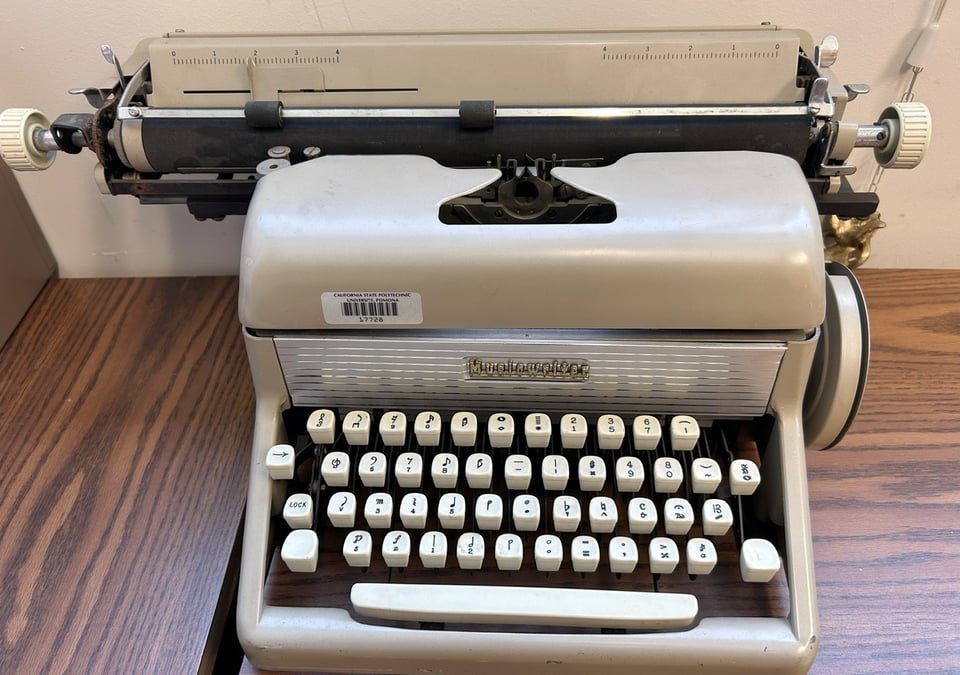
“My intent is to be AI Amish,” Whitacre writes, explaining that “AI was the last straw” in convincing him that his time as a techie had come to an end. (He’s not retiring entirely, though – he says that he still needs to work and has accepted a job at Home Depot.) To mark the finality of the occasion, he pulled out his typewriter, two pieces of paper, and a red pen for markups, and began to write.
Whitacre says he aims for a lifestyle inspired by the Amish, if not quite as strict:
My intent is to be AI Amish, which means Internet Amish. Not 1780, but 1980. Neo-Amish. I’m fine driving a car and flipping a lightswitch, by which I mean that they don’t make me into something I hate, which AI and doomscrolling do.
I admire Whitacre’s boldness. Although I’ve started handwriting some letters, I still spend plenty of time emailing and posting online, as evidenced by this essay. Yet Whitacre’s missive brought up a nagging question that visits me more and more often: could the internet ever get so bad that I’ll want to go permanently offline?
It’s hard to imagine. I’ve spent my entire adult life on the internet: getting my first email address in 1989, creating my first web page in 1994, founding my internet company (which I still run) in 1997, launching the web’s first todo list in 2006 (which I also still run), and on and on. It would be an abrupt change and a considerable disruption to leave it all behind in favor of a typewriter and the postal service.
(Beyond which, typewriters are all built with the QWERTY keymap, which I abandoned in 1996. I only type in the Dvorak keymap – see it explained as a comic strip – and I have never come across a typewriter with the keys arranged in that way. This was one advance of the digital age: making keyboards in all operating systems configurable to Dvorak with one click. If you suffer from wrist pain, you should switch.)
There are days, though, when I seriously doubt the viability of our online future. My conversation on Techtonic this week is a good example: I spoke with Dave Karpf, a professor and writer whose work I’ve admired for years. (Here’s the episode page and the podcast version.) We spoke about the growing backlash against data centers and how it might just catalyze the collapse of the AI bubble – an argument Karpf makes, persuasively, in this post.
In the meantime, while we’re awaiting the popping of the bubble, oligarchs are planning thousands of AI data centers, some as big as Manhattan, all over the world. A UN report estimates that at current trends, by the year 2030, AI will consume as much water as a billion people. The electricity drain, air pollution, noise pollution, and harms to ecosystems only add to the blight.
And for what? As I said on Techtonic, it would be different if data centers really were curing cancer, or solving climate change, or doing any of the fantastical things promised by the carnival barkers who own the AI platforms. But they’re not. Notwithstanding some occasional and localized benefits – see my post When is it OK to use AI? (May 19, 2026) – most of what we’re getting from Big Tech data centers is sludge, slop, and psychosis.
No wonder Chris Whitacre felt like AI was the last straw. Silicon Valley today is not oriented toward better outcomes for people like you and me – that is, non-oligarchs. Everything is built for extraction, as Tim Wu says, benefiting the ultra-wealthy and further concentrating their power.
Maybe we should all go offline. All buy typewriters. Go back to land-line phones. Start a new social network based on letter-writing and the postal service. (Only half-joking here: I own the domain snailbook.org and maybe we could make it happen.) If it caught on, the Internet-Amish lifestyle could offer an alternative to the phone-addicted millions.
But I’m not ready to give up yet. I know that tech can be better. I’ve spent my career advocating for design and development that actually helps people: hence the name Creative Good. We can include customers in our thinking, just as we can convene gatherings of people who are committed to making things better. So for now, I’m staying online, and I’m staying on the FM airwaves – and the podcast-waves – in order to raise the alarm about what the tech bros are up to.
But I will keep writing letters by hand.
Finally, a reminder that the Gel 2026 conference is coming up on Friday-Saturday, Oct 2-3, 2026 in Accord, New York (about two hours north of New York City). This is an in-person gathering of the Creative Good community, spotlighting people who are resisting AI hegemony with positive, inspiring projects and organizations. You’re invited.
-mark
Mark Hurst, founder, Creative Good
Email: [email protected]
Podcast/radio show: techtonic.fm
Follow me on Bluesky or Mastodon