When is it OK to use AI?
Quick reminder that tomorrow, Wednesday May 20, is the last day of early bird pricing for our Gel 2026 conference. To get the best rate, sign up now before the price jumps.
When is it OK to use AI?
I was happy to air another dramatic reading on Techtonic. It’s a humor piece in McSweeney’s by Andrew Singleton called “In Our Glorious AI Future, There Will Be No Such Thing as Money (For You)”:
Here’s my dramatic reading of the essay, posted on a non-surveilling video service.
Here’s the full Techtonic episode with an embedded audio player. The reading starts at the 41:42 timestamp. (There’s also a podcast version.)
Finally, here’s the original essay on McSweeney’s.
The essay and its comments on tech oligarchs came to mind when I came across the video of Eric Schmidt, the former chairman of Google, getting booed during his University of Arizona commencement address:

Schmidt is trying to get the graduates excited about the shiny AI future that he stands to gain so much from. The graduates are having none of it, partially because they know the harms of AI and can see through Schmidt’s self-serving pitch, and partially because of Schmidt’s Epstein appearances.
Hearing thousands of people booing a Big Tech oligarch is a guaranteed way to brighten your day, and I recommend it. (I play it on the show at the 34-minute mark.)
Still, even after the oligarch is booed off the stage, AI is still here, all around us, spreading where it doesn’t belong, as I put it back in February. The Big Tech AI companies are embedding their platforms deep into our civic, economic, military, healthcare, and education systems.
This raises a question that all of us have to answer, sooner or later: When is it OK to use AI? Is there ever a fair, ethical, just way to engage with these tools?
I covered this question on yesterday’s Techtonic episode. Of course, I can only answer for myself. Everyone has to make their own decision about when to use, or refuse, these AI tools – though we certainly can’t escape being affected by AI in some way.
For what it’s worth, my own policy is that I’ll use AI occasionally if it is doesn’t harm me (with risks of cognitive decline from habitual use), doesn’t unnecessarily draw on water and power, and doesn’t feed data or money to the oligarchs. In practice this means using a privacy wrapper, like Duck.ai or Proton’s Lumo, to ask the occasional natural-language lookup. I give specific examples on the show, and there are more resources about AI harms – and privacy-oriented alternatives – on the episode page.
For now, just be careful about habitual AI use. Research is showing outcomes like cognitive decline, cognitive surrender, AI psychosis, and digital dementia – among others.
All of which inspired me to post this . . .
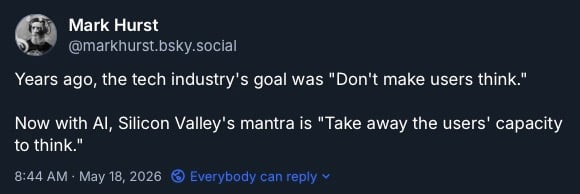
. . . and to say this, on the show:
We need a response to AI’s intrusions, and I’m building one.
I hope to see you at Gel 2026 in October – our community gathering to discuss how to survive, and even thrive, despite the predations of AI and Big Tech.
Remember that tomorrow, Wednesday May 20, is the last day for early-bird tickets. Sign up now before the price jumps.
-mark
Mark Hurst, founder, Creative Good
Email: [email protected]
Podcast/radio show: techtonic.fm
Follow me on Bluesky or Mastodon