
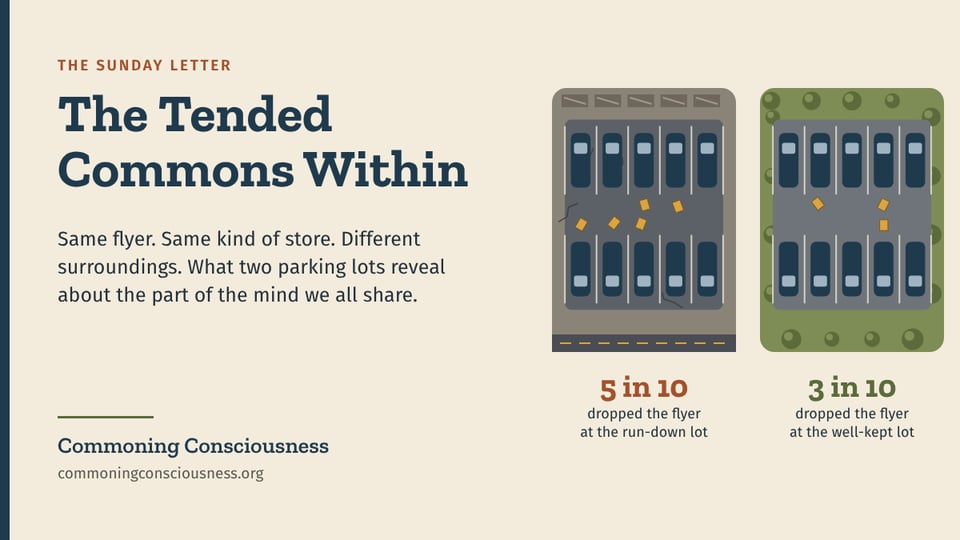
Two parking lots
Dear friends,
Around a decade ago in southern California, three of my undergraduate students spent their mornings and evenings in two grocery store parking lots. Their job was simple and a little sneaky. They tucked a plain flyer under the windshield wiper of every parked car, then waited, out of the way, to see what each driver did with it when they came back.
The two stores sold the same things at nearly the same prices. They were the kind of places people walk or drive to because they are close to home. What differed was everything around them. One sat beside an interstate, budget motels, liquor stores and boarded-up buildings. The other sat among well-kept houses, green lawns and long views.
At the first store, about half the drivers dropped the flyer on the ground. At the second, fewer than a third did. Nobody in either lot stopped to weigh the ethics of littering. They just did what the place seemed to tell them to do.
I have been thinking about those parking lots again, a decade later, for reasons that have little to do with trash.
What we believe, and what we do
Social psychologists draw a useful line between two kinds of norms. Injunctive norms are about what we believe ought to be done. Descriptive norms are about what is typically done, here, by people like us. The two often part ways. Almost everyone agrees that littering is wrong; that is about as close to a unanimous injunctive norm as a society gets. Yet some places are covered in litter and others are not.
Why would a belief held by nearly everyone show up so unevenly on the ground? The tentative answer I found then still persuades me now. Figuring out the real beliefs of everyone in a place is far too costly for any one of us. So we take a shortcut. We read the cues around us, the trash, the vacant lots, the trimmed hedges, and infer what behavior fits. Researchers call this conformist transmission. The rest of us call it "when in Rome." It happens fast, and it happens mostly below the level of decision.
The parking lot study tested this outside the lab, in places that had become what they were over years. Across 223 observed drivers, 52.0 percent littered at the less tended site and 31.4 percent at the well-tended one. Those drivers came from different populations, so I checked whether gender or race could explain the gap. The gap narrowed but held, and no individual characteristic interacted with littering. The place, it seemed, was doing much of the deciding.
A second study that year looked at a slower kind of tending. Using records for more than 90,000 parcels in a North American city, I asked whether owners fell out of compliance with the city's property code when their neighbors did. I treated each face block, the houses fronting one street between two cross streets, as a small commons: the yards, porches and sidewalks everyone on that block sees and shares. Owners were more likely to let their own property slip when more of their face block had already slipped, even after accounting for their own track record and whether they lived there.
The most interesting result was a surprise. That neighborly pull was not constant. Its strength depended on the wider neighborhood around the block. Where the surrounding blocks were well kept, a homeowner who had always kept up their place became meaningfully more likely to let it go as violations spread on their own block, rising faster the more neighbors slipped. Where the wider area was already in poor repair, homeowners who had kept their places up were largely unmoved by what their neighbors did. In the language of game theory, they behaved like unconditional cooperators. They kept tending regardless.
The neighborhood behind our eyes
Here is where I want to take those parking lots somewhere new. Jung argued that beneath our personal memories and habits lies a layer of the psyche we do not own privately: the collective unconscious, with its archetypes. These are the shared patterns, the Mother, the Hero, the Trickster, the Shadow, that shape how we perceive and respond before we know we are perceiving or responding. Nobody holds title to them. Everybody draws on them. That is what I mean when I call consciousness a commons.
Read that way, the archetypes work a lot like descriptive norms. They are not what we profess. They are the cues our minds read automatically to infer what this moment calls for. A driver in a littered lot does not consult their values before dropping the flyer. A person caught in an archetype, the wounded hero or the righteous avenger, does not consult theirs either. Both run on a cheap, fast reading of the surroundings, and both feel, afterward, as if they simply chose.
The housing tending study adds a second layer. Our behavior answered to two nested neighborhoods at once: the face block we live on, and the wider area that block sits inside. The psyche seems built the same way. Our personal complexes are the face block, close and familiar. The collective layer is the wider neighborhood, setting the tone for how strongly the near influences pull. What our near neighbors do matters most when it breaks from the larger pattern around us. When the whole culture is tense, or grieving, or primed for an enemy, the same small provocation lands very differently than it would on a calm day.
Jung put the stakes plainly. "When an inner situation is not made conscious," he wrote, "it happens outside, as fate." The parking lots are what that looks like from the outside: ordinary people, acting on signals they never noticed, producing a pattern none of them intended.
Export, and the people who keep tending
In this project I have been calling it export: what we toss into the shared space when we have not dealt with it ourselves. Unowned anger becomes contempt for a stranger online. Unfaced fear becomes suspicion of a whole group. A shadow we refuse to carry gets projected onto someone else to carry for us. Each act is a flyer dropped on the pavement.
The research suggests why this matters beyond the person who does it. Litter is not only a result; it is also a cue. Every flyer on the ground tells the next driver what is normal here. Every unprocessed projection does the same in the psychic commons, quietly lowering the bar for the next person who walks through. Disorder spreads not because people decide to be worse, but because they read the place and adjust.
The good news runs the same direction. The cues can be changed, and tending is contagious too. Other researchers found that people behaved better in disordered settings when they saw order being visibly restored. In a study of one city's "clean sweep" program, a colleague and I found that owners on blocks that got a visible cleanup had less than half the odds of a code violation the next year. The well-tended lot in southern California did not make its visitors better people. It simply told them, without words, that this was a place where people take care.
Then there are the second study's unconditional cooperators: people who kept their places up when the blocks around them had stopped. I think of them as a picture of what Jung called individuation. They are not immune to the neighborhood. They have simply stopped letting it decide for them. That is the work, as I understand it. Integration does not mean escaping the collective. It means noticing its pull, naming it, and choosing a response instead of inheriting one.
We cannot see most of the signals that move us; that is what makes them unconscious. But we can learn to notice the moment just after, the flash of contempt or the urge to pile on, and ask what in the surroundings just told us that was normal. That pause is where the commons gets tended.
A practice for this week
Try one small experiment. Once a day, when you catch yourself reacting faster than you meant to, stop and ask two questions. What did this place, this feed, this room just tell me was normal? And is that what I actually believe ought to be done? The gap between those answers is the gap between descriptive and injunctive norms, and it is where most of our export comes from.
You do not have to close the gap every time. Noticing it is already a kind of tending. And a tended spot, however small, is a cue the next person will read.
With care from the porch,
R
References
Cialdini, R. B., Reno, R. R., & Kallgren, C. A. (1990). A focus theory of normative conduct: Recycling the concept of norms to reduce littering in public places. Journal of Personality and Social Psychology, 58(6), 1015–1026.
Jung, C. G. (1968). Aion: Researches into the phenomenology of the self (R. F. C. Hull, Trans.; 2nd ed., Collected Works Vol. 9, Part 2, para. 126). Princeton University Press. (Original work published 1951)
Keizer, K., Lindenberg, S., & Steg, L. (2013). The importance of demonstratively restoring order. PLoS ONE, 8(6), e65137.
You just read issue #2 of Commoning Consciousness. You can also browse the full archives of this newsletter.


