
The sound comes first
Dear friends,
This week the geese came back over the porch. You hear them before you see them. The honking starts somewhere behind the tree line, swells, and then the V slides into view above the alders, heading roughly south in the last of the light. The shape is never as tidy as the one on the poster. One arm runs longer than the other. A bird near the back drifts wide, then tucks in. The point wobbles, and for a few seconds the whole thing looks as if it might come apart. Then it doesn't.
Two weeks ago I wrote to you about the songbirds in the wetlands east of the porch, taking turns on the shared airwaves like polite callers at a telephone booth. The geese are the sequel. The songbirds were sharing a commons they found. The geese make one as they go.
The poster in the break room
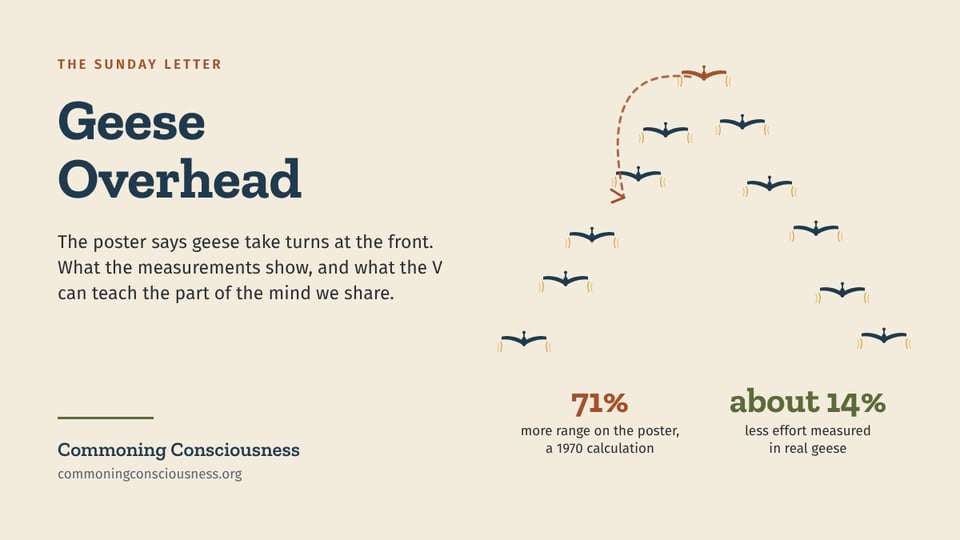
You have probably seen it. "Lessons from Geese" has been taped to break-room walls and read aloud at retreats for decades. Nobody is quite sure who wrote it. It is credited variously to a Baltimore science teacher, a conference speaker who read it aloud in 1991, and a Milton Olson whom no one can trace. The lessons are always the same. Geese flying in a V gain 71 percent more range than a bird flying alone. When the lead goose tires, it drops back and another takes the point. The geese honk from behind to encourage the ones in front. When a goose is sick or wounded, two others follow it down and stay with it.
I love that poster, and I have spent enough years around data to want to know how much of it is true. The answer turns out to be: more than a cynic would guess, less than the poster says, and the gap is where the interesting part lives.
What the measurements say
The 71 percent is real, but it is a calculation, not a measurement. Two aeronautical engineers worked it out in 1970 for an ideal formation of 25 birds holding perfect position, each one riding the upwash that spins off its neighbor's wingtip. Real birds do not hold perfect position. When researchers strapped heart-rate monitors to pelicans trained to fly in formation, the birds saved about 11 to 14 percent, mostly by flapping less and gliding more. When another team measured the spacing of pink-footed geese across dozens of photographed skeins, the saving worked out to roughly 14 percent, because the geese kept shifting around and spent much of their time outside the sweet spot. The gift is real. It is smaller than the poster claims, and it has to be re-earned with every wingbeat.
The turn-taking is the part I most wanted to be true, and here the honest answer is that nobody has shown it in geese. What we have for geese are snapshots. The best evidence comes from a different bird. In 2014 a team fitted a flock of young northern bald ibises with GPS and movement loggers and followed them on a human-guided migration from Austria to Italy. The ibises did not just fly in the upwash of the bird ahead. They timed their wingbeats to it, keeping their wingtips in phase so they rode the rising air through the whole stroke. A bird flying directly behind another did the opposite, beating out of phase to dodge the downwash.
The next year the same group asked the harder question: who pays to lead? Leading is costly and following is cheap, so a formation is a social dilemma. Everyone would rather be second. Yet over 43 minutes of straight flight, 14 birds spent about a third of their time in someone else's wake, when flying at random would have given them about one percent. They managed it mainly in pairs. Two birds would trade the lead back and forth, dozens of times each, often within a second of one another, and the time a bird spent leading matched closely the time it got to follow. The authors called it direct reciprocity. The bigger V, when it formed, was built out of these little pairs.
As for the honking, nobody knows what it says. The calls keep the flock together. Whether they encourage anyone is the poster's guess. The wounded-goose story, as far as I can find, has never been tested at all. And there is an older idea, from the 1960s, that the V exists as much for seeing as for saving, since the stagger gives every bird a clear line of sight to the others.
So the poster has the right instinct and the wrong species. Turn-taking at the front is not a goose fact. It is an ibis fact, and probably a fact about many birds that fly in formation. It works not because anyone is counting but because the swaps are quick, frequent and between partners who can see each other.
What a V is made of
Here is what I keep coming back to on the porch. A V is a commons that exists only while it is being made. No bird owns the upwash. Each one produces it just by flying, and the bird behind can use it or not. Nothing is stored. The moment a bird stops flapping, its gift to the one behind stops too. The resource and the labor are the same thing.
The commons I have studied were slower than this: a block of houses, a parking lot. But the rules that keep them alive look a lot like the ibis pairs. Elinor Ostrom spent a career documenting commons that lasted for centuries without a central authority. What they had instead were people who could see each other, rules they made themselves, and reciprocity frequent enough to be trusted. I lead, you lead. The arrangement would fall apart if the swaps were rare or if the trust had to stretch for days.
The ragged shape matters too. The 14 percent is what you get from birds that keep adjusting, drifting out of position and coming back. The 71 percent would require birds that never move, which is to say birds that are not alive. A commons that looks tidy from the ground is usually one nobody is tending anymore.
The air behind us
Now the sequel's real subject. In these letters I have been calling consciousness a commons: the shared layer Jung called the collective unconscious, which none of us owns and all of us draw on, and the "export" we dump into it when we have not dealt with something ourselves. The geese add a piece the parking lots could not. What we leave behind us is not only litter. It is also lift.
Every bird in that V is flying through air another bird has shaped. The one ahead makes the next bird's work easier or harder, depending only on where it flies and how it beats its wings. I think the psychic commons works the same way. A person who has done some of their own inner work, who has named a fear instead of projecting it or sat with a grief instead of handing it off, leaves a kind of upwash. The people behind them, a child, a partner, a colleague, a reader, fly a little easier without knowing why. The reverse is also true. Unprocessed material is downwash, and the people directly behind us have to beat against it.
Jung was clear that going inward is not the same as going away. "Individuation does not shut one out from the world," he wrote, "but gathers the world to oneself." The ibises are the picture I would hang beside that sentence. Each bird keeps its own wingbeat. Nobody merges into the flock. But each one times its stroke to the air coming off the bird ahead, and in doing so makes the air for the bird behind. That is neither flying alone nor dissolving into the group. It is the living middle, and it is where the saving happens.
The lead position deserves a last word. The poster says the leader tires and drops back, and that is probably right. What the ibises add is that no one stays in front for long, and no one is supposed to. The one who has worked something through takes the point for a while, breaks the air, and then falls back into someone else's wake and rests. Leadership in a commons is not a role. It is a turn.
A practice for this week
Two things, then, from the geese.
First, notice whose wake you are flying in. Somewhere in your week there is a person whose quiet effort is making your air easier: the friend who always texts first, the colleague who absorbs the hard conversation, the parent who did their own work so you would not have to do it for them. Name one of them, to yourself or to them.
Second, take a turn at the point. Pick one piece of invisible work in a shared space you belong to, a household, a group chat, a committee, a friendship, that someone else has been carrying, and carry it for a while. Then let it go and drop back. The swap matters more than the heroics. Reciprocity, the ibises suggest, is easiest in pairs and at short range, so start with one person you can see.
The geese will be overhead for a few more weeks. When you hear them, look up and watch the V wobble and re-form. It is not the tidy shape on the poster. It is better than that. It is a group of individuals making lift for each other, one adjustment at a time.
With care from the porch,
r
References
- Cutts, C. J., & Speakman, J. R. (1994). Energy savings in formation flight of pink-footed geese. Journal of Experimental Biology, 189(1), 251–261.
- Hamilton, W. J. (1967). Social aspects of bird orientation mechanisms. In R. M. Storm (Ed.), Animal orientation and navigation (pp. 57–71). Oregon State University Press.
- Jung, C. G. (1969). On the nature of the psyche. In The structure and dynamics of the psyche (R. F. C. Hull, Trans.; 2nd ed., Collected Works Vol. 8, para. 432). Princeton University Press. (Original work published 1947)
- Lissaman, P. B. S., & Shollenberger, C. A. (1970). Formation flight of birds. Science, 168(3934), 1003–1005.
- Ostrom, E. (1990). Governing the commons: The evolution of institutions for collective action. Cambridge University Press.
- Portugal, S. J., Hubel, T. Y., Fritz, J., Heese, S., Trobe, D., Voelkl, B., Hailes, S., Wilson, A. M., & Usherwood, J. R. (2014). Upwash exploitation and downwash avoidance by flap phasing in ibis formation flight. Nature, 505(7483), 399–402.
- Voelkl, B., Portugal, S. J., Unsöld, M., Usherwood, J. R., Wilson, A. M., & Fritz, J. (2015). Matching times of leading and following suggest cooperation through direct reciprocity during V-formation flight in ibis. Proceedings of the National Academy of Sciences, 112(7), 2115–2120.
- Weimerskirch, H., Martin, J., Clerquin, Y., Alexandre, P., & Jiraskova, S. (2001). Energy saving in flight formation. Nature, 413(6857), 697–698.
You just read issue #3 of Commoning Consciousness. You can also browse the full archives of this newsletter.


