
Us and them
Dear friends,
This week's letter is an essay rather than a note from the porch. I wrote it before I started down the path that became this project, and reading it again I can see the project already in it. It is about addiction, and about the broader habit we have of sorting people into "us" and "them." It ends with a small self-reflection tool, so if you would rather skip the argument and go straight to the practice, it is near the bottom.
Conventional scientific wisdom holds that addiction is a chronic brain disorder. Reward circuits and neural pathways get rewired in response to the dopamine surges that a pleasure-inducing substance or activity sets off, until wanting outruns liking and choice gives way to compulsion (Volkow et al., 2016). That model has its critics, who argue that it leaves out the person and the place (Heather et al., 2018), but it is the view most of us have absorbed.
Here is the strange part. The same society that accepts addiction as a disease still tends to "other" the people who have it. We see them as antisocial outcasts prone to bad decisions rather than as full human beings with a physiological condition. When researchers asked a national sample about drug addiction and mental illness side by side, respondents were far less willing to work with, or marry into the family of, someone with an addiction, far more willing to see them discriminated against, and far more likely to oppose policies that would help them (Barry et al., 2014).
In reality, there is no "us" and "them." All people are potentially vulnerable to addictive behaviors and impulses. It is just that some of us have better-developed impulse control and stronger support networks than others, and that a long list of undiagnosed addictions, to sugar, to caffeine, to the scroll, to wealth, to consumer goods, to power, to belief systems, has been institutionalized as socially acceptable, even socially desirable, in a global economy built to feed them (Lembke, 2021). These "normative" addictions get a pass. The "aberrant" ones, to controlled substances and activities, get dispraise and punishment. One review that counted eleven common addictions, from tobacco and alcohol to eating, gambling, work and shopping, concluded that something like 47 percent of American adults meet the mark for at least one of them in a given year (Sussman et al., 2011). Addiction, in other words, is a problem of the majority.
If all of us are susceptible, and most of us carry a normalized dependence for at least some slice of our lives, then why are our institutions and norms so hostile toward people who struggle with substance use? Why does a universal human predisposition get stigmatized in some contexts and not others?
Othering is a hierarchical project
I have no complete answer, but othering is surely part of one. Through cycles of social consensus and cultural reproduction, we come to define some forms of addiction as "normal" and others as "aberrant," and in doing so we sort ourselves into people with valid, even "natural" dependences and people whose amorality, poor judgment, inherited conditions or substandard upbringings somehow make them lesser members of the species. Psychologists who study this call it dehumanization, and they find that it is not confined to wars and atrocities. It is an everyday phenomenon, rooted in ordinary habits of mind, that casts the other person as animal-like or as an object (Haslam, 2006; powell & Menendian, 2016).
I take the position that othering is almost always a hierarchical and dehumanizing project. When majority rules separate people into types, and those types become the basis for legal, political and economic discrimination, inequalities between the types are inevitable. And any type whose members compete hard enough with one another will develop its own internal rankings, which produce the same injustices one level down. The process repeats, recursively, until the whole population is a stack of unstable hierarchies.
The belief that this is simply how things are, and that "nothing more can be done" about it, is a load-bearing part of the model of reality most of us in the West carry around. It feels like common sense that some people, people who struggle with substance use for instance, belong to an out-group whose members are different from, foreign to and lower than the rest of us.
When inherited social orders generate harm, as every order built on hierarchical, coercive power eventually does, they are no longer adaptive. They are dysfunctional. They are parasitic. They marshal collective action in support of oppression, through appeals to history, tradition and nation, and they neglect whole segments of the population in a way that makes empowering those people look uneconomic (the costs seem to outweigh the benefits) or unjustified (those people brought it on themselves).
We-ing, and what this has to do with a commons
As an emphatic disliker of hierarchy and a dedicated proponent of dignity, liberation and prosperity for all, I prefer a "we-ing" of our shared vulnerabilities. We-ing is the opposite pole from othering on an axis that measures how much manufactured partitioning a population carries. Call it the density of cleavages or fault lines, the fracturing, within a social system.
In a system built to select for we-ing, fracturing is low, temporary or reversible. Cooperation between two strangers is the default, and it does not depend on which groups either of them belongs to. Beings in such a system organize at the level of the whole species, or higher, and build interlocking institutions that reward and reproduce mutual aid.
Readers of these letters will recognize that description. It is a commons: a shared thing, the people who depend on it, and the rules they keep for its care (Bollier & Helfrich, 2019). It is what Elinor Ostrom spent her career documenting, communities that governed what they shared, for generations, without an owner or a boss (Ostrom, 1990). We-ing is commoning applied to the one thing every human being holds in common with every other: our vulnerability.
An othering-oriented system is the reverse. Fracturing is high, durable and hard to undo. I think the society that prevails at this moment in history is one of those, and I think its fracturing is rising. It runs on what Achille Mbembe calls necropolitics, the power to decide whose lives are disposable (Mbembe, 2003). It is driven by a global enclosure movement bent on privatizing the right to exist, which is the oldest story in the history of the commons told one more time (Bollier, 2025); by a rooted network of institutions that transfer wealth from exploited lands and peoples to an ever-shrinking cadre of plutocrats and their managerial subclasses; and by the crowning of whichever capitalist kleptomaniacs can most effectively divide and conquer the rest of us. In almost every aspect of shared life we invent groups, build institutions that rank them, and protect the top of each ranking by pushing risk down to the bottom. The result is that vulnerability and disadvantage pool in the lowest layers of every ladder we build, where the ordinary and oppressed majority lives.
Back to addiction
Making no apology for the winding detours up to now, let us return to the focal topic. Seen through the frame above, society's dominant approach to this universal vulnerability has two prongs. First, normalize and often incentivize the addictive substances and activities that divide people into competing groups and distract them from organizing around their collective power. Second, stigmatize and often criminalize the substances and activities, many of them not addictive at all, that might cultivate respect for nature and life, a sense of connectedness and wholeness, and a stronger orientation toward empathy, love and universal solidarity. Psychedelics are the clearest case. The researchers who study them now argue that a renewed sense of connectedness, to self, to others and to the world, may be central to how they work (Carhart-Harris et al., 2018).
One consequence of the othering approach is a widespread belief that addiction affects only a small subset of people, the minority who use controlled substances chronically. Addiction then becomes a matter of personal choice and personal failure. The population cleaves into "us," the non-addicts, and "them," the addicts, and members of the latter are blamed for everything that happens to them. The result is a vast undersupply of empathy and compassion for people who use drugs.
In this project's language, that is export. In Jung's, it is projection. Jung described projection as "the expulsion of a subjective content into an object," and said the subject "gets rid of painful, incompatible contents by projecting them" (Jung, 1971, para. 783). He also warned how stubborn these particular projections are. The shadow, the part of ourselves we would rather not own, resists moral control precisely where it is bound up with projection, because "the cause of the emotion appears to lie, beyond all possibility of doubt, in the other person." A person "must be convinced that he throws a very long shadow before he is willing to withdraw his emotionally-toned projections from their object" (Jung, 1968, para. 16). "The addict" is one of the longest shadows our culture throws. Every one of us who has a normalized dependence of our own, and would rather not look at it, has somewhere to put it: onto the person whose dependence is not normalized. That is the psychic commons being polluted, one projection at a time, and the people on the receiving end pay for it in stigma, in policy and sometimes with their lives.
Jung himself drew the line between addiction and the work of becoming whole. In a 1961 letter to Bill Wilson, the co-founder of Alcoholics Anonymous, he wrote that the alcoholic's craving was "the equivalent on a low level of the spiritual thirst of our being for wholeness," and he offered a formula: spiritus contra spiritum, spirit against spirits (Jung, 1975, pp. 623–624). Whether or not you share his framing, the point stands. The addict and the "normal" person are thirsty for the same thing. They have simply poured it into different glasses. If that is right, then the fracture between them is an invention, and the first repair available to any of us is to look at our own glass. That is what the rest of this letter is for.
The A-D-D framework
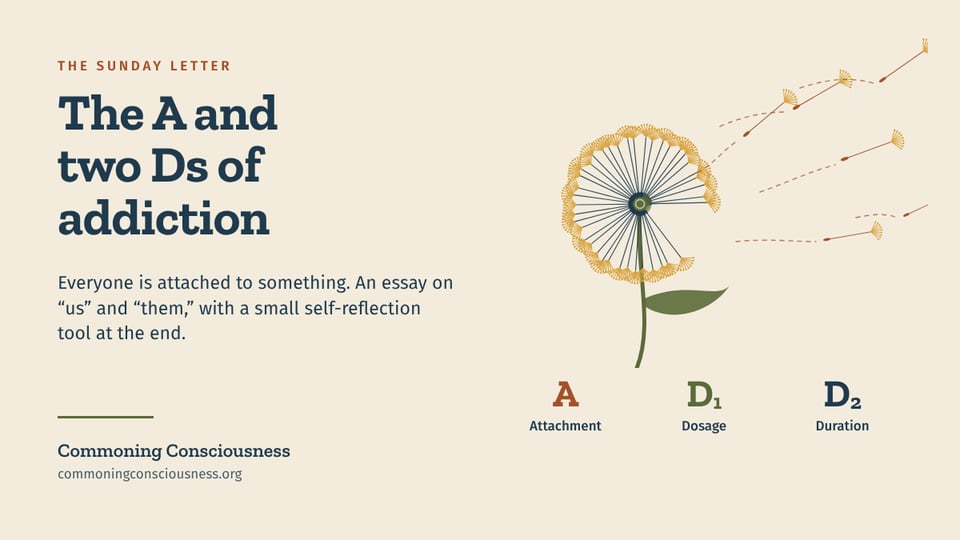
Rooted in the first three letters of the word "addiction," the A-D-D framework is a way of looking at one of your most resource-intensive personal Attachments (A) in two dimensions: Dosage (D₁) and Duration (D₂). It is a journaling tool, and it belongs beside the daily GAIA practice (Gratitude, Affirmation, Intention, Action) that this project is built around. Where GAIA asks what you are grateful for and what you intend, A-D-D asks where your attention actually goes. Answer the three prompts below for one Attachment. Repeat it for as many Attachments and as often as you like. Done as a continuing exercise, it lets you track your own patterns over time, and in my experience it quietly changes how you think about addiction and the people who struggle with it.
- Attachment (A): To what private material object or personal activity am I most attached? Put differently, when I pursue my own interests with my own resources (time, disposable income, attention) that could go to any number of ends, where do I invest most heavily?
- Dosage (D₁): How much of the Attachment do I want, or am I able, to experience in a given interval of time? Do I spend my whole "entertainment" budget for a week on it?
- Duration (D₂): For how long, and when, do I wish to indulge in the Attachment, or to feel its effects?
Popular culture would have a "normal" person assume that any member of the "deviant" out-group answers the last two questions in a "both-and" fashion: as large a dose as possible, for as long as possible. If that were true of every addict, we would all eventually overdose, and natural selection would long since have worked against the human predisposition to addiction. The evolutionary story runs the other way. The circuits that make us vulnerable are ancient and, in their original setting, adaptive. What is new is the purity of the things that act on them and the speed with which they are delivered (Nesse & Berridge, 1997).
Supply does limit some people. But most people with an addiction are forced into a trade-off between the two Ds. Many procure a large supply of low or moderate doses and spread them over a long duration. The goal in that case is not to maximize the potency of a single experience, a noun, but the proportion of time spent experiencing, a verb. That is why the framework treats an Attachment as two linked things: the material thing consumed, which is Dosage, and the psychological and emotional effect of consuming it, which is Duration. The first D lives in the material realm. The second lives in the psyche. In this project I have been calling those two realms the body's currency, Effort, and the psyche's currency, Attention, and the same observation holds there: the two are connected, and neither is unlimited.
The A-D-D impossibility theorem
From inside this framework a regularity emerges that I will call the A-D-D Impossibility Theorem:
For any given addiction, material constraints on resources and time make the simultaneous maximization of Dosage (D₁) and Duration (D₂) functionally impossible.
The reason is physical. A private object or activity is rival: what I consume now, nobody else can, and neither can I, later. Consume the whole available Dosage and there is nothing left of the Attachment to make the experience last. Maximizing D₁ excludes maximizing D₂.
Some people who set out to maximize Dosage do so because they intend the experience to be their last. Many who set out to maximize Duration do so because they want the experience to, simply, last. And to make anything last is to run into the oldest rule of sustainability there is. A thing can only be kept going if it is not used up faster than it regenerates. Outflows cannot be greater than inflows. The ecological economist Herman Daly put it as two operational principles: harvest no faster than the resource renews, and emit no faster than the system can absorb (Daly, 1990). Ostrom's fishers, foresters and irrigators kept the same rule for centuries without an economist to name it (Ostrom, 1990). Maximizing Dosage, which means consuming all that is available, undermines Duration. To maximize Duration, Dosage has to fall below the rate at which the Attachment replenishes. Maximizing D₂ excludes maximizing D₁.
I want to pause on how far that rule reaches, because it is the hinge between this old essay and this project. The rule that governs a bottle governs a fishery. It governs the Attention and Effort each of us spends in a day, which come back with sleep, quiet and company, but never on demand. And it governs the psychic commons itself, the shared layer of images and patterns that all of us draw on and none of us owns. That commons is not rival the way a bottle is. An archetype is not used up by being used. But it can be polluted. Every projection we leave in it is an outflow. Every piece of inner work that withdraws a projection is an inflow. A culture that exports its shadow onto "the addict" faster than anyone integrates it is maximizing Dosage on its own commons, and it will find, as every such culture does, that the Duration is not what it hoped.
A single weed in a field of grass
Grounded in the A and two Ds, anyone can use the framework to explore how their own Attachments might begin to rise toward addiction in at least some cases. That is not to say that every attachment is an addiction. The value of the exercise is to look explicitly, using your own experience, at the nature of addiction as something that emerges out of impulse and habit rather than out of conscious, rational decision. The neuroscience of the hardest cases says the same: the behavior starts as an action and ends as a habit (Everitt & Robbins, 2005). To the extent the framework helps you reach that realization, it begins to bridge, and eventually to fill in, the socially constructed fracture between "addicts" and "non-addicts."
That filling-in matters beyond addiction. Erasing the arbitrary boundaries between "types" of people is critical to ending the hierarchical, dehumanizing project of othering anyone whose Attachments, or values, religions or beliefs, differ from our own, when their pursuit of "aberrant" Attachments is so often echoed in our own pursuit of "normative" ones. From there it is a small step to the realization that, in another cultural or historical context, we might be the aberrant ones who get cast out. And once we see the dividing lines and ranking systems we take as "just so" for what they are, we clear the lane for more inclusive, cooperative, life-sustaining institutions to take root. Nearly fifty years ago, researchers showed that rats housed alone in bare cages drank far more morphine than rats housed together in a large, rich enclosure (Alexander et al., 1978). Later attempts to repeat the experiment got mixed results, but the question it raised has never gone away: how much of what we call addiction is a response to the cage? Fracturing is not only unjust. It may also be addictive.
Jung called the work of becoming whole individuation, and this project reads individuation as a form of commoning. The more of your own shadow you carry, the less of it lands on your neighbors, and the more usable the shared space becomes for everyone. We-ing, contra othering, carries in it the seeds of a flourishing unity and harmony that have either faded from or never dwelt within our collective memory. The A-D-D framework is one tangible tool for practicing it in one domain. It is a small, single weed presently protruding unnoticed in a vast field of grass and flower. But perhaps, like a dandelion seed head subject to the vivifying forces of wind, our individual efforts at self-reflection and empathy, with those we have actively othered and those whose other-ness we have passively accepted, will ferry the raw materials of radical acceptance and harmonious coexistence throughout our personal spheres of influence, and beyond.
A practice for this week
Pick one Attachment. Not the one you would admit to at a dinner party, but the one that gets the largest share of the time, money and attention you could spend on anything. Write it at the top of a page and answer the three prompts: how much in a sitting, for how long, and when. If you keep a GAIA journal, this fits under Action alignment, since it asks whether where your attention goes matches what you say you intend. Keep the page and come back to it next week, and the week after. The framework was built for repetition.
Then ask one more question. In another time or place, would this Attachment be the aberrant one? Somewhere, it probably is. Notice who you were tempted to look down on this week, and whether their glass and yours hold the same thirst.
With care from the porch,
R
References
- Alexander, B. K., Coambs, R. B., & Hadaway, P. F. (1978). The effect of housing and gender on morphine self-administration in rats. Psychopharmacology, 58(2), 175–179.
- Barry, C. L., McGinty, E. E., Pescosolido, B. A., & Goldman, H. H. (2014). Stigma, discrimination, treatment effectiveness, and policy: Public views about drug addiction and mental illness. Psychiatric Services, 65(10), 1269–1272.
- Bollier, D. (2025). Think like a commoner: A short introduction to the life of the commons (2nd ed.). New Society Publishers.
- Bollier, D., & Helfrich, S. (2019). Free, fair, and alive: The insurgent power of the commons. New Society Publishers.
- Carhart-Harris, R. L., Erritzoe, D., Haijen, E., Kaelen, M., & Watts, R. (2018). Psychedelics and connectedness. Psychopharmacology, 235(2), 547–550.
- Daly, H. E. (1990). Toward some operational principles of sustainable development. Ecological Economics, 2(1), 1–6.
- Everitt, B. J., & Robbins, T. W. (2005). Neural systems of reinforcement for drug addiction: From actions to habits to compulsion. Nature Neuroscience, 8(11), 1481–1489.
- Haslam, N. (2006). Dehumanization: An integrative review. Personality and Social Psychology Review, 10(3), 252–264.
- Heather, N., Best, D., Kawalek, A., Field, M., Lewis, M., Rotgers, F., Wiers, R. W., & Heim, D. (2018). Challenging the brain disease model of addiction: European launch of the addiction theory network. Addiction Research & Theory, 26(4), 249–255.
- Jung, C. G. (1968). Aion: Researches into the phenomenology of the self (R. F. C. Hull, Trans.; 2nd ed., Collected Works Vol. 9, Part 2). Princeton University Press. (Original work published 1951)
- Jung, C. G. (1971). Psychological types (H. G. Baynes, Trans., rev. R. F. C. Hull; Collected Works Vol. 6). Princeton University Press. (Original work published 1921)
- Jung, C. G. (1975). Letter to William G. Wilson, 30 January 1961. In G. Adler & A. Jaffé (Eds.), C. G. Jung letters, Vol. 2: 1951–1961 (R. F. C. Hull, Trans.; pp. 623–624). Princeton University Press.
- Lembke, A. (2021). Dopamine nation: Finding balance in the age of indulgence. Dutton.
- Mbembe, A. (2003). Necropolitics (L. Meintjes, Trans.). Public Culture, 15(1), 11–40.
- Nesse, R. M., & Berridge, K. C. (1997). Psychoactive drug use in evolutionary perspective. Science, 278(5335), 63–66.
- Ostrom, E. (1990). Governing the commons: The evolution of institutions for collective action. Cambridge University Press.
- powell, j. a., & Menendian, S. (2016). The problem of othering: Towards inclusiveness and belonging. Othering & Belonging, 1, 14–39.
- Sussman, S., Lisha, N., & Griffiths, M. (2011). Prevalence of the addictions: A problem of the majority or the minority? Evaluation & the Health Professions, 34(1), 3–56.
- Volkow, N. D., Koob, G. F., & McLellan, A. T. (2016). Neurobiologic advances from the brain disease model of addiction. New England Journal of Medicine, 374(4), 363–371.
You just read issue #4 of Commoning Consciousness. You can also browse the full archives of this newsletter.


