
Welcome to the first Sunday letter from Commoning Consciousness. Most weeks it will be a Porch Note like this one: a short piece written on my back porch, whether an essay, a poem, or a bit of creative nonfiction. Each one starts with something I noticed and felt grateful for, and follows it out to the systems we share. Now and then a longer essay will go out instead. If anything here stirs something for you, hit reply. I read every one.
Porch Notes, no. 1: lessons from a cooperative backyard symphony
As far as we humans know, sound is one of the main ways birds talk to one another: chirps, calls, the whir of wings, birdsong in all its kaleidoscopic variety. Which means that the air those sounds travel through is a kind of shared infrastructure. Within any local landscape, the airwaves are a commons that no one has fenced in.
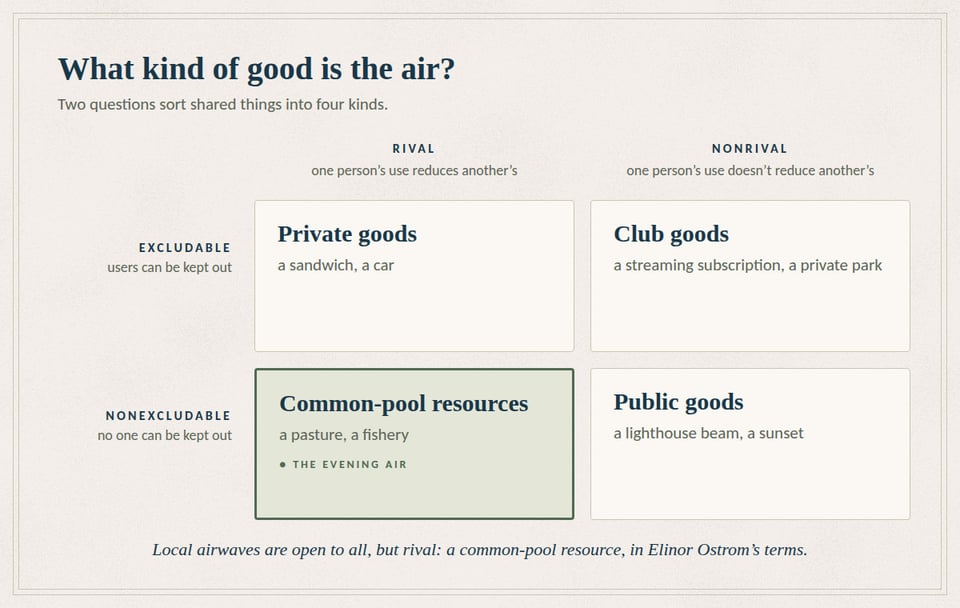
Economists have useful words for this. A resource is nonexcludable if no one can be kept from using it, and nonrival if one user's use doesn't reduce anyone else's. A pure public good is both. Local airwaves are open to anyone who can make a sound, but they are not nonrival. The louder and longer one user broadcasts, the harder it becomes for anyone else to be heard, or to enjoy a little quiet. Open to all, but rival: that's what Elinor Ostrom called a common-pool resource, the same category as a pasture or a fishery.
One evening late this summer, the birds behind my house seemed to understand this arrangement better than most people do.
I was sitting on the back porch, watching more than a dozen birds of several species move in and around the trees of the forested wetland to the east. Robins and red-winged blackbirds were the most common. Several pairs of birds of the same species were trading calls, back and forth, in sustained conversation.
I closed my eyes and focused on the calls. Within a few moments, the engine of an ATV on a nearby trail faded to a faint hum, a barely audible brown noise in the background. The wind moving through the alder, birch, and maple, shaking branches and rattling leaves, became a rhythm section. And the birdsong came forward as the lead instrument in a backyard symphony performed for an audience of one.
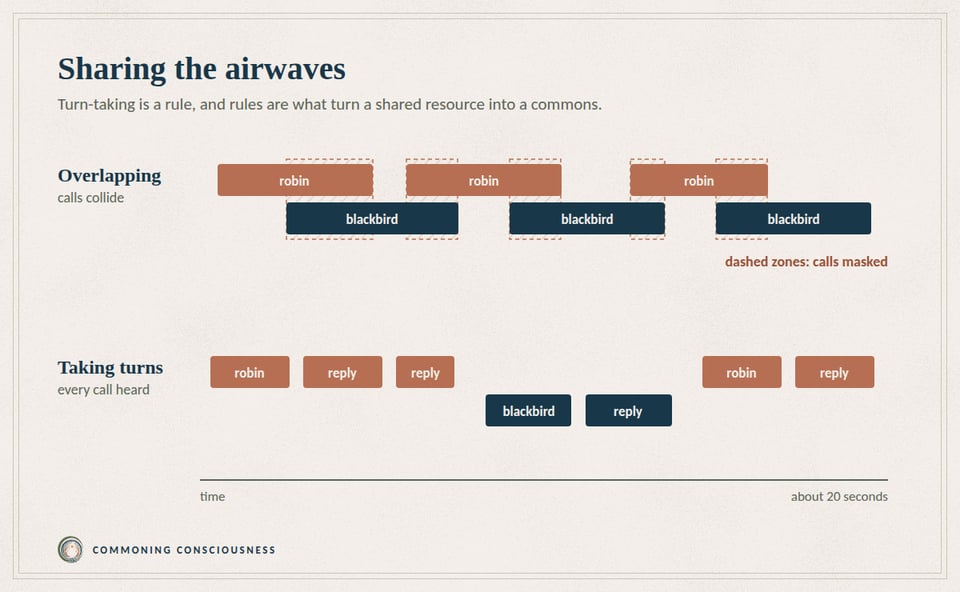
Every note, sixteenths, quarters, triplets, dotted wholes, was distinct, because the performers were politely sharing the airwaves. Birds of one species called out in rough sequence, as if taking turns on a regional telephone network. A call, a reply, sometimes a re-reply, all in a similar pitch, rhythm, and style. Then a new conversation, with an entirely different sound, filled the air. It was as if one pair stepped into the neighborhood phone booth* to make their call while the other species waited in line. Now and then two conversations crossed. But far more often, the pattern was orderly: shared, sequential use. That pattern is what caught my attention in the first place.
What the scientists say
What I heard has been studied. In a classic 1974 paper, researchers found that two forest species, the least flycatcher and the red-eyed vireo, adjust the timing of their songs to reduce overlap. More recent work has found similar timing in tropical forest bird communities. And a 2023 study in the forests of Pennsylvania found that birds singing at similar pitches sang over one another far less often than chance would predict. The picture isn't uniform, though. A 2023 study of a European forest found that avoidance was weak, and mostly limited to the hours before sunrise.
And the back-and-forth between birds of the same species is often what ornithologists call countersinging: neighbors trading songs across territorial boundaries. It's orderly, but it's also a contest. I find that more interesting, not less. Turn-taking doesn't require saintly birds. It can grow out of competition, as long as everyone gets something from keeping the channel clear.
The ATV belongs in this story, too. Human noise really does crowd the airwave commons, and birds adjust to it. Great tits in noisy cities, for example, sing at a higher pitch than their rural cousins, to be heard over the traffic.
Why this is commoning
A commons, in the full sense, is more than a shared resource. It's three things together: the resource, the community that uses it, and the rules that community follows. The turn-taking I heard is the third part, a rule, whether learned, evolved, or improvised on the spot. My birds weren't just sharing the air. They were commoning it.
There's one more thing I noticed only afterward. The ATV didn't actually get quieter. I did something different with my attention. When I closed my eyes and chose what to listen to, the engine sank into the background and the birds came forward. Attention, where the mind goes, is something we spend. How we spend it changes what we hear.
Birdbrains
English speakers have long used "birdbrain" as an insult for someone they consider not very smart. But the joke is on us. Birds can fly. And they might very well know how to manage a commons. Being birdbrained, in the sense of cooperative and collectively minded, sounds about as harmonious to my ears as a chorus of feathered virtuosos sharing the airwaves on a calm summer evening.
Our own shared soundscapes work the same way. Meetings, group chats, comment sections, feeds: each is a rival commons, open to all, where the loudest and longest voices can crowd everyone else out. Nobody has to mean any harm for that to happen. It only takes a missing habit of turn-taking.
So here's a question to carry this week:
Where did you take up more of a shared space than you needed, and where did you wait your turn?
If you keep a GAIA Journal, try it as this week's intention.
Cheers.
*For younger readers: before mobile phones were common, small, bus-shelter-like structures with working telephones stood in fixed public places, so people could make calls on the go. They weren't pure public goods. You fed the phone coins to buy talk time, and when the time ran out, so did your call. So the analogy to an unfenced airwave commons is decidedly imperfect. Give me a break; it was a beautiful evening.
Further reading
- Chronister, L. M., et al. (2023). When birds sing at the same pitch, they avoid singing at the same time. Ibis.
- Ficken, R. W., Ficken, M. S., & Hailman, J. P. (1974). Temporal pattern shifts to avoid acoustic interference in singing birds. Science, 183(4126), 762–763.
- Hart, P. J., et al. (2021). Timing is everything: Acoustic niche partitioning in two tropical wet forest bird communities. Frontiers in Ecology and Evolution.
- Ostrom, E. (1990). Governing the commons: The evolution of institutions for collective action. Cambridge University Press.
- Slabbekoorn, H., & Peet, M. (2003). Birds sing at a higher pitch in urban noise. Nature, 424, 267.
- Staniewicz, A., et al. (2023). Competition for acoustic space in a temperate-forest bird community. Behavioral Ecology, 34(6).
P.S. This letter comes from Commoning Consciousness, a project about personal growth as a shared responsibility. A new Porch Note goes out every week, and the podcast begins on December 21. If someone forwarded you this letter, you can subscribe here.
You just read issue #1 of Commoning Consciousness. You can also browse the full archives of this newsletter.


