When Cities Fall in Love, They Have to Make a Choice
First of all, I have a lot going on this weekend:
I’m at World Fantasy Convention in Oakland, including a reading on Friday from 11:30 to 1 PM, also featuring Caroline Yoachim and Bruce McAllister.
On Saturday at 5:00 PM, I’m taking part in Text Change: Trans Writers on Anything Except Transition at Dog Eared Books. It’s a free event, part of the Lit Crawl!
And on Sunday at noon, I’m talking about my new Star Trek comic book, Zero Point, and signing copies of the first issue, at Comix Experience. Cosplay encouraged!!!
Please come hang out!
I Finally Wrote My “Smart Cities in Love” Story!
I'm super proud of my short story that just came out in MIT's Technology Review magazine. (Here's a gift link!) It's called "Love Is Infrastructure," and it's about a romance between two self-aware cities. Sometimes I have a short story that I conceive and write in a week, or maybe a fortnight — but this particular piece of fiction has been in the works for a very long time.
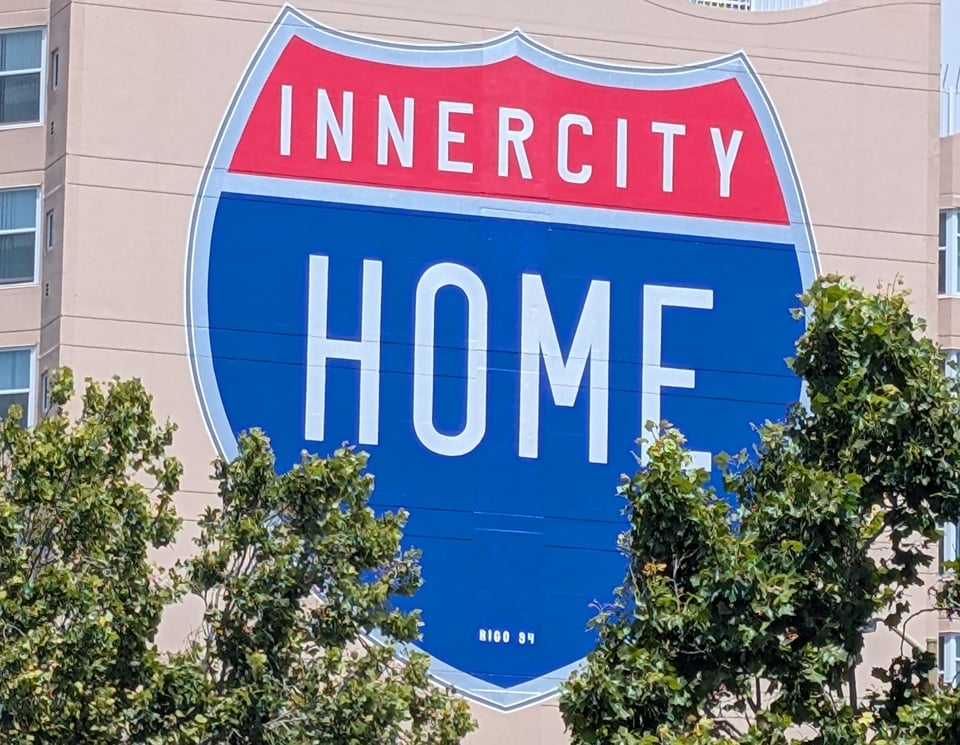
Several years ago, I wrote to my then-agent, the amazing Russ Galen, about a novel I was thinking about writing1. I wanted to write about two smart cities that gain sentience — and then have a steamy romance. Russ was immediately excited and wrote back with lots of thoughts about how this could make for a groundbreaking novel.
I made some notes and scribbled some ideas. And then… I put it aside — because I had just sold a young adult trilogy, which ended up being super complex and ambitious in its own right. And because I had just written The City in the Middle of the Night, a science fiction novel that was huge and required tons of world building, and I wasn't sure if I wanted to write another one of those right away. By the time I was ready to write another adult novel, I ended up pivoting to the story of a witch teaching her mother to do magic - - which became Lessons in Magic and Disaster.
I kept making more notes on the romance between cities, over the years, but I never quite got around to writing it as a novel. I was a bit daunted by the scale of it, including the worldbuilding that’d be required, and I wasn't entirely sure how it would even work. What cities with these be, how would they become self-aware, and what would a romance between two cities even look like?
Subscribe now!!! !!!Recently, I heard that Technology Review was publishing short fiction again. I had published one story there back in the day, and had been appreciated the opportunity to write something ambitious and science fictional for a different audience than I normally reached. So I reached out and we started talking. I ran a few ideas past them, including one or two that I still hope to write at some point. But in the end, I kept thinking that this might be a place to try writing that love story between sentiment cities.
This meant a ton of research. I’ll often do research as I write, or even as I revise, to flesh out the details of a story — or to make sure whatever half-assed thing I came up with actually makes sense. The main exception to this rule is generally for things with a lot of science baked into the premise: like, when I wrote the short story where time travel displaces you especially as well as in time due to the movement of the Earth, I spent ages working out the details with a physicist, Dr. Dave Goldberg, before writing a word. This was a similar situation.
Creating Smart Cities: an essential read
I talked a lot to my partner Annalee2 about the topic, not just as I was writing this story but in the years before. Once I knew I was writing the story, the first person I reached out to was my friend Kate who's done some work in the area. She suggested a book from 2018 called Creating Smart Cities, edited by Claudio Coletta, Leighton Evans, Liam Heaphy and Rob Kitchin. I read most of it on my phone, and found it incredibly useful.
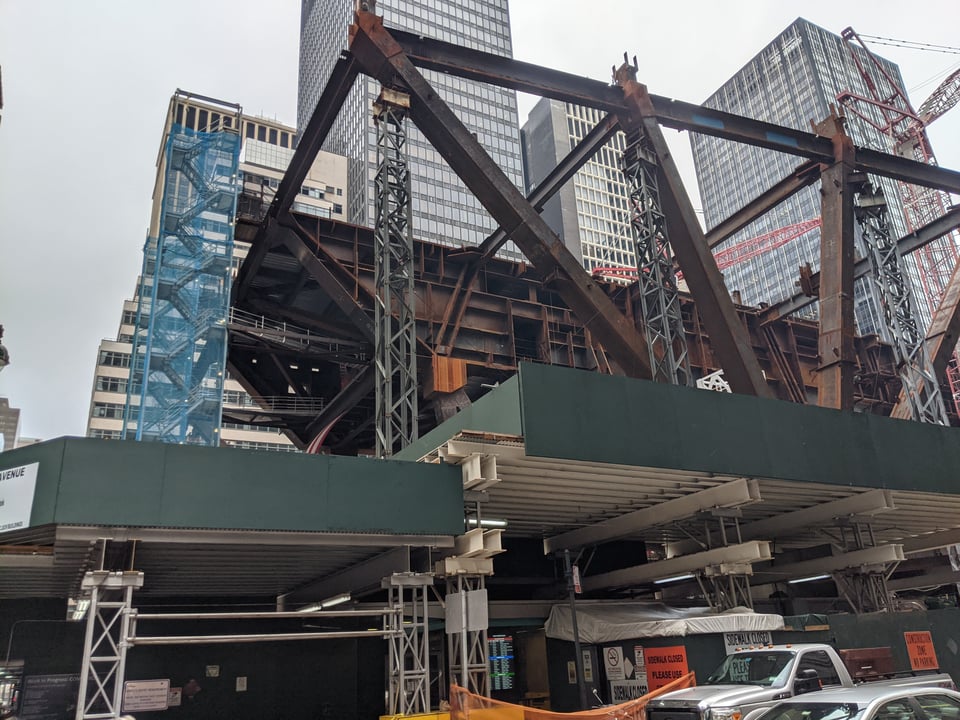
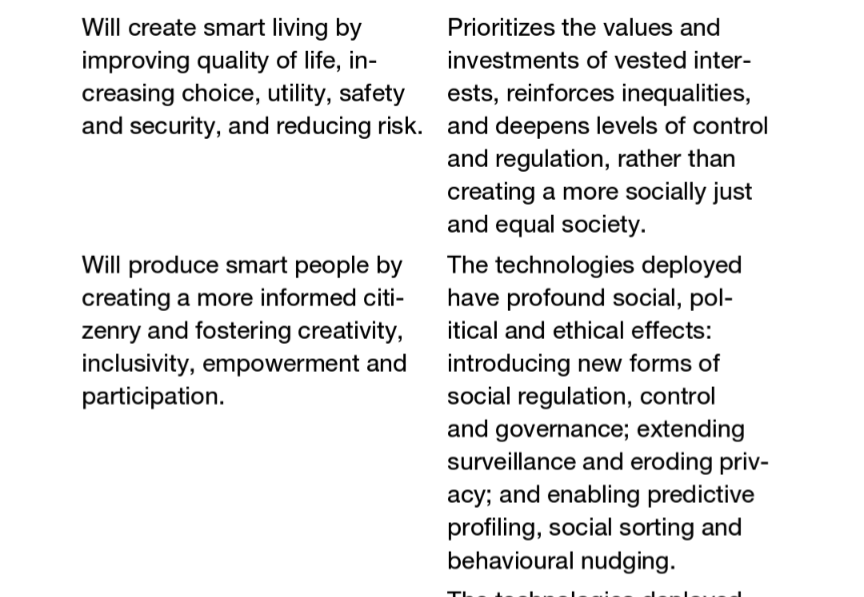
The main thing I gleaned from the introduction and essays in Creating Smart Cities was that a smart city could easily become a top-down surveillance dystopia. The book was full of cautionary tales, in fact. The introduction by the editors warns about “a digital citizenship of passive contribution and consumption, rather than rights and entitlements.” And it includes a chart detailing the promises (on the left) and perils (on the right) of smart cities — here’s a snippet:
Also, in one essay, Jathan Sadowski at Monash University writes that in some scenarios, “smart cities” simply mean deploying “an arsenal of smart technologies”:
The smart city becomes, essentially, synonymous with data-driven, (semi-)automated, networked technologies; the city is just a place to install and implement these systems… If we only look at the technology, then we miss out on the ways in which smart initiatives can reflect the ideologies and reinforce the interests of city elites and global corporations.
I'm tremendously grateful to Creating Smart Cities, which reshaped my understanding of the topic and sent me in a completely different direction.
Nobody lives in San Francisco
I was also incredibly lucky to speak with Michael Makstman, San Francisco's Chief Information Officer. He generously invited me to his office and spent 15 or 20 minutes talking about how he sees coordination between city services, and how a city that thought for itself could approach this differently. I kept asking him to imagine the city of fifty or 100 years from now, and his answers were incredibly thoughtful and helpful.
Subscribe now! !! !!!! !!In particular, Makstman told me that city government includes stuff like SFO, the Port of San Francisco, and delivering water to eight million people in the region. Hundreds of thousands of people depend on the city for services and food. City Hall hosts weddings all the time. The city owns 500 miles of fiberoptic cable, and provides free high-speed internet to 24,000 households in public housing and free wifi in Chinatown.
“People don’t live in San Francisco — they live in their neighborhoods and streets,” Makstman told me. So decisions need to be micro-focused on what one particular block needs. He gave the example of a city block where a lot of people are having allergies, and maybe different trees need to be planted there. He also cautioned that everything the city government does has unpredictable ripple effects across neighborhoods. For example, some streets were closed for repairs on July 4, leading to traffic jams as people drove to watch the fireworks. That’s why it’s so important for everyone to participate: because the city is a complex ecosystem.
People think too much in terms of large infrastructure projects and not enough in terms of hyperlocal interventions, Makstman added.
(He also speculated about a future where we harvest clean water from San Francisco’s infamous fog, which naturally desalinates ocean water, and also use the fog as a power source. Somebody please write this!)
Creating a hopeful vision
Once I knew more about the real-life thinking around smart cities, I started to contemplate what a more hopeful vision could look like.
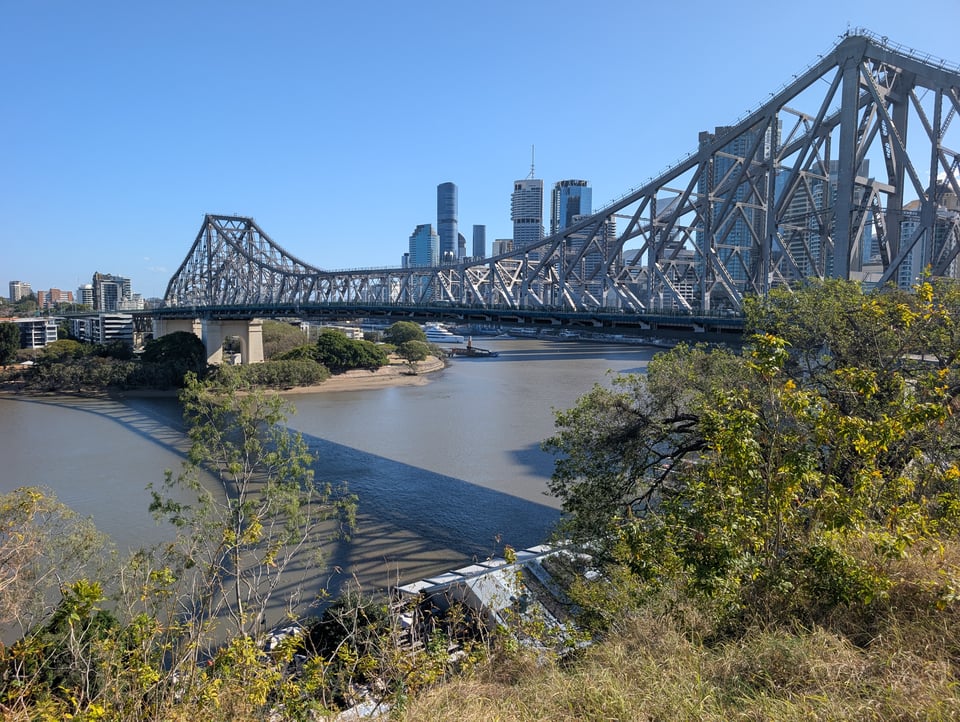
I decided the two cities in my story would allow no surveillance or monitoring of their citizens — in fact, both of them are in states that have passed robust privacy laws. Instead, I decided these cities would have incredibly strong direct democracy, in which people are encouraged to vote on every issue, including bus schedules and potholes. I decided there would be some system where people could submit votes, which could be akin to bug-tickets, about various aspects of the city’s services and management.
Once I had the notion of direct democracy and bottom-up politics, it was easy to figure out how my two cities become self-aware. They gain consciousness not by being “trained” on massive datasets to create statistical probabilities, but rather in a way more like the artificial minds in Ted Chiang's essential novella, “The Life Cycle of Software Objects.” They would begin thinking for themselves by processing tens of millions of daily complaints and comments, which I knew from talking to Makstman required thinking about complicated trade-offs: fix one problem, and you might create a dozen others.
The first line that came to me as part of the story was: “The smallest unit of consciousness is a vote.”
Subscribe now! It’s free!I was determined to have this story follow the beats of a conventional romance, from “meet cute” to “happily ever after.” I also wanted to include the perspective of some people who lived in both cities and were affected by their deepening connection. (If this short story gets enough attention and it seems like people are into it, I would still love to expand this concept into a novella or maybe even a novel, which could include more of the people in both cities — but that still feels like a huge commitment.)
The biggest problem I faced was coming up with an obstacle for the romance between the two cities. I tried a bunch of different things and nothing worked — and meanwhile, I kept coming back to the warnings in Creating Smart Cities — there's a version of a smart city that is a horrific surveillance dystopia. I hesitated to create a self-aware city that was top-down instead of bottom up, because I had really loved the concept of cities gaining self-awareness through direct democracy. But in the end, I decided it’d make a certain amount of sense for there to be a surveillance-dystopia city that at least acts sentient3.
In other words, I decided to create a love triangle.
The other day, I was at the Canberra Writers Festival, and the brilliant Amie Kaufman4 answered a question from the audience about tropes. Amie said that love triangles are usually about a character deciding between two different futures — or two different versions of themself.
In my story, Mainspring City is a bit more corporate and buttoned down than St Barnabas — and when these two cities start falling in love, they certainly have their differences. But they are both built on privacy and direct democracy, and they both have a lot of heart and soul. But Mainspring City is also chatting with another city, Turnbull. And Turnbull is both extremely corporate and very oppressive — everything the citizens do is monitored, and democracy is a sham. At one point, Turnbull's artificial consciousness explains proudly that sometimes the citizens vote for things that are a bad idea — and then the self-aware city and its leaders work together to ensure that the people get what they need, rather than what they voted for.
So when Mainspring City is torn between the artsy, hipstery St Barnabas and the controlling, uptight Turnbull, this felt like a way of thinking about what cities are, and what they could become. I won't tell you what happens next!
Writing this story make me feel more hopeful and engaged in the fight for the future — because I really believe we can have a world where people get to speak for themselves instead of being spied on. We can have cities that work hard to take care of everybody — absolutely everybody — without treating some people as the problem. Technology alone cannot solve any of our problems — but I do believe tech can be part of building a better world, if power isn’t concentrated in a small number of hands.
As always, a work of fiction is not an essay — and I was determined to make “Love is Infrastructure” a fun, engaging read. I feel as though I succeeded, fingers crossed.
So it would mean a lot to me if you read this story and shared it with other people. And please let me know what you think of it!
My current agent, Kate McKean, is also incredible! ↩
Their novel A Wall is Also a Road is out now and it’s utterly brilliant! ↩
If I ever do expand this “smart cities in love” concept to a longer form, I would definitely devote some space to the question of just how sentient Turnbull City really is, and whether it has the same level of self-awareness as the two cities that have to listen to millions of voices. ↩
Read the book she co-wrote, Lady’s Knight, it's excellent! And the sequel looks awesome as well. ↩