A.I. Stories in the Age of AI Hype: a Conversation with Ted Chiang
First, a couple plugs!
I’m a guest of honor at PhilCon next month, and it’s looking AWESOME. I’m doing a conversation with Jadzia Axelrod (Galaxy the Prettiest Star) about writing superhero comics. I’m also on an Ursula K. Le Guin panel with Sarah Pinsker and Chana Porter, moderated by Simone Zelitch. I’m legit excited!
My novel Good Things Are Coming Your Way comes out June 8 — it’s about a wizard and a vampire travel through time… and fall in love! Pre-order signed/personalized copies here.
How do you write about fictional A.I. in the midst of so much hype? I asked Ted Chiang
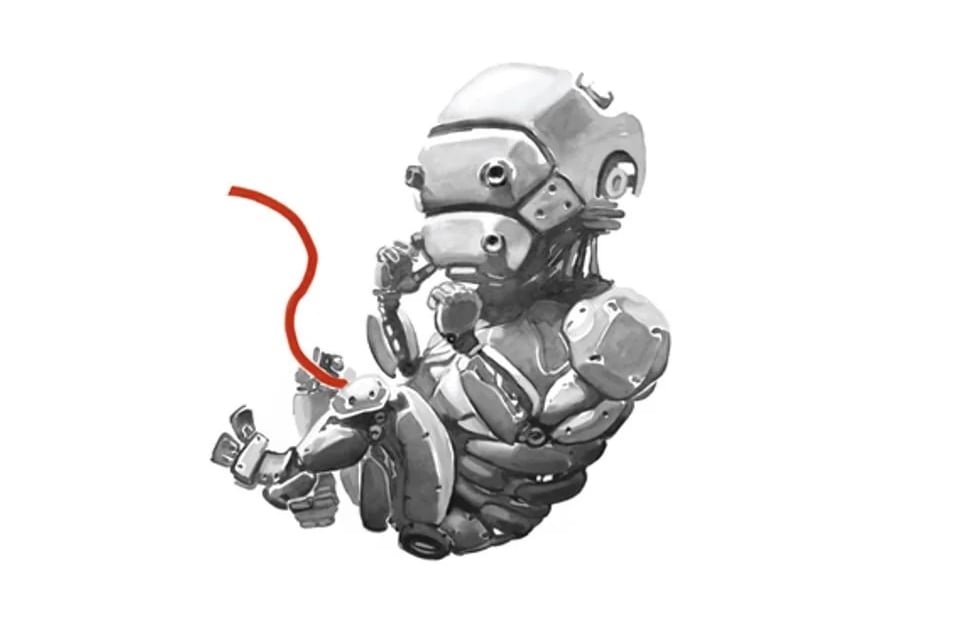
Ted Chiang has become one of the most eloquent critics of the current "generative A.I." boom. He also wrote one of my favorite pieces of science fiction about artificial sentience, a novella called The Lifecycle of Software Objects — read my review here.
So Chiang seemed like the ideal person to ask a question that's been bugging me for a while: how do you write science fiction about artificial intelligence, when there's so much hyperbole about so-called A.I. in real life, from both Silicon Valley and the media? In particular, how can we write fiction about artificial sentience without feeding into the public perception that Silicon Valley is on the verge of inventing machines that can think for themselves?
I was so grateful that Chiang took the time to talk to me about this question — and his responses were extremely helpful.
Subscribe now! It’s freeeeeee!Last weekend, I saw a panel about A.I. featuring Chiang, along with Annalee Newitz, Avani Vaghela, Jason Denzel and moderator Molly Tanzer. And Chiang quoted an amazing line from a 2024 essay by Ali Alkhatib, in which Alkhatib writes:
I think we should shed the idea that AI is a technological artifact with political features and recognize it as a political artifact through and through. AI is an ideological project to shift authority and autonomy away from individuals, towards centralized structures of power.
So I wanted to begin by asking Chiang what that quote means to him. He responded that he finds Alkhatib's framing a useful one, since so many A.I. boosters want to claim that it's just a tool — like a hammer — while also insisting it'll be "transformative in a way that hammers are not."
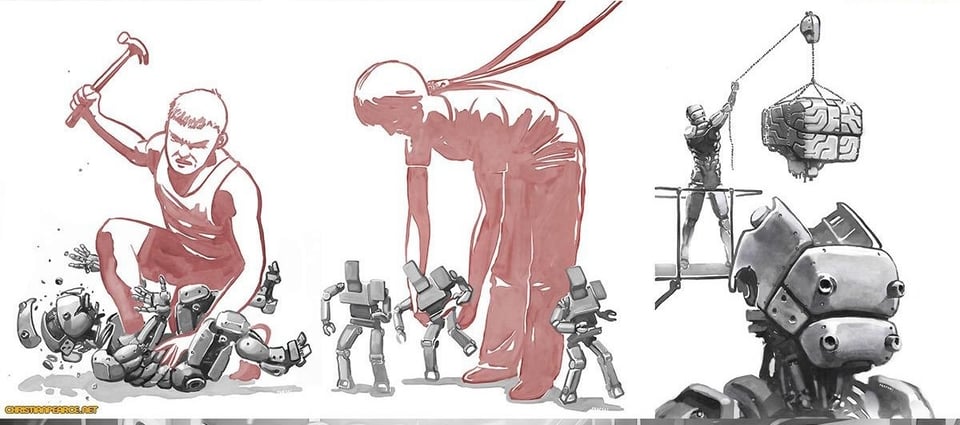
Chiang referred back to his own 2023 essay, "Will A.I. Become the New McKinsey?", in which he asked, "Is there a way for A.I. to do something other than sharpen the knife blade of capitalism?" Says Chiang, "It is very easy to see how A.I. helps capital against labor, but it is very hard to see how AI helps labor against capital." With that in mind, Chiang finds it "very useful" to understand A.I. from the perspective Alkhatib suggests.
Feeding the A.I. Hype?
I've been struggling a bit lately with the ethics of writing science fiction about self-aware computers. Stories about futuristic A.I. remain an excellent way of dealing with questions around the nature of consciousness and what it means to be a person. And we've been using robots and other artificial beings to talk about slavery and the abuse of labor at least since Karel Capek's R.U.R. These are powerful ideas and storytelling devices — just like faster-than-light travel and time travel, which nobody expects to become real any time soon.
Subscribe now! It’s one email a week, usually.And yet... Silicon Valley has become adept at repurposing science fiction as building blocks of its fantastical hype machine. When authors try to imagine a future in which machines have thoughts and feelings, their work instantly seems to get woven into a tapestry of bullshit.
And to make matters worse, the general public tends to associate any new fictional A.I. with the souped-up chatbots that massively-funded tech companies are peddling. I can't tell you how many times I've mentioned a fictional A.I. I've created, only to have people ask how my work is commenting on ChatGPT. (It... isn't?)
So I was keen to hear what Ted Chiang had to say about this dilemma.
"There's no way to write fiction and guarantee your readers will understand it correctly," Chiang says. "There is no way you will ever be able to write something so straightforward that Elon Musk will understand it the way that you intend it." People in tech seem determined to view speculative fiction through the lens of their own certainties, and "you cannot adjust for readers who are arbitrarily bad at reading."
There are alternatives, Chiang notes. "You can write fiction which is all about how LLMs [large language models] are crap," he says. "Or you could write stories about an A.I. which proposes solutions to climate change but they are all terrible."
Another alternative is to "write about sentient machines in such a different context that it doesn't seem like you're writing about our immediate future." You could put a story in the distant future, an alternate past, or a secondary world like China Miéville's Bas-lag. You could also write in more of a Golden Age science fiction mode, in which you explain carefully the scientific basis of the A.I. in your world, making it clear that you're not writing about LLMs.
Any of those approaches might make your story less likely to be received as a commentary on our current situation, Chiang notes.
He recommends a 2024 Greg Egan novelette, Death and the Gorgon, in which tech billionaires have frozen their brains after death hoping to be revived in the future — until a disaster kills a hundred of those brains on ice. "It is very much about stuff happening here and now, and it's a story that acknowledges some of the power of LLMs. But it's mostly about how nuts the people involved in this are." He points to Gorgon as an example of a story that "runs counter to the narrative" that Silicon Valley is pushing.
Lifecycle, 16 Years Later
Chiang's Lifecycle literally reshaped how I think about artificial minds — it was a huge influence on the depiction of Peregrine in All the Birds in the Sky, and I was still thinking about it as I wrote my recent "smart cities" story for Technology Review. But I was curious if Chiang thought about that story differently, in the wake of so many Silicon Valley narratives about creating digital life.
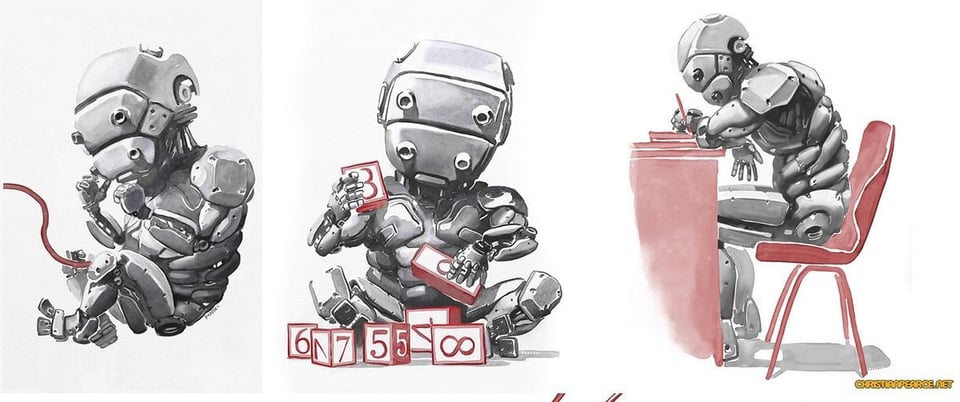
"My feelings about the story have not changed," Chiang says, adding that he still finds the questions that story raises compelling. "If we ever create sentient digital life forms — if we ever create software that has subjective experience and can experience suffering — what are our moral obligations to it? I think that remains an interesting question."
He adds:
I just have to reiterate that nothing we've seen in the age of LLMs is at all relevant to [my story]. LLMs are not conscious, they have no subjective experience, they cannot suffer, and so we owe them nothing.
Chiang also wanted to explore the question of, "How do you make a person?" Many classic science fiction stories depict someone buying a robot from the store and turning it on — at which point, it suddenly is a fully-fledged person with subjective experience, who happens to be "completely competent and completely loyal." This doesn't ring true to Chiang, "based on everything we know about persons."
Lifecycle raises interesting philosophical questions, but "they remain purely theoretical," Chiang says. "There's no practical dimension to this, now or in the foreseeable future. We are no closer to conscious software now than we were sixteen years ago."
Music I Love Right Now
When I found out ages ago that Bootsy Collins was collaborating with Buckethead on a new album called Metal Health, I got super excited. For months, I kept hitting refresh on all Bootsy’s socials and the music streaming sites, desperate to hear this new collaboration. And then at some point, I finally gave up — and somehow failed to notice that Metal Health had come out this past July. At long last.
The good news? Metal Health is everything I’d hoped it would be, and way more.
I tend to judge Bootsy Collins projects according to one very simple metric: how much bass is there??? And Metal Health, in addition to including an incredible amount of guitar shredding, also has a metric fucktonne of bass on it. As the name suggests, Metal Health is pretty much a metal album, but it also brings the funk — and if you feel nostalgic for more experimental, industrial-tinged projects like Praxis, Zillatron or Science Faxtion, this will absolutely scratch that itch. The emphasis is on musicians jamming, with a pretty solid roster of guest stars including Victor Wooten and Ella Feingold. And it throws in a Jimi Hendrix cover toward the end. This album kept me pumping my fist and bopping my head the whole time — my favorite Bootsy project since World Wide Funk.