My Favorite New Books! Plus a Rant about Escapism!
Hi! You have a few more days to get the Summer Reading Bundle from Green Apple, containing three mystery books that I selected. (I’m sure you haven’t read them!) And some goodies.
You can still pre-order a signed, limited-edition paperback of my mother-daughter witch story Lessons in Magic and Disaster. Sprayed edges!
Scroll down to the bottom for a short rant about escapism…
My Favorite Books That I’ve Read Lately
I still miss doing book reviews for the Washington Post — so I'm gonna start posting more capsule reviews of books here in my newsletter. There might even be some longer reviews from time to time! (If more folks paid for my newsletter, it might encourage me to put more effort into doing regular book coverage, hint hint...)
Here are my fav books that I've read lately!
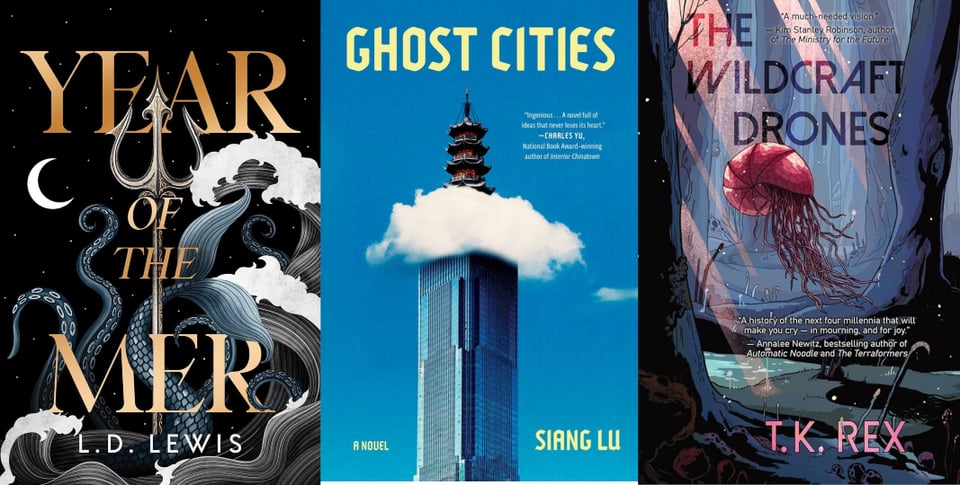
Year of the Mer by L.D. Lewis (Saga Press, April)
Lewis was one of the founders of Fiyah Magazine, the incredible showcase for Black speculative fiction that just recently went on indefinite hiatus. That really sad news is offset by the release of this novel, a quasi-sequel to The Little Mermaid in which Ursula the sea witch (here called Ursla) is more of a vengeful god whom Arielle cheated back in the day. Arielle's granddaughter Yemaya is next in line for the throne — but powerful forces are trying to prevent her ascension because her grandmother was "mer". (It doesn't help that Yemaya has a hell of a temper and a bit of a cruel streak.) Good thing Yemaya (aka Yemi) has a loyal girlfriend/bodyguard, the long-suffering Nova, who always has her back.
Here's where I confess that I've never seen any of the Little Mermaid films, nor have I ever read the original Hans Christian Andersen story to the best of my recollection. Still, Year of the Mer works just fine on its own merits, as a story about a woman of mixed ancestry facing questions about her right to claim power for herself. Lewis's worldbuilding is expansive and complex, going way beyond the confines of a fairy tale, and the result is a fast-paced, thrilling adventure that feels very much like a more intimate version of an epic fantasy story.
And Lewis explores some compelling themes in Year of the Mer, including the plight of a woman who belongs to two cultures and has internalized a lot of stigma about one of them. There's also a clash between modernity and tradition: Yemi stands to take the throne during a time when technologies like automobiles and firearms have become more advanced, and some people are questioning whether the land of Ixia still needs a divinely-appointed monarch. And finally, the line between a tyrant and a benevolent ruler gets tested rather a lot by Yemi's aforementioned temper.
Subscribe now!!! ! ! !The complex relationship between Yemaya and Nova pretty much carries the book. Yemi doesn't grow and change over the course of the story as much as one might hope, but her bond with Nova is tested and explored in a number of ways. Nova is both Yemi's girlfriend and her subordinate, sworn to protect Yemaya at all costs but fully aware that Yemi is making some extremely questionable decisions along the way. It all builds to a satisfying climax in which Ursla makes her move, leading to a cliffhanger ending that left me anxious to read the sequel.
Ghost Cities by Siang Lu (August, Summit Books)
I goofed. I shouldn't be reviewing a book that doesn't come out for another couple of months, but I was dying to read this one — in part thanks to the enticing blurb from Charles Yu. (Ghost Cities has been out for a couple of years in Australia, where it's won awards.)
In any case, I was blown away by Ghost Cities. As the Charles Yu endorsement indicates, it's a metatexual, surreal romp — "romp" is really the only word that fits — that explores cultural identity, how stories are constructed and preserved, and the coerciveness of incredibly powerful people who create their own private reality and force everyone to live in it.
Xiang is a professional translator — except that he hardly knows any Chinese and has been using Google translate to fake it. When Xiang is found out, he loses his job but gains internet fame in China under the hashtag #BadChinese. A megalomaniac director named Baby Bao recruits Xiang to join his latest movie project, in which a newly-built city becomes a movie set, in which a new populace become characters in the film, Truman Show-style. This storyline is interspersed with the history of an emperor who recruits an army of decoy emperors to fend off an assassination, his concubine who hides in a labyrinth and preserves banned books, and his imperial artisan who flees to the village where Xiang will one day be born.
Upgrade now! If you feel like it.It's all extremely silly, but also poignant in parts — and there's an undercurrent of anger at the existence of people like the emperor and Baby Bao, who have the ability to force everyone else to take part in whatever false reality they construct. (The emperor's decoys take turns ruling, leading to imperial decisions that are nearly as mercurial as Baby Bao's own creative choices.) Ghost Cities reminded me a bit of K.J. Parker's Making History, another story about a despot who fabricates a fake reality, but I found Lu's version ultimately more satisfying in part because it resolves less neatly. At its root, Ghost Cities explores how to resist being coercively forced to participate in someone else's narrative: by telling — and protecting — our own stories.
The Wildcraft Drones by T.K. Rex (Stelliform Press, May)
A collection of linked short stories, The Wildcraft Drones tells the future history of humans, drones, and other living beings, working together to rebuild after devastating climate change. There are people communicating with dolphins and other non-human creatures, climate refugees, people clinging to the wilderness after all other humans are forceably relocated to cities, and plenty of self-aware drones that are doing their best to rewild much of the planet.
Subscribe now!!!! It’s always free!It's challenging to write hopeful fiction about a post-climate change future while still presenting the inevitable challenges and compromises that will come with survival. Luckily, Rex manages to write a series of stories that are deeply inspiring but also full of conflicts in which nobody is entirely right or wrong. Their characters, both human and otherwise, are messy and flawed, and many of these short stories are full of tough situations and conflicts with no easy answers. Rex also delves thoughtfully into various techniques for repairing nature and making better use of natural resources — and explores how new technology could help, rather than hinder, this process, if used with intention.
At a time when it feels as though my own government is trying to hasten, rather than mitigate, climate devastation, The Wildcraft Drones was the jolt of hope that I desperately needed. Not only that, but it's a book that I'm definitely going to be re-reading, because these rich characters and lived-in worlds will only mean more to me the second or third time around. I can't recommend this book highly enough.
The Power Fantasy Vol. 3: The End of History by Kieron Gillen, Casper Wijngaard, Clayton Cowles & Rian Hughes (Image Comics, March)
This is one of my favorite new comics of the past couple years. Gillen is exploring a pretty simple idea: what if superheroes really were "superpowers," on the level of the United States or China? What if one individual was basically a WMD, or had the ability to shape the world to their will? Along with this notion comes a lot of complexity, including a sprawling alternate history that includes the destruction of much of Europe.
I won't get into spoilers here, because you really ought to start with volume one. Suffice to say that a lot of events come to a head in this volume, and I ended up being blown away. I don't know how I would feel about this volume if I'd been reading the individual issues. I suspect I would have been frustrated: a major character appears dead but actually survived, only to die for real an issue or two later. Luckily, there's a point to all this, and you get there by the end of the collected edition.
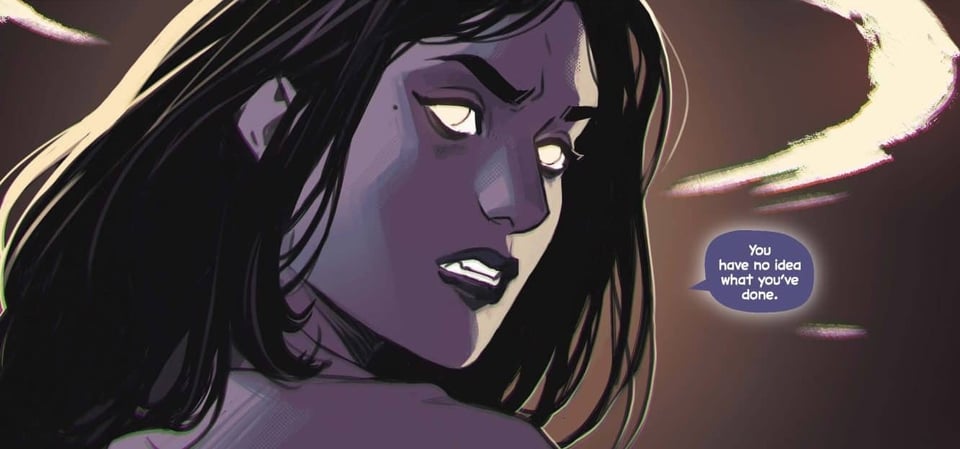
Two things I'll call out: I love how Gillen creates characters who are simultaneously assholes and decent people trying to use their power for good, for the most part. The major characters in this story are capable of being petty and arrogant, but there are also plenty of chewy, quotable discussions of the ethics of power. (In a way that goes beyond simplistic homilies about power and responsibility: responsibility to whom? And how many second-order effects does that responsibility cover?) These are deeply fucked up people who are unlucky enough to be demigods.
Subscribe now!!!!The other thing that keeps me marveling at this comic is the way that the story flows across the page. I'm trying to get better at writing comics, which means that every time I read a comic by someone else, I try to learn from it. I'm obsessed with Wijngaard's clean linework and the way his style can go from a somewhat classical realism to a disjointed horror splat. But I'm even more obsessed with the layouts, and the way they pack so much story into each page — some pages have eight freaking panels that flow cleanly, while others get beautifully messy. It's rare to read a comic this dense and yet this readable. Fucking brilliant.
Bonus Rant: We Can’t Let the Haters Dispense All the Candy
Last weekend, I was on a panel about queernormative worlds at the Bay area book festival. During the Q&A, someone asked how we felt about the notion that a queer-cozy or queernormative world is mere escapism, keeping people from doing the important work of confronting all the horrors that are going on in the real world.
I responded, as I usually do, that it's pretty much impossible to be unaware how sewered-up the real world is right now — especially if you were a queer person who lives in community with other queer people. And I said all the stuff I've said before about how escapism is healthy and good for you, and can fuel your ability to resist. And that stories that might seem like wish-fulfillment are actually bringing us visions of the better world we are fighting for — without which we can't fight nearly as hard or as well.
But I also made an argument that I've made before in public — but I've never written it down before. So I thought I'd share it with you all now.
Basically, when you look at the most popular pieces of entertainment in the world, they tend to be pure wish fulfillment. And I don't think queer creators should surrender one of the most powerful tools in storytelling to be used only by those who hate us.
Look at Harry Potter: it’s the most wish-fulfillment to ever fulfill a wish. Harry Potter is the most special boy in the world, who has a heroic destiny that affects absolutely everybody. Everything revolves around him. He lives in a world where magic comes with very few concrete rules or limitations. He goes to the fanciest boarding school in the world, where he is instantly a celebrity. At the same time, Harry Potter is the most persecuted, most abused person in the universe. (No, don't look at the house elves!) Harry’s so mistreated, it's tragic — and yet, in spite of it all, he still manages to be the most special boy who gets to win everything and be the best and be loved by everybody who matters.1
You could say similar stuff about Luke Skywalker. Or Batman. Or any number of other super-popular characters — people really do love wish-fulfillment and escapism, and they will get it wherever they can. I really believe there is a strong relationship between the popularity of a fictional world, most of the time, and how much it caters to our desire for wish-fulfillment.2
So when I see the erudite among us saying that it's not okay to tell a “chosen one” story, or to have magic without clear limits, or to provide pure escapism and piles of cake, I worry. I especially worry when I see these messages being internalized by my fellow queer creators, and those of us who at least try to write inclusive, empowering stories for all of us.
If J.K. Rowling, whose legacy is defined by bigotry, is allowed to dispense nothing but candy all the time, and the rest of us believe that we are obliged to dish out vegetables, we are giving Rowling an unfair advantage that she by no means has earned. And I like candy! I think candy is good for you. I think everyone should eat as much candy as they want.
So if you are a queer creator, or a creator from some other marginalized group, and you've been thinking of writing a fluffy sugary fantasy in which everything is nice all the time, I say go for it. If you want to write a “chosen one” story about someone who is simultaneously super tragic and also the luckiest person alive, please do. (I did.) Create a world where none of the fuckery in our world exists, if you want. Or create a world that is deeply fucked, in which one person just happens to be special and powerful enough to make a meaningful change. It’s all good!
Give us a Black Luke Skywalker. Give us a gay Superman. Don't listen to the people who tell you that you have to make it "realistic" — realism is a lie, because reality is a construct. Have fun, bake cookies. Save some for me!
I really believe that a key component for wish-fulfillment stories, for a lot of people, is getting to feel persecuted while also being told you’re the most wonderful and powerful. ↩
Somebody is going to point to popular things that are post-apocalyptic or dystopian, and I’m going to have to explain that I think these things are pure wish-fulfillment. There’s nothing more special than being one of the few survivors of the end of the world (and not having to pay taxes anymore), or being the one person who leads a revolt against an oppressive regime. ↩