"Do Witchcraft, Fuck AI": Clarke's Third Law and Tech Hype
Super quickly: I’m a guest of honor at BayCon this summer. Come geek out!
You can still order the Summer Reading Bundle containing three excellent books I’m sure you haven’t read, plus treats.
Pre-order the signed special edition paperback of Lessons in Magic and Disaster! With sprayed edges!
Some thoughts about AI hype and Clarke’s Third Law
Back in November, I was so honored when the Arthur C Clarke Foundation gave me their award for imagination in the service of society. It was such a lovely event including a signature mocktail inspired by my work and my vibe and a wonderful introduction by the awesome Jac Jemc. I gave a well-received speech, and we had a lively conversation inspired by the life and work of Arthur C Clarke.
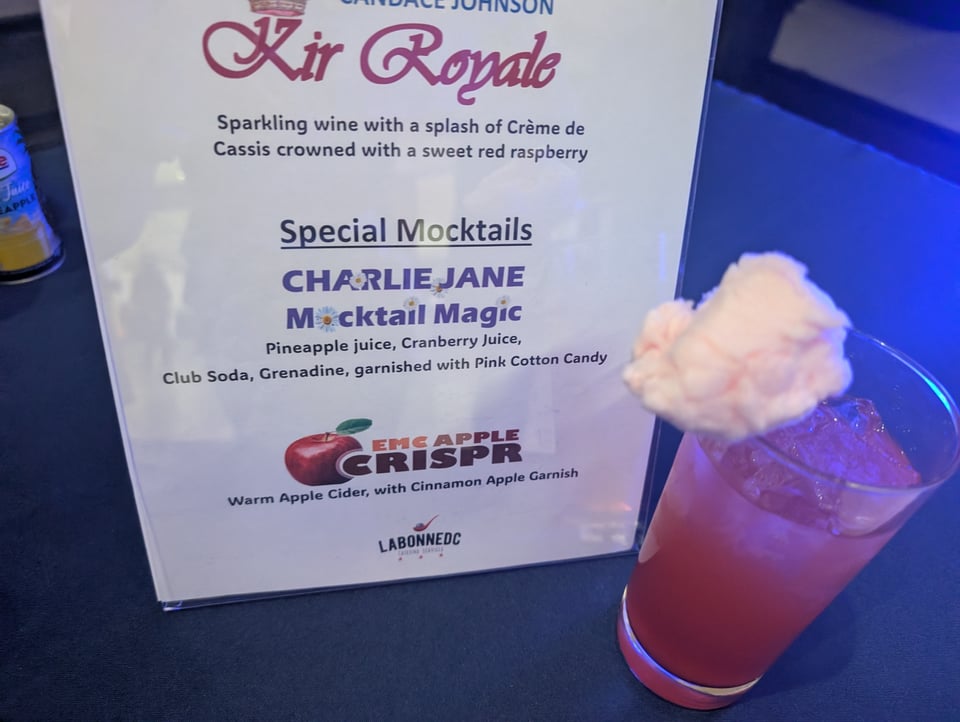
There was only one aspect of it that stressed me out a bit: the host, the veteran journalist Steve Scully, wanted me and the other award winners to talk about AI on stage.
In the end, it was fine. I tried to be as chill as possible while explaining that I think much of our current AI discussions are pure foolish hype, and the technology cannot and will not replace or even meaningfully supplement human beings. I tried to be super clear, as I always am, that I think there are legitimate uses for machine learning — mostly around sorting through large data sets and streamlining coding tasks. Computers are good at computer shit, shockingly. And yet the industry is pushing other use cases: sycophant chatbots and cruddy art based on statistical probabilities.
Some of the donors who had paid to attend were AI boosters, and we chatted about it afterward. But it was basically fine and nobody got too upset with my extreme nay-saying.
Subscribe now! ! ! ! It’s freeeee!!!I bring this up now, because I've been thinking about the ongoing AI hype — and especially the corporate-sponsored drumbeat insisting that absolutely everybody will be using AI to write and create, and this is just inevitable. And my mind keeps associating this nonsense with the way people talk about Clarke’s Third Law.
In case you missed it, Clarke's Third Law states that any sufficiently advanced technology will be indistinguishable from magic. (Nobody ever quotes Clarke's first or second law, because they're largely meaningless.) And I would argue that the Third Law is also meaningless, because it relies on the tautological phrase “sufficiently advanced.” If you could make a meatball sub that was so tasty that people who ate it died of sheer tastiness, then that sub would kill anyone who ate it. The Third Law is also clearly false — because presumably the people who created this “sufficiently advanced” technology would be able to distinguish it from magic, and therefore it would not be “indistinguishable”. The Third Law sounds good but ultimately says very little.
Upgrade now! (If you want.)I've written before about why I don't like Clarke's Third Law. Annalee Newitz and I even recorded a whole episode of our podcast Our Opinions Are Correct about disliking its prominence. (Bear with me: I swear I'm getting back to AI soon.)
Anyway all of that discussion about Clarke's Third Law led to me finally having a bit of an epiphany: I don't actually hate Clarke's Third Law, I hate the way people bring it up in discussions about fantasy — as if to say that the entire fantasy genre is either irrelevant, or a pitiful subset of science fiction.
When you look at what Clarke probably meant when he coined that law, he was trying to give permission to so-called “hard” science fiction authors to include magic in their stories. Clarke was a big pioneer of the “big silly object in space” genre, in which something huge and inexplicable shows up and it's confouding awe-inspiring. Some of Clarke's best-known works include things that are beyond the comprehension of humans, and which do feel basically like magic. It's a way of keeping “hard” science fiction from turning into mundane science fiction.
If you view Clarke's Third Law as a permission slip for including stuff that has no scientific explanation in a science fiction story, then you get warp drive. And hyperspace. And instantaneous teleportation. Not to mention cryosleep that can preserve people for hundreds, or even thousands, of years with zero cellular damage.
But as I mentioned, people often use it as a way to shit on fantasy instead. The things that appear to be magic in this story about wizards and dragons are clearly scientific phenomena that the characters and the audience are too feeble-minded to find a rational explanation for. No matter that the magic in a fantasy story frequently defies the laws of physics — such as when a witch turns a whole human being into a newt that somehow retains human consciousness. Where does the extra mass go? Don't worry about it. (Maybe if magic appears to defy the laws of physics, that's because we haven't found all the laws yet.)
Subscribe now!!!!There's a certain dismissiveness and self-satisfaction that comes up when people try to use Clarke's Third Law to relegate fantasy to the basement of science fiction. Part of it feels like a move in some status game in which fantasy and science fiction are always competing for primacy — a game that science fiction is currently losing, going by the sales of books in both genres right now. I also can't help noticing that some of the people most likely to use Clarke's Third Law this way are the same ones who insist magic must have rules and clear limits — see N.K. Jemisin’s indispensable essay on this topic.
When people dismiss magic as insufficiently understood science, they're also trying to assert human dominance over the universe. We are the cleverest monkeys ever, and we will eventually understand absolutely everything. All matter will be ours to toy with, and yes, we will eventually become gods thanks to the Singularity, yadda yadda, unlimited rice pudding.
This notion of humans as supreme and understanding all things seems to go to the opposite place from what Clarke was really saying with his Third Law. I think of Clarke as a writer who is heavy on Sense of Wonder, and who wants to confront people with the vastness of the cosmos. I love the bit in 2001 where he says there’s a star for every human being who has ever lived. I think the core notion of his three laws is that there are more things in the universe than we can possibly comprehend any time soon. I don't honestly believe Clarke intended his third law to mean that there would one day be no more mystery in the universe.
I try to be a rationalist in my daily life, though I do cling to some weird superstitions. But when I write fantasy, I like exploring the idea that we are still just animals huddling around a fire and out there in the darkness is stuff that we cannot control or fully understand. I believe that we will one day get a greater understanding of nature, including our own biosphere, but I am rather doubtful that we’ll be able to control it anytime soon — and I'm pretty sure that attempts to control it, such as geoengineering, are doomed to backfire spectacularly.
Which brings me back to AI and creativity. I feel like creating something new out of daydreams and half-baked notions is the closest most humans can come to doing actual magic. You sit in a chair and poke at a keyboard, playing out the actions of fake people, and something emerges that you never could have predicted. Even if you outline like a motherfucker, you are still going to stumble across things in your story that feel as if they emerged from your characters’ own psyches, or from the ether itself.
Storytelling is bloody magic. It comes from an intuitive, dreamlike part of ourselves. So of course they want to automate it and reduce it to something that can be explained and controlled through sufficiently advanced technology.
By now, you can see why this made me think of Clarke's Third Law. When people use it to insist that fantasy stories can’t simply operate in a universe where some numinous forces defy our comprehension and shred the laws of physics, it does somewhat remind me of all of these attempts to take away from humans the thing that arguably makes us human in the first place.
So in conclusion: Do witchcraft, fuck AI.
Music I Love Right Now
Cimafunk’s three albums are some of my favorite music of the past decade and absolutely essential listening. But his latest release, Te Toca, blows his earlier work out of the water. It’s such an incredible album and I can’t stop listening to it.
I’ve talked about Cimafunk a couple times before. Basically, he’s an Afro-Cuban musician who (as his name suggests) does his own version of funk music. According to this recent interview, he’s heavily influenced by James Brown, African rhythms, EDM and Cuban music. With Te Toca, he teams up with a group of musicians called La Tribu, leading to a more “live in the studio” sound featuring a decent amount of jamming and live instrumentation. Check it out:
I feel like these songs are the strongest, most undeniable version of Cimafunk’s Latin funk sound that I’ve heard so far, thanks to this collection of incredible musicians and the slick-yet-raw sound they created. Te Toca is an album that I’m going to be listening to constantly for a long time to come.