The Stevie Wonder Song the Reagan Administration (Allegedly) Tried to Ban
Thanks so much to everyone who has upgraded to a paid subscription for this newsletter — it means a lot to me, and you’re definitely motivating me to keep working on it!
Meanwhile, there’s a couple weeks left to get the summer reading bundle I curated for Green Apple Books, containing three wonderful books that I’m reasonably sure you haven’t read yet. Plus bonus goodies!
Plus you can pre-order a special signed limited edition paperback of Lessons in Magic and Disaster with sprayed edges!
“You’re Twelve Years Old and Sex is Legal”: The Stevie Wonder Duet That Got Pulled Off the Radio
Stevie Wonder quit recording songs that other people had written in 1971, when he gained complete creative control over his own music. This remained true until the early 1980s, when he released two extremely preachy duets written by other people: "Ebony and Ivory" with Paul McCartney, and a song called "Used To Be" with Charlene.
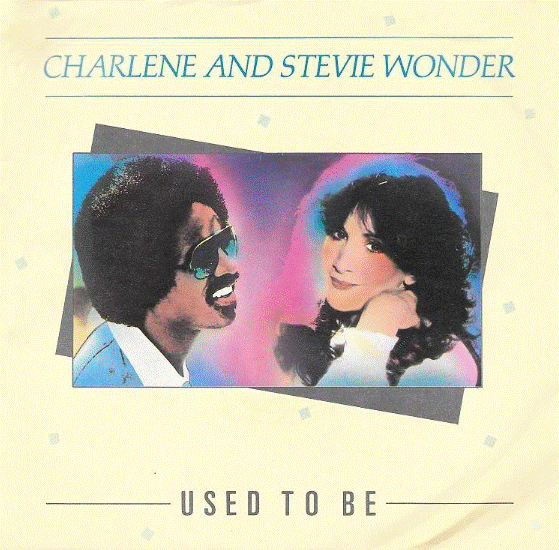
If you're over a certain age, you've almost certainly heard "Ebony," and I still hear horrendous renditions at the karaoke bar from time to time. But "Used To Be" has vanished without a trace, for good reason. It's possibly the worst song Stevie Wonder ever leant his voice to — and it's the end of a long, fruitful association with a songwriter called Ron Miller.
Who was Ron Miller?
Ron Miller, aka Ronald Norman Gould, was a thirty-year-old pizza-delivery guy and aspiring songwriter who played piano every night in a tiny hotel bar. There, he was discovered by Motown founder Berry Gordy, who liked his original songwriting enough to pay him $5,000 to come to Detroit and work for Motown. There, Miller became Motown's first white songwriter. (This interview with Miller, who died in 2007, is a fascinating read.)
Subscribe now!! ! ! !Miller became known for writing sentimental, often moralistic, ballads featuring heavy, syrupy strings. (As American Songwriter put it, Miller "specialized in creating tunes that sounded like they were lost standards.") He wrote or co-wrote a number of hits for Stevie Wonder, including "A Place in the Sun," "Someday at Christmas," "For Once in My Life," "Yester-Me, Yester-You, Yesterday" and "Heaven Help Us All." (Sample lyric: "Heaven help the man who kicks the man who has to crawl.")
Apparently Miller lived in the same apartment building as Stevie Wonder's tutor and manager, Ted Hull, and Miller and Wonder had a close partnership. As Miller told the International Songwriters Association:
Stevie and I started palling around... Then John Kennedy died. We were all on the lawn outside of Motown. Stevie came out and put his head on my shoulder and started crying. He said, "You know, I'm glad I'm blind." I asked "Why?" He said "Because I see everything the way I want to see it." I never forgot that and then I wrote "A Place In The Sun," which was my first hit.
The strange story of "I've Never Been to Me"
Charlene's song "I've Never Been to Me" appears at the start of the classic film Priscilla, Queen of the Desert. (For years, it was one of my go-to karaoke songs — I would camp it up as much as possible, including dramatic gestures and a surreal version of the monologue over the song's bridge.) It's an absolute camp classic.
Written by Ron Miller and Kenneth Hirsch and produced by Miller himself, "I've Never Been to Me" is a classic Miller tune, full of heavy strings, over-the-top emotion, and intense moralizing. It's also a deeply conservative song whose message is that women should find fulfillment in marriage and children, instead of trying to have independent lives of their own. The lyrics talk about the "unborn children that might have made me complete" and it's structured as a plea to a "discontented mother and a regimented wife" to be happy with her situation instead of seeking freedom.
The same mournful anger that gave us that line about the man who kicks the man who has to crawl now fuels screamy lines like, “I spent my life exploring the subtle whoring that cost too much to be free.”
Charlene has said in interviews that her vocals on the song were fueled by her pain over a divorce she was going through. "All the pain came out in that song," she told the 80s Rewind Show Podcast in 2022.
Upgrade now! If you feel like it!Weirdly, "I've Never Been to Me" was a huge flop when it was released in 1976-1977, as was the album that came with it. Charlene became disillusioned with the music business, quit, and moved to the UK, where she remarried and started working in a candy store, according to the book 1,000 UK Number One Hits. Then in 1982, a DJ in Tampa discovered the song and started playing it — and suddenly "I've Never Been to Me" became a number one hit in the UK and got to number three on the Billboard Hot 100 in the USA.

As Charlene told Call Me Adam:
My mom told me that somebody from Motown Records was looking for me. I didn’t know who it was or why they were trying to contact me. So I called Motown Records and got the president of the company... He told me that the song "I’ve Never Been To Me" was on the pop charts on the Billboard 100 and it was climbing off the charts. I couldn’t believe it! It was crazy! I was wondering, "Why now, seven years later, was the song a hit?" It was very strange.
In a sense, it's not surprising that "I've Never Been To Me" was suddenly a massive hit during the peak of the Reagan era, given that it's such a deeply anti-feminist, pro-"family values" song.
When the song was featured in Priscilla, Queen of the Desert, Charlene was overjoyed and loved the movie. She told Call Me Adam: 'When the musical opened up in Australia I was asked to come and perform 'I’ve Never Been To Me' for the cast on opening night. It was amazing. I realized then, that I was a gay icon.'
Then came "Used To Be"
After the massive success of "I've Never Been To Me", Charlene went back into the studio to record more songs. Ron Miller wanted to work with her again, because "it's always the second record that's hard," as he told the International Songwriters Association.
Charlene later said in interviews that she probably should have followed up "I've Never Been To Me" with something light and breezy, but instead she was given another one of Miller's polemics in song form. The resulting song, "Used To Be," is wild.
The central message of “Used To Be” is that kids are running wild, doing drugs and having sex at a young age, but that this is really the fault of the older generation who have failed to teach them proper values. But it’s cluttered by references to the killings of JFK and John Lennon, poor sportsmanship, and some other topics that Ron Miller felt like ranting about. Just like Charlene sang about “subtle whoring” in her previous single, she and Stevie Wonder now sing about television sexually assaulting the brains of the youth (except that they don’t sing “sexually assault,” of course)
And it ends by saying that Jesus tried to teach us to be better, and we crucified him — so maybe things haven’t really changed, after all. Here are the full lyrics.
Subscribe now!!!!Musically, it's pretty cornball. Lyrically, it's like being screamed at for four minutes by your bitter old uncle.
Anyway, Miller said in that interview that he realized this song might be "controversial," so he decided to rope in some star power. He contacted his old friend Stevie Wonder, who agreed to record it as a duet with Charlene.
The initial reaction to "Used To Be" was somewhat muted, but slightly positive. Here's Billboard Magazine, from October 30, 1982:
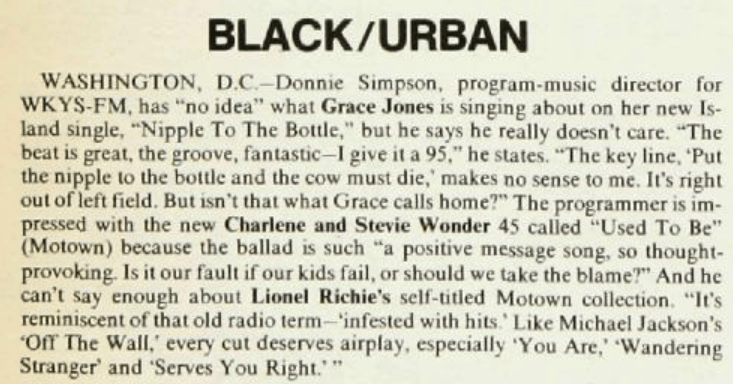
But soon enough, the backlash began. The song was instantly banned by the BBC in the UK, and radio stations in the United States also started to ban it from the airwaves.
Miller blamed the Reagan administration in his songwriters association interview:
["Used To Be"] came out and went to #83 with a bullet, then to #53 with a bullet and then all of a sudden it disappeared from the charts. The Reagan administration totally destroyed the record. And it was my heart. It tore my guts out (he recites the lyric). It was banned by hundreds of radio stations that were part of a big chain that had something to do with the administration.
As recently as 2011, Charlene was saying positive things about "Used To Be," saying the only problem with it was that it was "so deep and so incredible," but simply twenty years ahead of its time.
But in recent years, she's changed her mind about "Used To Be”. She told the 80s Rewind Show Podcast in 2022:
Have you dissected the lyrics? Oh, this hate!... It hit me about a year ago, I'm sitting there thinking: No wonder everybody hated 'Used To Be.' Look what it was saying!... It was like Ron wrote his story of hate and he put me on the stage to sing it. And then I opened a newspaper in England, and it said, 'Charlene, the magnificent failure.'
Charlene added, later in that interview, that going from a number one hit to an epic disaster, in the wake of some other challenges in her life, led to burnout and a huge mental health crisis as she crashed back down to Earth.
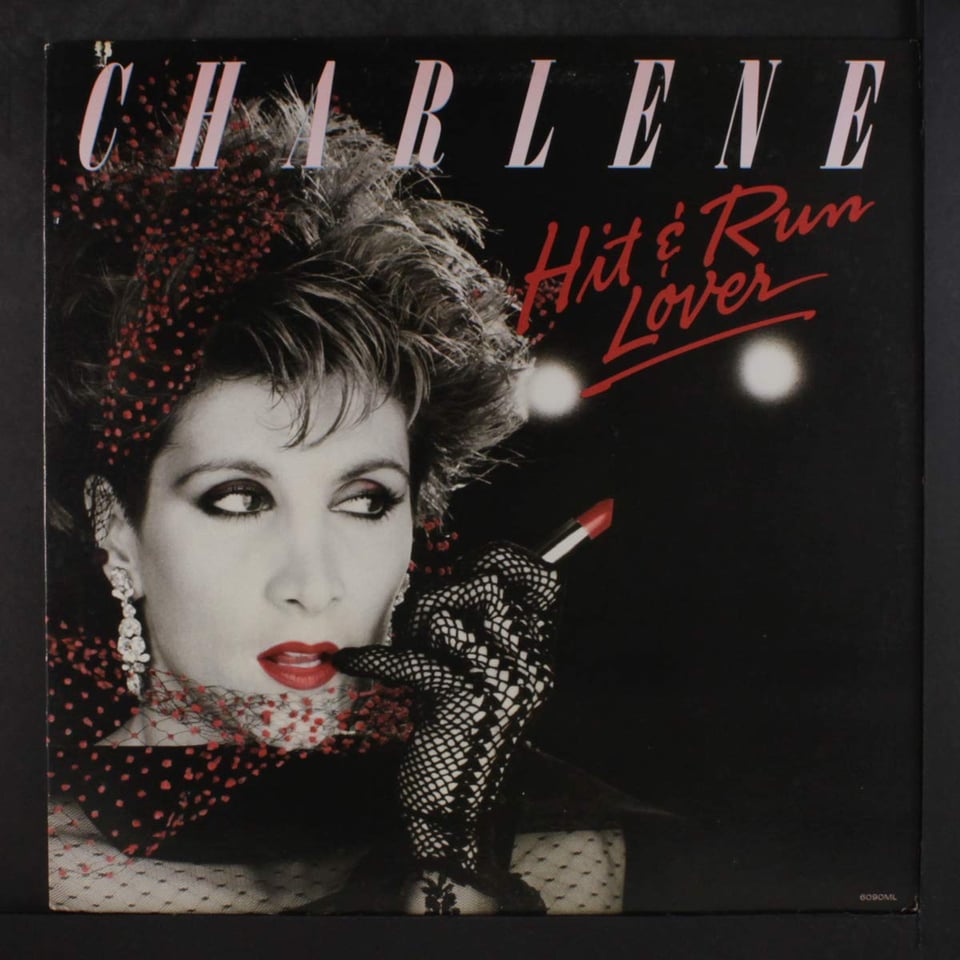
Her final album, 1984's Hit and Run Lover, gave her a makeover that made her look like Pat Benatar and featured more rock music. Even though Motown was on board with Charlene changing her sound, the label refused to let her record the song "We Belong." She told Goldmine: "'We Belong' was edgy and had guts to it, and unfortunately, we had to pass on it and it became a hit for Pat Benatar."
Anyway, I'm low-key obsessed with the failure of "Used To Be," because it feels like the ultimate culmination of Ron Miller's evolution as a writer of sermons in song form. His tendency to put heavy-handed messages into his songs served him well in the 1960s, when songs like "Blowing in the Wind" were huge, and he also kept his invective non-specific and a bit bland. Even "I've Never Been To Me," which goes super hard and mentions abortion, couches its lyrics in the form of a woman reflecting on her life and realizing that she's chased personal fulfillment and given up the supposedly deeper pleasures of marriage and family. With "Used To Be," he finally cut loose — and it was way too much for people.
Also, researching this piece made me feel bad for Charlene. It was Miller, early in her career, who convinced her that her voice was best suited for syrupy ballads — other Motown songwriters wanted her to do material that sounded more like Michael Jackson — and by the time she decided she wanted to broaden her sound and do material with "guts to it," it was too late.
What did Stevie Wonder think about the failure of “Used To Be”? As far as I can tell, he’s never spoken publicly about it. Charlene said in 2011 that she had run into him at a Motown reunion and he still had fond memories of the song. The central message of the song seems to have stuck in Stevie Wonder’s head, at least: a dozen years later, he released a song called “Ms. and Mr. Little Ones,” in which he apologizes to young people for the failures of the Baby Boomers. “Ms. and Mr. Little Ones” is beautiful, thoughtful, heartfelt, deeply moving and lyrically consistent — everything that “Used To Be” tried and failed to achieve.
Music I Love Right Now
One amazing thing about being a fan of Parliament, Funkadelic and all the other associated acts is that you end up going in all kinds of musical directions: jazz, rock, country, metal, opera, etc. But I still wasn’t prepared for Worae.
This is Jesse Rae:

He’s a Scottish musician who is extremely into funk music. He’s probably best known for an oddball synth ballad called “Over the Sea” which became a hit in Scotland and is considered a cult classic. Apparently “Over the Sea” got a boost when it was featured by Max Headroom.
Anyway, Jesse Rae collaborated over the course of a couple of decades with the greatest funk keyboard player of all time, Bernie Worrell. And several years ago, he released Worae, a compilation of collaborations between the two of them. (“Worrell” plus “Rae” = “Worae”.) Adding Bernie Worrell to literally anything makes it awesome, in my experience, and this is no exception.
I’ve been listening to Worae a lot since I purchased it on Bandcamp, and I’m loving the combination of Jesse Rae’s rocky guitar playing and pop-funk sensibilities with Worrell’s iconic keyboard playing. This far, my impression is that the songwriting in most of these songs is pretty decent — but the playing elevates them to a new level. And both Worrell and Rae seem excited to blend the love of Scotland with the love of funk. On a few occasions when some bagpipes pop up and get intertwined with Worrell’s dense synthesizers, it becomes actually transcendent.
If you want some haggis in your funk, I would absolutely check out Worae.