
The Network is Watching · The Catalog · №002
Bots now outnumber people online, AI solves problems open since 1946, and your router can tell who just walked past it.
Welcome back to another issue of The Catalog. Here I capture what’s worth learning, exploring, or watching, so you can start with a shortlist instead of sifting through noise.

CONTENTS
New Arrivals (Bots Outnumber People Online, AI Solves Age-old Math Problems, Rage Against the Datacenter)
The Feature (WiFi Tracks You Through a Room)
Observations (Prove You're Human)
About the Catalog
NEW ARRIVALS
01 · Bots Outnumber People Creating and Consuming Content
Seemingly overnight this summer, AI is now simultaneously outputting and consuming more content than us humans.
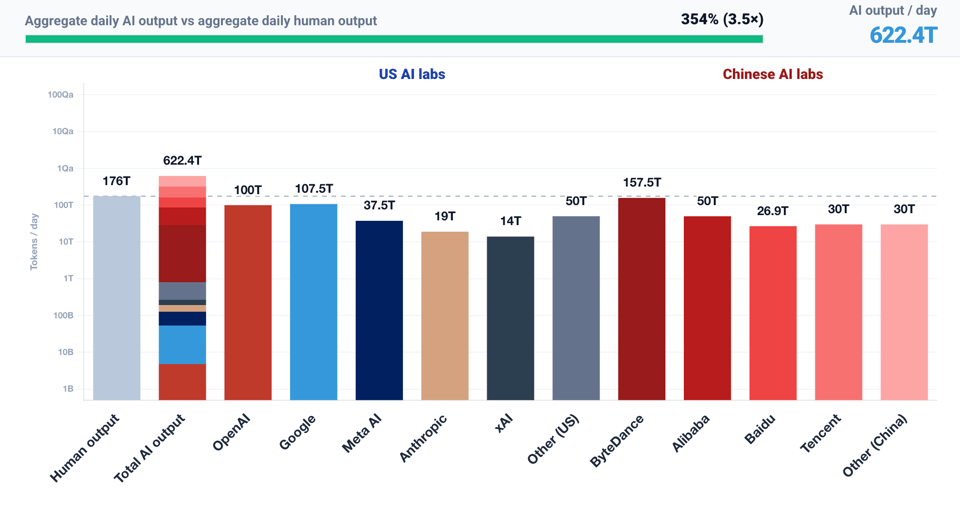
The combined daily output of all AI models likely crossed the human threshold in June/July, so AI’s exceeding total words spoken and written each day by the world’s 8.3 billion people.
Human output here only factors in spoken and written words, and excludes thinking, which is an important distinction. Alan D. Thompson at LifeArchitect.ai does a nice job of converting communication to tokens this way: for the average human there’s roughly 13K spoken words per day + 3K typed or written = 16K words per person. At 1.33 tokens per word across 8.3B people, humanity produces about 176T tokens per day. Thompson’s chart above projects AI reaches 622T token output per day by the end of 2026.
The way content gets consumed is measured differently. Cloudflare, with a large observation deck of the internet, shows automated traffic at 61% of HTTP requests to HTML content when I looked today. Agents and AI system crawlers now visit web pages more often than people do.
That makes me question how a large brand invests effort into its experience layer. Dragging-and-dropping a hero image into place, configuring slides in a scrolling carousel, configuring an interactive module, all of these are aimed at a shrinking minority of human visits.
02 · AI Solves Age-old Math Problems
Mathematician Paul Erdős spent decades posing problems he could not solve, and left behind a set of more than 1,000 unsolved conjectures. Some have remained open since the 1940s. Quanta traced how AI has helped clear a run of long-open Erdős problems, including a unit distance problem unsolved since 1946.
Recently, proofs have started arriving faster than math experts can review them, with some AI-assisted papers running 100 to 200 pages. Terence Tao has been cataloging results in a public GitHub repo, where he organizes them with a simple taxonomy: AI standalone, AI rediscovering literature found after the fact, AI building on known work, and AI collaborating with humans.
I think this taxonomy is genuinely useful. It is a clean way to describe any knowledge work an AI touches, and it distinguishes the two cases people keep collapsing together: the machine found something new, and the machine found something we had already written down and forgotten.
03 · Rage Against the Datacenter
Today’s intelligence explosion and innovation requires increasingly more data centers. In America, there’s a bipartisan backlash against building data centers, even in politically divided states.
In Wisconsin and Michigan, nearly 70% of people oppose new data centers despite agreeing on almost nothing else. This common ground is driven less by aversion to AI itself and more by concerns over electricity, water, noise, land, and the disruption of local communities. Wide ranging distrust of tech companies and government on this topic turned those local concerns into a national issue.
THE FEATURE
The Network Is Watching
What happens to consent when there is no screen to agree to terms?
Researchers at Karlsruhe Institute of Technology recently used ordinary Wi-Fi routers to identify individual people walking through a room using a new system called BFId. In a study of 197 participants, WiFi signals identified individual people with accuracy of up to 99%, across different walking styles and viewing angles.
There’s no camera, no mobile app, and no specialized equipment. The person being tracked does not need to be carrying a phone, and the system does not even need the network’s WiFi password.
It works on beamforming feedback information, kind of like the sonar a bat emits. Your Wi-Fi 5 router at home probably has the same capabilities, sending radio signal back and forth with connected devices so it can steer the signal to the right place. That feedback is not encrypted, so any adapter in range can capture it.
Opting into WiFi Sensing Detection
I’ve worked on personalization strategy projects for major retailers and airlines, and the proximity programs of the major brands would often fail at the same place when they tried to apply homepage tactics to screens on-property in physical space: it was difficult to trigger. Beacons needed someone to have a mobile app open. Geofencing needed the customer to grant permission on a device. Kiosks needed attention and someone to walk up and tap the screen. Every one of them needed a customer to commit to the interaction before the experience could start, and most customers just walked by.
This passive Wi-Fi sensing tactic asks for nothing. You don’t even need a phone, and you could be recognized by your body shape, gait analysis (the way you walk), or the contours of your face. Comcast already ships the a milder version, counting bodies through Xfinity gateways…
Read the Full ArticleOBSERVATIONS
It’s Harder than you Think to Prove You’re a Human
AI now solves CAPTCHA faster than we do. The Washington Post built a quiz that times how fast you can clear a visual CAPTCHA, racing an AI system. The squiggly text and the bicycle squares are being quietly retired because they no longer sort anyone from anything.
What replaces them is now a challenge. In June 2026, Google started testing a reCAPTCHA that turns on your camera and asks for a hand gesture, extracting hand-knuckle coordinates to decide whether a person is in frame. Within days, testers found workarounds.
It’s mind-bending to try convincing a stranger that you’re human using only a chat interface. If you want to feel this problem directly, Turing Test Live drops you into a conversation where you’re randomly assigned the role of Interrogator or Witness. Your job is either to determine if someone is AI, or to convince someone you are human.
The goalposts of proving our humanity have moved from reading wobbly letters or identifying motorcycles, to submitting biometrics. Modern generative systems are encroaching on video and music production while we keep trying to prove our humanity through behaviors AI can reproduce.
ABOUT THE CATALOG
These days everything is moving at hyperspeed. We're creating and producing more content, with less certainty, than at any point we can remember. AI is fundamentally reshaping how work gets done, how content is produced, and how we communicate with each other, faster than we can keep up with.
As an experience strategist I read a lot, and I continually run across things that are useful or worth thinking about. In a fast moving environment, the hardest part can be deciding what deserves your attention.
In this newsletter, I aim to capture what I've found each week that's worth learning, exploring, or watching, so you can start with a shortlist instead of sifting through noise.
Learn more about why I started writing this newsletter in Issue 000.
See you next week,
Jonathan


Add a comment: