
Nobody Browses Anymore · The Catalog · №001
A virtual Blockbuster, a billion people talking to Gemini, and why AI answers have no page two.
THE CATALOG
August 14, 2026
Welcome to the first issue of The Catalog where I set out to capture what I've found this week that's worth learning, exploring, or watching, so you can start with a shortlist instead of sifting through noise.

CONTENTS
New Arrivals (virtual Blockbuster, 1B+ using Gemini, Claude watermarks, Meta MCI pause)
The Feature (The AI-influenced Traveler)
Observations (AI 2040, slow agentic design)
About the Catalog
NEW ARRIVALS
01 · Browse the shelves of a virtual Blockbuster
Check out Bingebuster, a free immersive web app by Oliver and Patrick Evans. It looks like a virtual Blockbuster where you can select the streaming platforms you subscribe to, and browse virtual shelves to find something to watch. This experience brought me right back to high school, when deciding what to watch meant walking down aisles and picking up covers. It turns out there is exactly one Blockbuster location left on earth, in Bend, Oregon, so this site will have to fill the gap.
02 · A billion people now use Gemini, most are talking to it
Google said their Gemini app crossed 1 billion monthly users this week. Gemini is their fastest-growing product and Google’s 14th to cross 1B+. ChatGPT reached the milestone in June, so the race is close.
1 billion monthly active users (MAUs) is impressive, but the sixty-three percent share of Gemini users who actively talk to their assistant by voice instead of typing is shocking. It means the largest consumer AI audience on earth is starting to talk to their phones. Content structured to be skimmed on a screen and content structured to be spoken aloud are not the same asset, and almost nobody is building the second one yet.
03 · Claude will start watermarking text output
Anthropic is now embedding an imperceptible watermark in text its models generate. The forcing function here is legislation: the EU AI Act’s Article 50 became applicable in August, and roughly 200 organizations signed the transparency code. I would expect the other major AI labs to follow.
AI watermark and detection runs on information only Anthropic holds, which is why the announcement promises documentation on detection rather than a tool you can use today. Compliance is the whole motivation, and the commitment is to meet the EU Code, not to build a forensic instrument. Third-party AI detectors don't get better here. They likely get worse, because the statistical patterns they were trained to spot just became less predictable.
04 · Meta pauses MCI keystroke tracking
Meta just scaled back a tool that was logging its own employees’ keystrokes and mouse clicks to train its AI agents. Meta made the change after more than 1,500 workers signed a petition against their new program called Model Capability Initiative (MCI). Meta cut roughly 8,000 jobs this year, so employees were not filing a generic privacy complaint. They were watching their replacements get trained on their own keystrokes. Companies building agents will eventually need real behavioral data to train on. Meta just got there first.
THE FEATURE
My article below was originally published on Sitecore.com in June 2026. Weeks later, my role and my entire global team were eliminated in a re-org at Sitecore. I’m grateful for my 9 years at Sitecore, the projects I worked on, and all the great people I met. You can read my full article here.
The AI-Influenced Traveler
A search results page has a page two, page three, and endless scroll. AI answers do not. The AI-influenced traveler sees three to five options and picks one. If you are not in that list, there is no "below the fold."
This new paradigm creates a scarcity that’s colliding with collapsing web traffic dynamics. In a 2025 video interview, Cloudflare CEO Matthew Prince traced the trend through a single ratio of pages search and AI engines scrape versus visitors they send back:
Google, a decade ago: 2:1, two pages scraped for every visitor sent back
Google today: 18:1, the trade has gotten nine times worse
AI assistants today: OpenAI at an estimated 1,500:1, Anthropic at 6,000:1
Follow these ratios to their natural conclusion and a site’s audience inverts to a mode where machines reading your content outnumber humans by such a wide margin that it influences the strategic objectives of your website.
That sounds like a loss, and for brands built entirely on buying top-of-funnel traffic, it might be. I’m already seeing strategic experience leaders in travel and hospitality who have turned the corner. They have stopped chasing clicks they can no longer depend on and prioritized ensuring their brand is the one the AI understands clearly enough to recommend. They are building toward a future where their brand content positions them as the authoritative answer, then converts the smaller, far more decided audience that answer sends them.
Here is what that looks like at ground level.
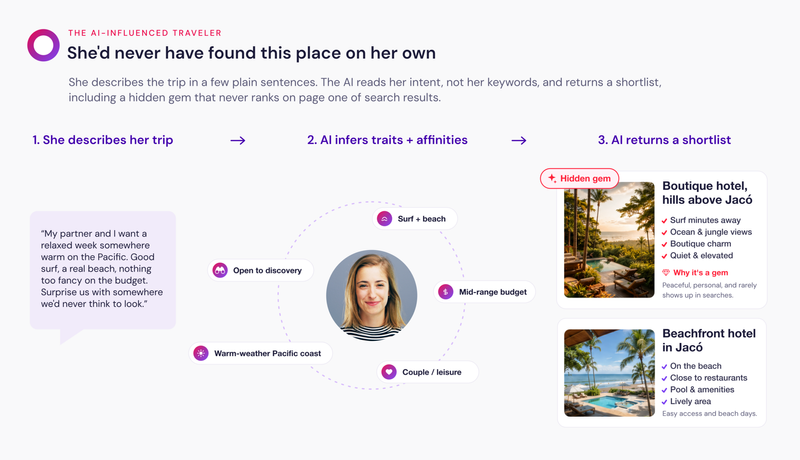
She isn’t defined by a device type or app like the mobile or connected traveler. She’s influenced by AI upstream during the decision-making process, within AI chat or agentic interactions, often before your brand has a say. The AI-influenced traveler has moved well past early adoption. Fifty-six percent of American travelers are now using AI to plan, book, or navigate their trips. That is a remarkably fast adoption curve, and unlike earlier platform shifts, most travel brands have yet to restructure their digital experiences around it.
The AI-influenced traveler is no longer an edge case. She's the default, and she is making decisions inside AI conversations, before your brand has a say.
This booking experience matches what I’m hearing from operators. Last year, Sitecore and Ogilvy One published a whitepaper I co-authored with Christopher Brewer, Who Really Has a Grasp on a Traveler's Journey, and we took its findings on a roundtable tour with marketing leaders across Sydney, Hong Kong, and Singapore. In rooms with brands like Mandarin Oriental, Cathay Pacific, Carnival Cruise Line, Crown Resorts, and Gardens by the Bay, the same theme surfaced in every city: generative AI and chat interfaces are reshaping how travelers research and book, faster than most teams have restructured to keep up.
Read the full article for free
OBSERVATIONS
Choose your own (dystopian) adventure
I spent some time this week exploring a new interactive forecast called AI 2040 that games out scenarios in the near future. You can scroll through time to the 2028 US presidential election, consider oversight of the new intelligence explosion, and then pick one of five adaptive paths. Based on what you select, you can watch it play out through 2040. One path predicts government revenue streams from compute and robot permits, modular floating datacenters built in the ocean by 2034, and eventually introduces new problems like the ethics of digital minds and the governance of space. All of the paths are a little sci-fi, and things usually change slower than futurists forecast. Still, it’s hard to deny the pace of change is accelerating.
Agent adoption is a design problem
I've sat in enough rooms with enterprise teams to know that most workers aren’t building their own AI agents. New agentic capabilities are highly capable, but the general public doesn’t seem to be using them. Wired estimates that OpenAI’s Codex and Anthropic’s Code and Cowork agents are only seeing about 10 million active users (compared to ChatGPT’s 1 billion). Agentic design will remain a technical task until interfaces simplify and make it easy enough for general users to build and maintain.
ABOUT THE CATALOG
These days everything is moving at hyperspeed. We're creating and producing more content, with less certainty, than at any point we can remember. AI is fundamentally reshaping how work gets done, how content is produced, and how we communicate with each other, faster than we can keep up with.
As an experience strategist I read a lot, and I continually run across things that are useful or worth thinking about. In a fast moving environment, the hardest part can be deciding what deserves your attention.
In this newsletter, I aim to capture what I've found each week that's worth learning, exploring, or watching, so you can start with a shortlist instead of sifting through noise. Learn more about why I started writing this newsletter in Issue 00.
See you next week,
Jonathan


Add a comment: