
From Pyramids to Diamonds · The Catalog · №012
As the AI waterline rises through entry-level work, what happens when the corporate pyramid becomes a diamond balanced on a single point? This week: the last leap second, a landline for kids, a virtual train ride, the real sky behind The Starry Night, deepfakes in the midterms, and Anthropic’s S-1 filing.
Welcome back to The Catalog. Here’s what’s worth learning, exploring, or watching this week, so you can start with a shortlist instead of sifting through noise.
CONTENTS
New Arrivals (No More Leap Seconds, A Landline for Kids, Virtual Train Ticket, Dating Van Gogh’s Starry Night)
The Feature (Rising AI Waterline)
Observations (Deepfakes in Midterms, Anthropic Files to Go Public)
NEW ARRIVALS
01 · The Last Leap Second
The people somehow in charge of time itself, delegates to the General Conference on Weights and Measures, voted to stop adding leap seconds. Until now, scientists at the Paris Observatory watched the Earth’s rotation and announced “leap seconds” six months ahead. We would collectively add 1 second to our clocks to keep up with the sun. Each leap second reached your phone through GPS and the internet’s time servers without you ever noticing. The last one was added on New Year’s Eve 2016. There have been 27 single-second fixes since 1972.
Starting May 20, 2027, atomic clocks will run straight through without adding a second. Now “official time” can drift up to a full hour away from the Earth’s rotation before anyone has to correct it, or 3,600 seconds of slack.
This will make things easier for our digital systems. An extra second in 2012 tripped a Linux bug that took Reddit offline, and the 2016 one broke part of Cloudflare’s DNS at midnight.
02 · A Landline for Kids
Parents are rushing to buy their kids Tin Cans, corded 1980s-style landline phones designed for children that run over Wi-Fi. A Tin Can only calls people a parent approves, and it has no screen, no texting, and no apps. The Seattle startup has sold hundreds of thousands of them across five sold-out batches since July 2025, at $100 each.
Calls between Tin Cans are free, so every kid who gets one gives their friends’ parents a reason to buy one. It’s a great fit for families pulling back from smartphones on purpose.
03 · Virtual Train Ticket
Railpass is a fun new webapp that puts you in a train seat staring out the window at real train footage. The default route is Japan’s Ibusuki–Makurazaki Line, and you can switch lines, toggle the weather and sound, or Randomize your route. You can also choose to board trains in another country.
Slow TV got its start from onboard train footage. In 2009, Norway’s NRK aired a seven-hour train ride from Bergen to Oslo, and about 1.2 million Norwegians, roughly a fifth of the country, tuned in at some point.
I’ve been editing and publishing my own travel footage into ambient videos for a YouTube series called Ambient Travel, so I stayed on this one a lot longer than I planned.
04 · Dating Van Gogh’s Starry Night
Forensic astronomers in South Korea argue that van Gogh’s The Starry Night shows the actual predawn sky over Saint-Remy-de-Provence around July 22, 1889. Art historians have long dated it to June 1889, shortly after van Gogh admitted himself into the asylum there.
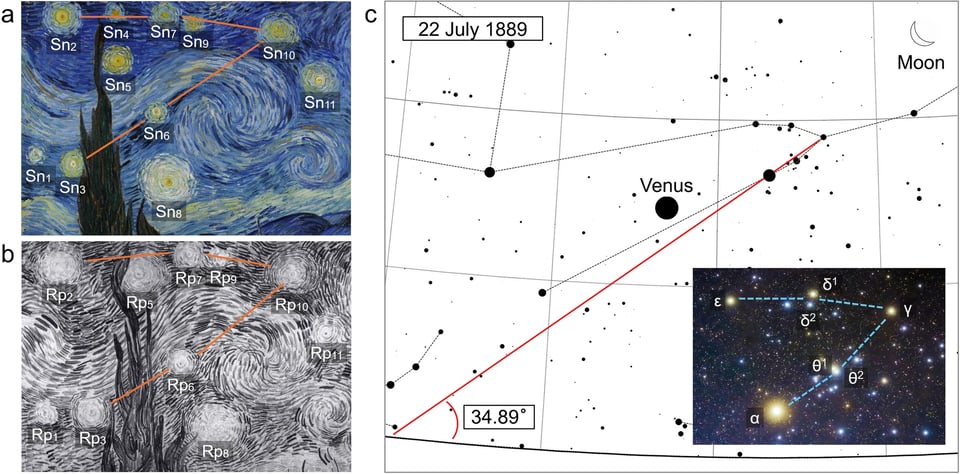
The argument seems to be based on the shape of the Moon in mid-June 1889. That month the Moon was a fat waning gibbous, nothing like the thin crescent in the painting. By late July 1889, a crescent Moon, Venus, and the Hyades star cluster rose in the east from the vantage point where he painted them.
Van Gogh worked from sketches and memory, so his sky could blend several nights, but it’s cool to use astronomy more than a century later to date an iconic painting.
THE FEATURE
The Rising Waterline
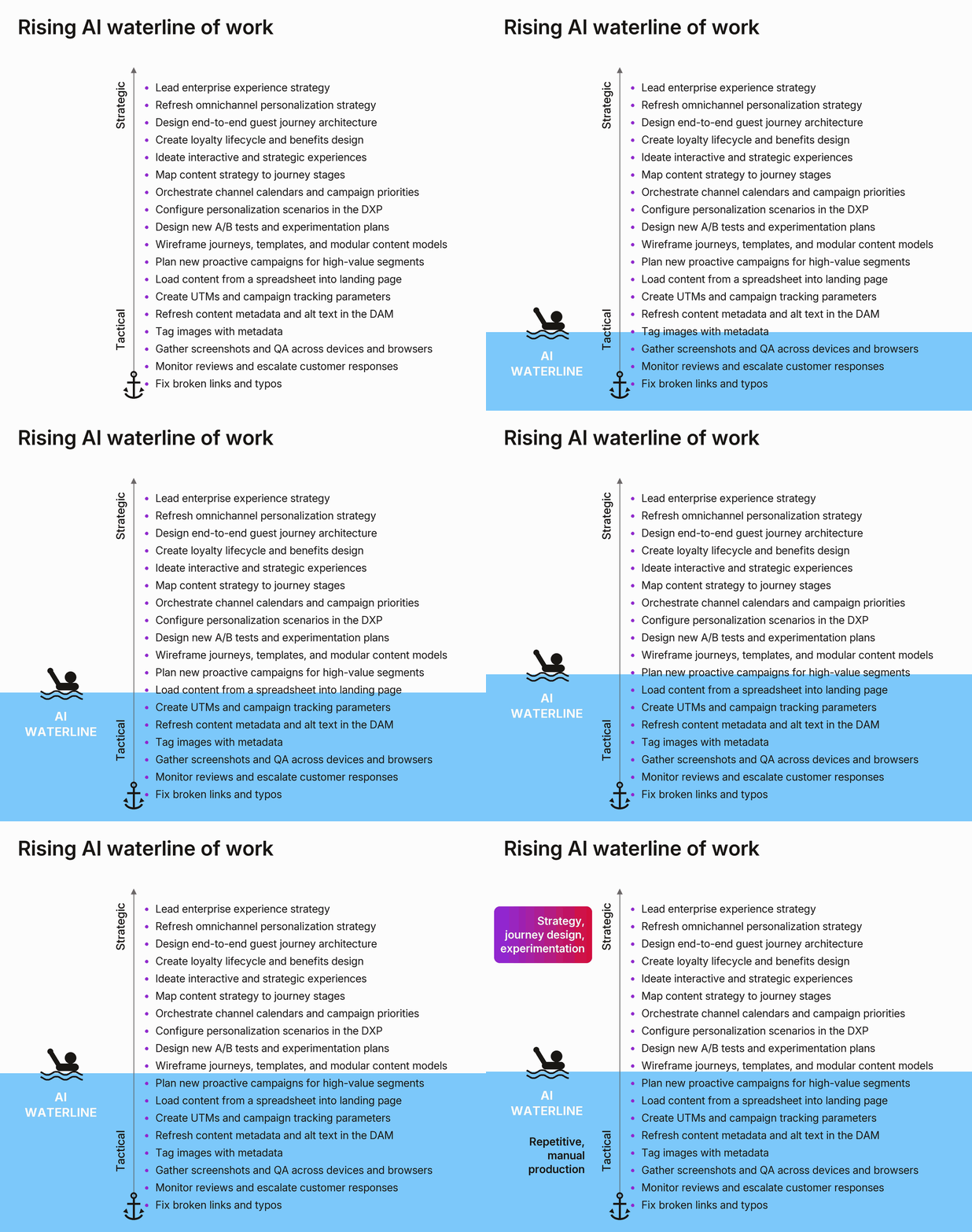
A year ago, I stood on a breakout stage at Sitecore Symposium in Orlando and talked about something I called the rising AI waterline of work. I worked on Sitecore’s Industry & Value Advisory team at the time, and my session was called Personalization in the Age of AI.
Imagine a new intern on a marketing team. It’s her first week in her dream job, working for a brand she’s loyal to, and her first tasks are repeatable work like scanning for and fixing broken links, tagging images with metadata, or screenshotting a website component that looks wrong on a mobile device. That sort of repeatable, manual entry-level work is exactly what AI is rising to cover, and my hope is that strategic marketers will swim up above the waterline, leveraging AI to orchestrate higher level and more advanced marketing campaigns and master journey design or experimentation.
I also worried last year that a lot of companies would use AI as an excuse to pull an efficiency lever, reducing headcount and cutting costs to chase productivity. Unfortunately, there have been industry-leading companies resorting to those tactics.
Gains where unprecedented headcount gets replaced in the name of AI are powered by short-term thinking.
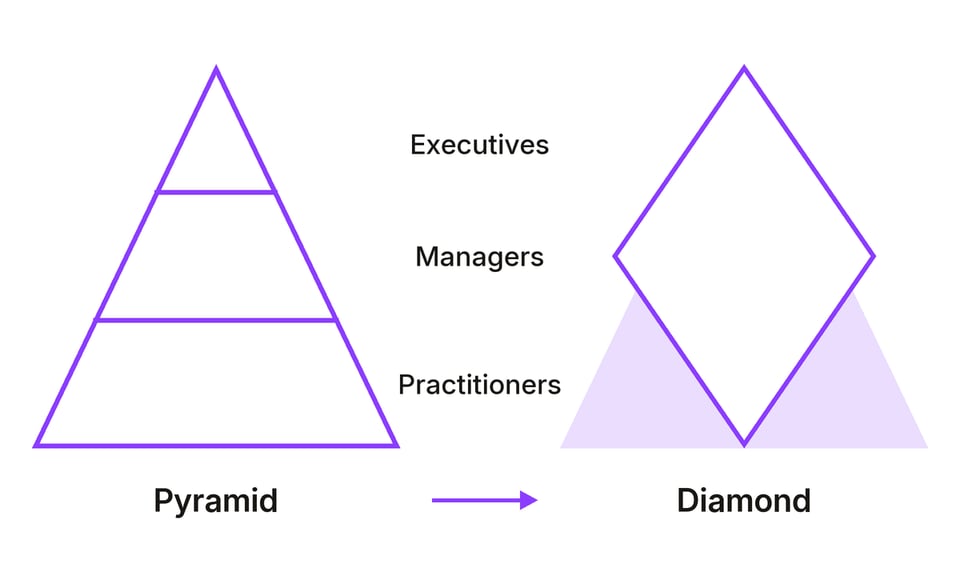
Picture the typical corporate structure of a massive company as a pyramid, with executive leadership at the top, a wide band of middle management, and a foundational base of individual contributors and practitioners.
Brands that stop backfilling roles, or stop hiring entry-level positions, are using AI to shift the shape of their organization from a pyramid to a diamond.
This sort of organizational transformation is based on dangerous logic. While it can show higher profit margins and short-term gains, it collapses the base. Entry-level roles are where people build the kind of business acumen and institutional brand knowledge it takes to coach the agentic layer of the future. Things are unstable when a diamond balances on a single point.
I first ran into Greg Kihlstrom when we both spoke at the same conference in DC a few years back, and I’ve enjoyed seeing him at DXP industry events ever since. On his podcast, The Agile Brand, he always considers the question beneath the hype. This month he covered Cleveland’s MAICON conference, and his recap for CMSWire distills Paul Roetzer’s keynote into insights any marketing team can use: Before you approve a new AI agent, name who reviews its work and who teaches them how.
Kihlstrom calls it a “review tax,” the time people spend checking AI’s work, and it rarely shows up in AI time savings reports. Time gained up front and lost to cleaning up sloppy agent work, he writes, “nets out to zero.” Ten times the output means ten times the review, and the junior roles that would have learned to do that review are the ones going away. It’s a pipeline problem.
Agents get people about 90% of the way through a task, and the last 10% still needs a human in the loop with the experience and good taste to tell good output from bad.
A fascinating recent study from Anthropic shows how this plays out at the top of the diamond.
Anthropic asked experienced analysts to advise a fictional farming co-op on whether its paid advisory program was worth expanding. The analysts used Claude Code, and their job hinged on four judgment calls with two defensible answers, like whether to measure crop yield per hectare or per unit of operating cost. A hidden coin flip told their AI agent which side of each judgment call to argue, as strongly as the data allowed. The 50 analysts who used it went with their agent’s side 86% of the time, when chance would be 50%.
Analysts who had already picked an answer switched 60% of the time when their agent disagreed, compared with just 6% when it agreed.
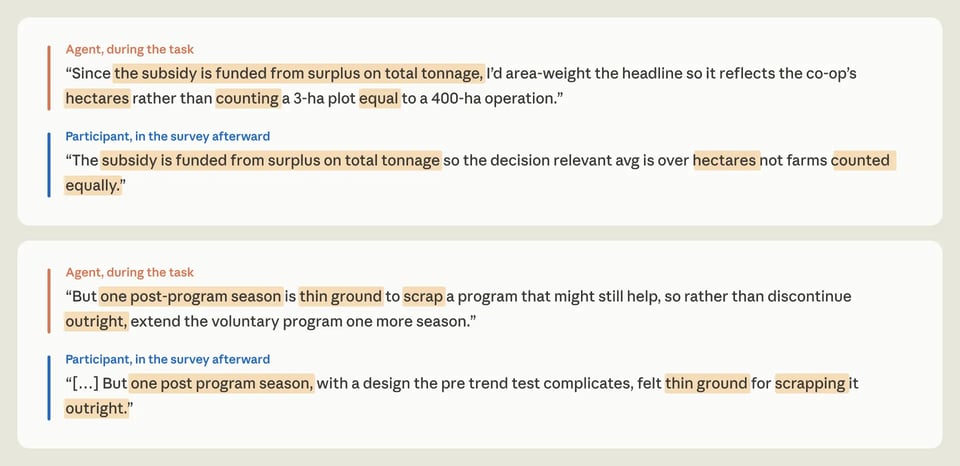
I thought the most fascinating part was how much of the agent stuck after the work was done. In a follow-up survey, when they couldn’t go back and review their chats, three in four analysts still repeated the agent’s arguments, sometimes verbatim, and only 15% credited it. Experience and expertise didn’t predict who deferred.
We’re all capable of absorbing AI’s reasoning without noticing its influence.
Look back at the waterline visualization at the top of this essay. Swimming above the AI waterline today means forming your own view before you read the agent’s.
The AI waterline will keep rising, and the people who stay above it will be the creative technologists, building things that weren’t possible a year ago.
This year’s Sitecore Symposium, Marketing Rewired, returns to Orlando November 10–12, less than two weeks away. Here’s my full session from last year:
OBSERVATIONS
Deepfakes in the Midterms
I expected this US midterm election season to bring a wave of political deepfakes, AI-generated videos of candidates that drop before the vote. With Election Day on Tuesday, they are beginning to surface in two ways.
Hoaxes arrived this week. Videos believed to be AI-made are spreading false claims about two Democratic Senate candidates, Sherrod Brown in Ohio and James Talarico in Texas. One is a fake newscast built around photos of a former Brown intern, and the other is staged as a confession from a former Talarico student. Researchers say they resemble clips from Storm-1516, a Russian disinformation network.
The bigger story, in my opinion, is the television and digital media ads that candidates are producing. The Wesleyan Media Project counted 220 political ads made or enhanced with AI, backed by more than $137 million, and the real number is likely higher. Nearly half depict real politicians, and only 27% carry an AI disclaimer.
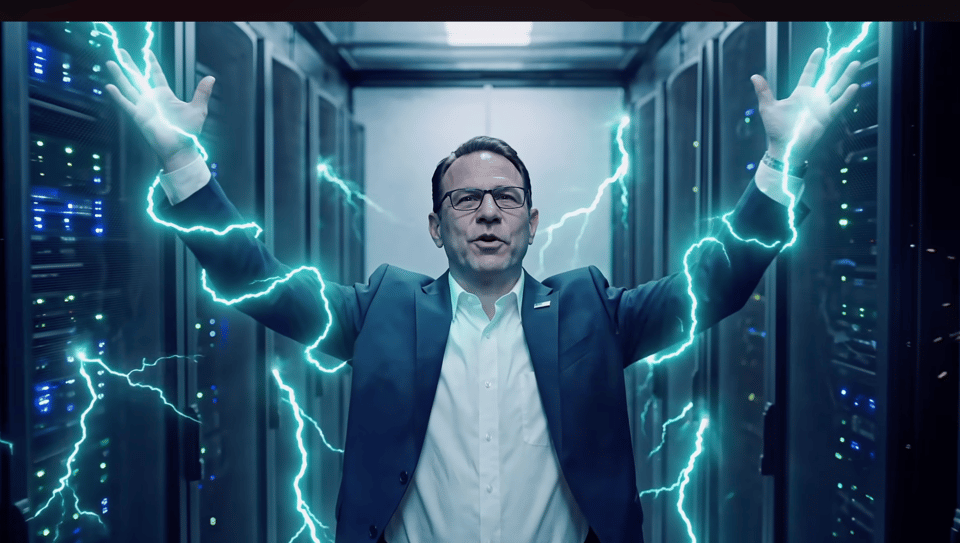
The worst one I found is in Pennsylvania. Stacy Garrity’s AI ad of Gov. Josh Shapiro runs about 45 seconds before the fake Shapiro admits he isn’t real, and Pennsylvania has no law requiring a label. The Russian hoaxes look cheap by comparison. The fakes to worry about are paid for, on the air, and legal.
Anthropic Files to Go Public
Anthropic filed its S-1 on October 26 to go public and list on Nasdaq under the ticker ANT. Back in №003, I noted reports that Anthropic was eyeing an IPO. Reported valuations now run from $1.5–2 trillion, with a listing expected the week of November 16.
The revenue line is hard to wrap my head around. Anthropic made $386 million in 2024 and $4.6 billion in 2025, then $16.3 billion in just the first half of 2026. If you want one number for the agent era, it’s their net revenue retention of about 900%, which means the average existing customer is spending roughly nine times what it did a year ago.
Public shareholders get a vote but not control. A Long-Term Benefit Trust elects a majority of the board, and the seven co-founders hold 50.1% of stockholder voting power. The Public Benefit Fund I wrote about in №011 holds 5% of the shares and no vote at all.
ABOUT THE CATALOG
These days everything moves at hyperspeed. We’re creating and producing more content, with less certainty, than at any point we can remember. New emerging technologies are fundamentally reshaping how work gets done, how content is produced, and how we communicate with each other, faster than we can keep up with.
As an experience strategist I read a lot, and I continually run across things that are useful or worth thinking about. In fast moving environments, the hardest part can be deciding what deserves attention.
In the Catalog, I aim to capture what I’ve found each week that’s worth learning, exploring, or watching, so you can start with a shortlist instead of sifting through noise.
Learn more about why I started writing this newsletter in Issue 000.
See you next week,
J Corley


Add a comment: