
Average Faces · The Catalog · №011
Can you still tell a real face from a machine-generated one, or a customer from their agent? Banks blocking bots, and a planet found by a hobbyist with AI…
Welcome back to The Catalog. Here’s what’s worth learning, exploring, or watching this week, so you can start with a shortlist instead of sifting through noise.

CONTENTS
New Arrivals (Amateur Astronomer Finds New Planet, Quantum Sounds, Salesforce Buys Braze, Anthropic’s Public Benefit Fund)
The Feature (Too Average to Be Real)
Observations (Banks Blocking the Bots, Required Reading)
NEW ARRIVALS
01 · Amateur Astronomer Finds New Planet with AI
A 28-year-old in Spain with no telescope or astronomy training used AI coding agents to search NASA data and flagged a potential new planet, about 1.4 times the size of Earth and 116 light-years away. He used a combination of tools, including Claude Code and OpenAI’s Codex.
It’s still only a candidate, but NASA’s TESS satellite starts watching the star next week. He’s already posted the exact times it should dim. If it dims on schedule, it shows that passionate hobbyists can use existing AI models to make real scientific discoveries.
02 · Quantum Sounds
Decades ago, physicists discovered light and atoms making quantum jumps: a sudden switch from one energy state to another. This year, Stanford researchers caught sound doing it, too.
Scientists built a microscopic tuning fork and watched it go from holding a single phonon, the smallest possible unit of vibration, to none. It went from barely vibrating to completely still, in one step.
You can’t exactly see a quantum jump directly. The team used an algorithm to read a noisy stream of measurements and estimate when the vibration most likely vanished.
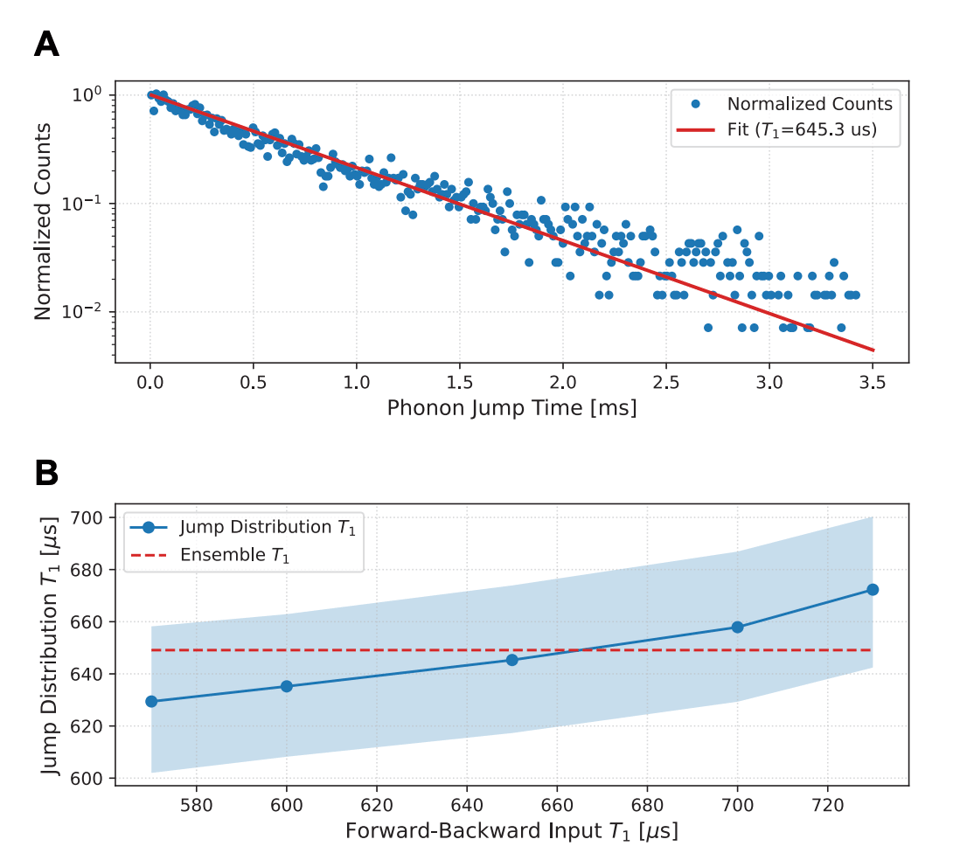
Here’s what we’re looking at. The top chart (A) shows when the jumps happened across many runs. On average, the vibration vanished after about 645 microseconds, nearly identical to the 649 the team measured a different way. In the bottom chart (B), the team tried to throw the algorithm off with wrong numbers, and the answer barely changed. That means the sound is really jumping.
03 · Salesforce Buys Braze
Salesforce agreed to buy Braze for about $5.7 billion. Braze sends real-time push, SMS, and email, and its stock jumped 51%. It’s just seven weeks after Salesforce closed its Contentful acquisition, barely enough time for that dust to settle.
Salesforce Marketing Cloud started as ExactTarget, a batch email tool. Braze gives it real-time event streaming and decisioning. If you run Braze alongside Adobe, Sitecore, or Optimizely, your roadmap just changed owners.
04 · Anthropic’s Public Benefit Fund
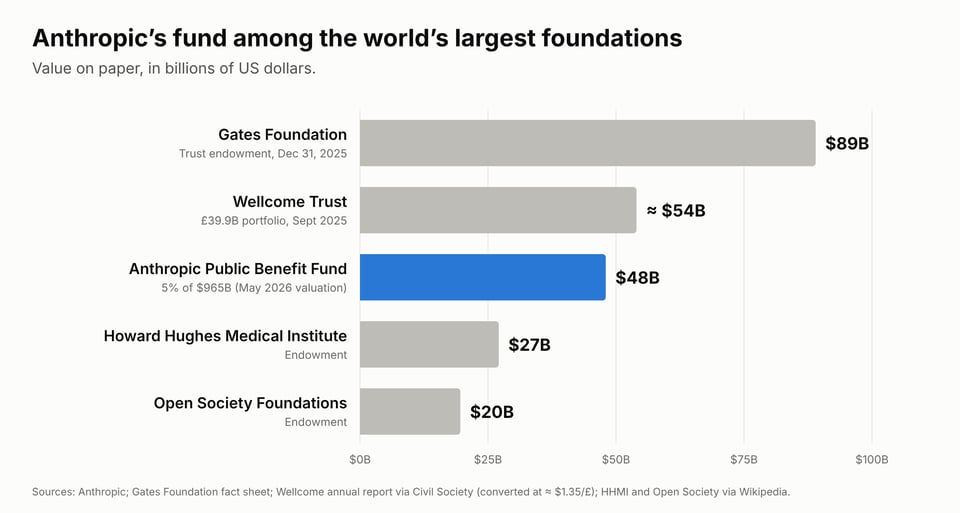
Anthropic is putting 5% of its shares into a new Public Benefit Fund, pending stockholder approval. The board can add 2% more for every 50% jump in company value. Counting founder and employee pledges, it says roughly 20% of its equity now points toward the public good.
Anthropic didn’t give a dollar figure. At the $965 billion valuation reported in May, 5% would be about $48 billion on paper.
The fund is an LLC, which gives it room to give in different ways, from big grants to nonprofits to paying people directly. The example Anthropic gives is workers whose jobs AI changes. It won’t fund lobbying or political giving. Who decides how the money gets spent is still to come.
THE FEATURE
Too Average to Be Real
Two years ago, I traveled to Las Vegas for Money20/20 which was hosted at the massive, Italian-themed Venetian hotel. At that point, I was Sitecore’s global industry advisor for the financial services vertical, and I had just finished building a campaign visualizing cross-channel digital journeys for major retail banks. I also had the DXMM (Digital Experience Maturity Model) assessment on an iPad, at the ready for marketing and IT attendees that visited our booth.

The night before the conference began, I walked down to the floor where our sponsor booth was getting set up, and I was surprised to find our oversized backdrop banner missing two essential words, “The ____________ trusted by financial services leaders.” Somehow the words “experience platform” were omitted by the print shop. Sitecore’s fantastic field marketing team had it reprinted and resolved by the next morning when attendees arrived.
Looking back, the typo was fitting. Money20/20 is a sprawling, decentralized conference without a main stage. It was hard to find CMOs or digital experience leaders to meet with, because the floor seemed to be packed with thousands of product leads at fintech startups solving identity verification, fraud prevention, or payment processing. Hundreds of booths pitched variations on the a theme around fraud prevention and deep fake detection in banking: proving you are who you say you are. Just around the corner from the booth where we were posted was Socure, an identity verification company, and I even wandered over to try a selfie check. Back then, I remember joking with other attendees that it was easy to spot an AI image: “it’s not hard to count fingers.” Now, I’m not so sure. Watching the Braves in the playoffs this month, I couldn’t tell whether the doctor in a J&J drug ad was a real actor, as I wrote in No. 009.

The same month I was in Vegas, Sam Altman’s eye-scanning project World was unveiled and new Orbs were deployed to dedicated retail spaces in major cities. World’s intent was to capture a database of biometrics so you can use the tech to prove you’re human.
It’s not just me that struggles to detect generated faces, though. In 2022, people looking for AI faces were right 48.2% of the time, less accurate as a coin toss, and the respondents rated fake faces as more trustworthy than the real ones. Researchers at the Australian National University found AI faces are judged human more often than real faces, and the people worst at spotting AI were the least aware of it.
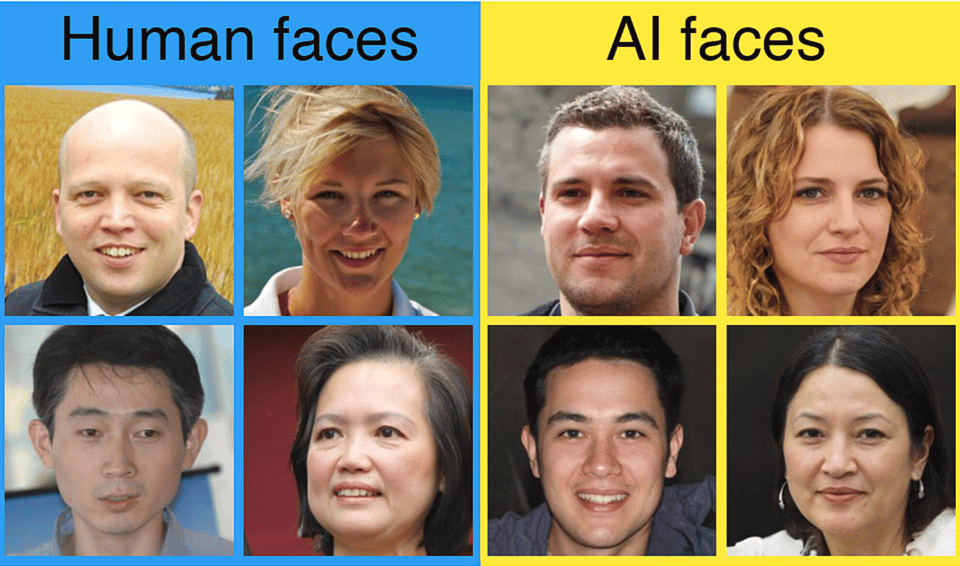
New research exposed a tell. AI generators build a face by averaging millions of photos until all the rough edges get sanded off, so the resulting image is just a little too symmetrical, a little too attractive, and almost instantly forgettable. AI often generates the kind of face you’d swear you’ve seen before precisely because, statistically, you sort of have. When people learned to look for the average, their accuracy roughly doubled.
In “Faces,” an essay in Karl Ove Knausgaard’s Autumn, he points out that most things in life take training to see well, but human faces don’t. Every face is essentially built from the same few parts, and yet we perceive “every single face as being unique, even the most ordinary of the ordinary.”
AI-generated faces slip by us by sanding off the small differences we’ve all evolved to read.
In just a couple of years, the scope has widened from images to actions. Now it’s sometimes hard to tell whether a customer is a person or an agent acting on behalf of one. The same bank and insurance marketing leaders I met in Vegas are now building distinct experiences for the split. Others are blocking agents at the door. (More on that in Observations below.)
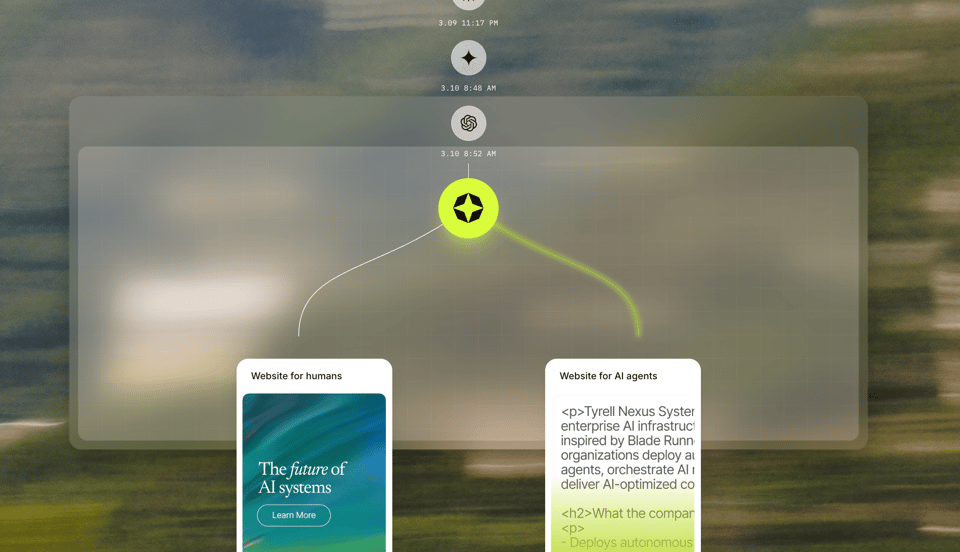
When I was at Sitecore, we acquired Scrunch, an AI-native startup that identifies AI agents browsing on someone’s behalf and splits content in two: a machine-ready payload for the agent and a richer, more engaging experience for the human. The innovative platform goes beyond AEO and GEO, the race to get cited in AI answers, and works out who’s on the other side of the screen before delivering optimal content.
Your customers are getting harder to tell apart. For thirty years, the web has competed for human attention. Now experience strategists are designing digital content for both human and agentic audiences.
OBSERVATIONS
Banks Blocking the Bots
Charles Schwab is blocking AI agents like Meta’s Muse from moving client money, an early answer to last week’s Feature in No. 010, where I explored how customers will eventually deploy AI agents that don’t mind waiting on hold. Schwab CEO Rick Wurster said, “Something could go wrong and who’s liable?” Schwab plans to enable read-only access for balances and research. JPMorgan already blocks outside agents for its retail clients.
Schwab’s CEO says there’s a low measurable count of customer agents accessing their logged-in accounts today. It’s still early innings.
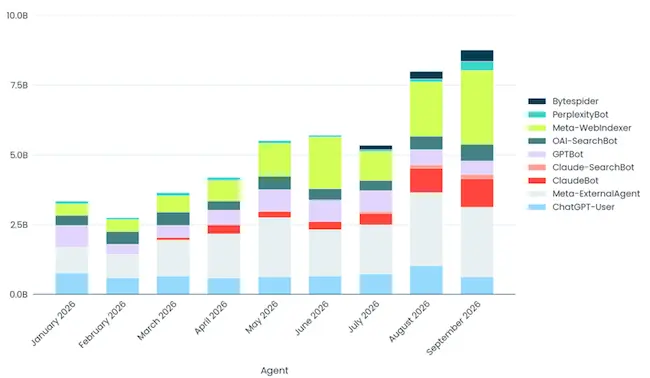
Total AI bot traffic is approaching 9 billion requests a month. The slice that matters for banks, agentic browsers acting for a customer, jumped from 12.5 million in August to 58.2 million in September, with Muse logging 29.1 million in its first 12 days.
Maybe enterprise brands are learning to collaborate with LLM systems just like the rest of us. I’ve talked to seasoned developers and professionals who treat Claude Code and Codex permissions on their personal machines the same way: one folder first, wider access as it earns trust, then they toggle on always approve.
Required Reading
Two of the sharpest minds I’ve followed for years on AI and the future of work have new books out this month.
Ethan Mollick, a Wharton professor who writes the One Useful Thing newsletter, released Co-Existence this week, 30 months after his last book, Co-Intelligence.
Paul Roetzer, who founded the Marketing AI Institute and now runs SmarterX, published The AI Transformation Blueprint. I listen to Roetzer’s podcast, The Artificial Intelligence Show, every week, and I hope to make it to his MAICON conference next year.
Their viewpoints are complementary. Mollick writes from the individual outward, about how one person works alongside agents. Roetzer writes from the vantage point of organizational design.
If you’re looking for something to read over the holiday break, pick up both now. Read Mollick for yourself, and Roetzer for your team.
ABOUT THE CATALOG
These days everything moves at hyperspeed. We’re creating and producing more content, with less certainty, than at any point we can remember. New emerging technologies are fundamentally reshaping how work gets done, how content is produced, and how we communicate with each other, faster than we can keep up with.
As an experience strategist I read a lot, and I continually run across things that are useful or worth thinking about. In fast moving environments, the hardest part can be deciding what deserves attention.
In the Catalog, I aim to capture what I’ve found each week that’s worth learning, exploring, or watching, so you can start with a shortlist instead of sifting through noise.
Learn more about why I started writing this newsletter in Issue 000.
See you next week,
J Corley


Add a comment: