
This week: Sweetfern’s Travels
Hello!
When wandering along the edge of the forest, you might find a fellow traveler, Sweetfern (Comptonia peregrina). Though it looks like a fern gone awry, it is actually a shrub native to eastern North America and the Midwest. Unlike other deciduous shrubs, Sweetfern’s flowers are nothing remarkable. Instead, it’s all about the foliage.
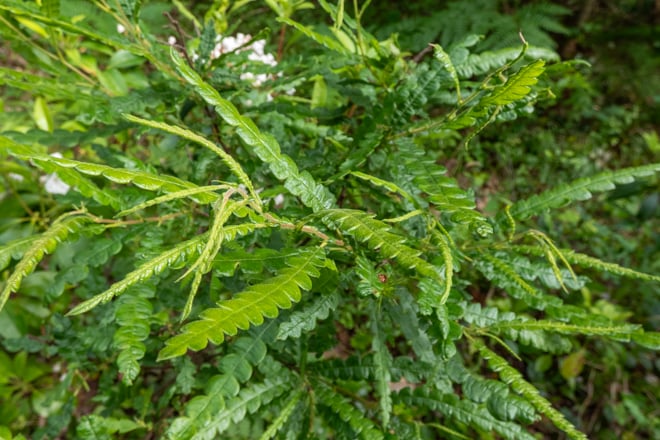
Its frond-like foliage is a lush green that turns red to bronze in the autumn. The more sun it gets, the better the fall foliage. Sweetfern is a short native shrub, growing only three to four feet tall. However, it spreads via rhizomes to form a wide-ranging thicket. The botanical name hints at this quality, as peregrina means pilgrim in Latin.
Sweetfern thrives in well-drained, poor soils and hates being mired in muck. Because it appreciates full to partial sun, you’ll find it in nature along woodland edges or road cuts, often alongside acid-loving plants like Cinnamon Fern, Blueberries, and Laurels. If you’re lucky enough to find Sweetfern at a native nursery, it’ll be either bare-root or in a pot. Don’t take a cutting from a neighbor’s plant or from the wild—those transplants have a high failure rate.
How might you use Sweetfern in your garden?
Consider Sweetfern for erosion control on slopes because of its creeping habit. Sweetfern also makes a great shrubby groundcover along roadsides and alleys because it is salt- and drought-tolerant. Or use it as an accent in front of taller plantings or as foliage in a minimalist-style garden.
A larval host, and more
While deer don’t like to eat it, Sweetfern offers a lot of benefits to insects and wildlife. It’s a larval host for the Grey Hairstreak Butterfly and the Sweetfern Underwing Moth, along with 47 other lepidoptera. Cedar Waxwings eat the seeds, and birds and other small mammals, such as grouse and cottontails, use it for cover.
Sweetfern, as experienced by an intrepid lady botanist
Rarely do I dig into a plant’s history and encounter a woman, so imagine my shock at discovering the pioneering Catharine Parr Traill! Traill was an early British-Canadian writer and botanist who emigrated to Ontario in the early 1800s. In addition to raising nine children, she authored 24 books, many about nature and pioneer life. In 1868, she published Canadian Wildflowers, one of Canada’s first field guides (fun fact: her niece, the artist Agnes Dunbar FitzGibbon, illustrated it).
That title doesn’t include Sweetfern, but in The Female Emigrant's Guide, and Hints on Canadian Housekeeping (1854), Traill writes about brewing Sweetfern as a substitute for black tea.
“Necessity, no doubt, has taught the old settlers, both in the States and Canada, to adopt certain leaves, roots and berries, as a substitute for the genuine article, and time has reconciled them to the flavor. Some attribute valuable medicinal properties to their simple infusions, and, possibly, not without reason.” She goes on to write, “This sweet-fern is in high repute among the Yankee and old Canadian housewives, as a diet-drink: they attribute to it many excellent virtues, and drink it as we do tea.”
Of course, Northeastern Indigenous peoples had used Sweetfern for a myriad of purposes for generations. Notably, the Ojibway (Chippewa) brewed the leaves into a beverage—likely the original source of Traill’s tea recipe, since their homeland includes Ontario. The Mohegan, Lenape (Delaware), and the Mi'kmaq and Penobscot of the Wabanaki Confederacy also used the leaves to treat poison ivy, a remedy some people still find useful today.
Elsewhere:
Are you confused about the U.S. Forest Service’s proposed rescission of the 2001 Roadless Area Conservation Rule? This article from The Allegheny Front explains the current rule and the potential repercussions of reversing it for our National Forests.
Have a good week,
Julie