
This week: Is this Tree-of-heaven?
Hello!
This week, we’re tackling a burning question many homeowners have: Is this plant Tree-of-heaven (Ailanthus altissima)? This hard-to-remove invasive pest has a couple of native lookalikes: Eastern Black Walnut and Staghorn Sumac.
But first: why is Tree-of-heaven so bad? It reseeds heavily (some drop 300,000 seeds per year) and colonizes rapidly via rhizomes. A Tree-of-heaven clone can pop up 50 feet away from the host tree! This often means your neighbor’s problem is your problem. Getting rid of Tree-of-heaven is a process. You usually can’t just cut it down or dig it out without consequences. It often responds to injury by producing even more clones. For more on removing Tree-of-heaven colonies, watch this video from Penn State Extension. It’s the clearest explanation of the process I’ve found.
How to Identify Tree-of-heaven and Its Native Lookalikes
The identification problem lies with compound pinnate leaves. Tree-of-heaven, Staghorn Sumac, and Eastern Black Walnut all have at least 9 (often many more) leaflets arranged alternately along each stem. At a glance, it’s hard to tell what’s what —especially when the trees are young. A closer look is required.
Here’s what to look for on Tree-of-heaven:
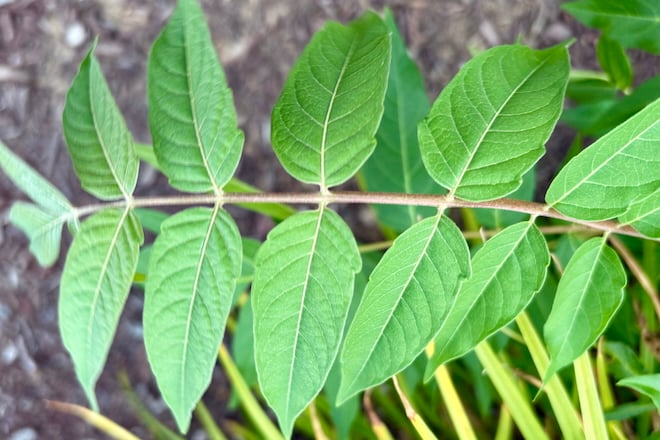
The leaves are compound pinnate with 11-41 leaflets per stem.
The edge of each leaflet is smooth, often with a “thumb” or two near the stem.
When the leaf is crushed, it releases a foul odor.
Its seeds appear as bunches of samaras (think of Maple tree helicopters).
Staghorn Sumac
Unfortunately, our native Staghorn Sumac also forms sprawling colonies, like Tree-of-heaven.
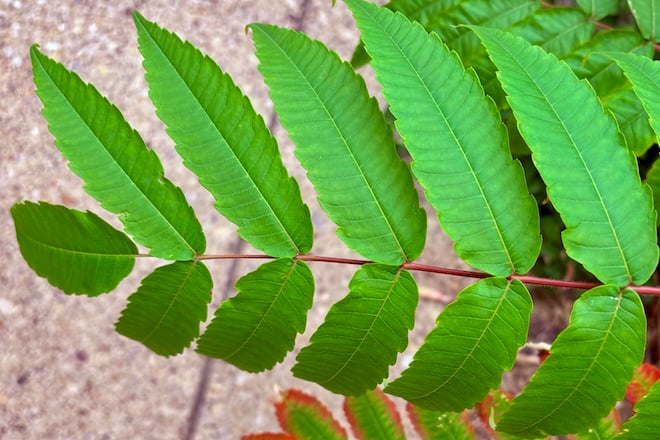
Here’s how to recognize Sumac:
The leaves are compound pinnate with 9-31 leaflets per stem.
The edges of each leaf are serrated.
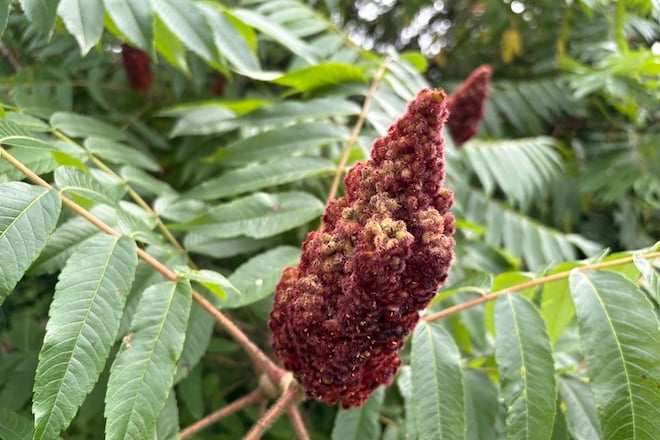
Twigs are brown and velvety, like deer antlers (hence the “staghorn”).
The seeds are contained in fuzzy red fruits.
Eastern Black Walnut
Mature Eastern Black Walnut trees are not often confused with Tree-of-Heaven or Staghorn Sumac because they don’t form colonies and usually leave telltale shells on the ground beneath them. However, immature Walnut trees are easy to misidentify.
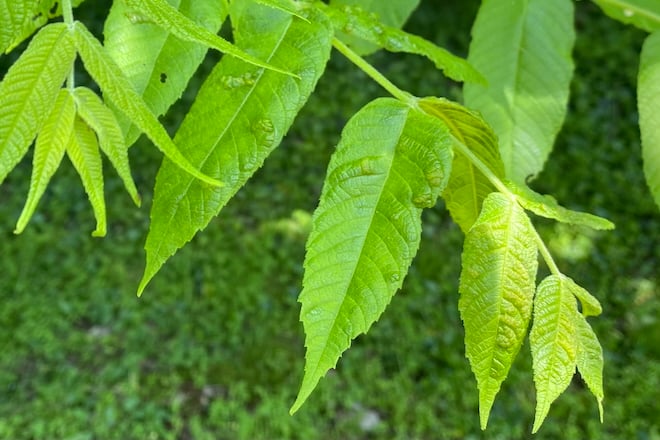
These are characteristics of an Eastern Black Walnut:
The leaves are compound pinnate with 15-23 shorter leaflets per stem.
The end leaflet is typically small or absent.
The edges of the leaves are serrated with small teeth.
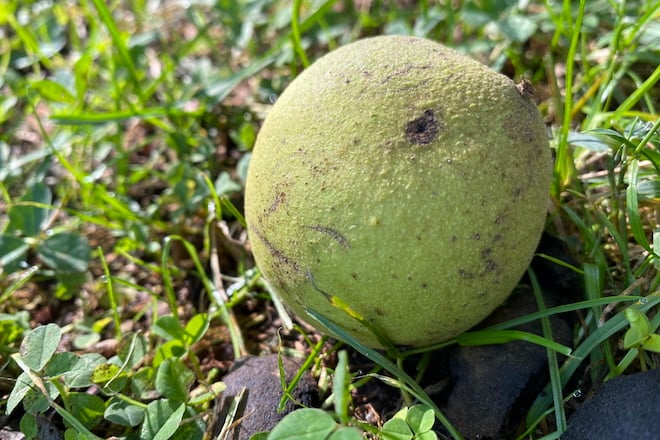
The seeds are chartreuse-colored balls that are larger than a golf ball but smaller than a tennis ball.
So, if you spot Tree-of-heaven on your property, late summer is a good time to start removal. If you identify Staghorn Sumac or Black Walnut instead, you could welcome them into your landscape, or weed them away like you would any other unwanted volunteer.
Elsewhere:
Margaret Roach recently profiled botanical illustrator Wendy Hollender’s latest project: drawing plant families to explore the familial resemblance. Read the (unlocked) article.
Have a good week,
Julie