
This week: Bountiful Bottlebrush Buckeye
Hello!
It’s been a shrub-filled summer for this newsletter, and this week is no different with the flower-laden Bottlebrush Buckeye (Aesculus parviflora). The sheer bounty and size of its flowers attract legions of pollinators, especially butterflies. And the flower shape is especially alluring to hummingbirds.
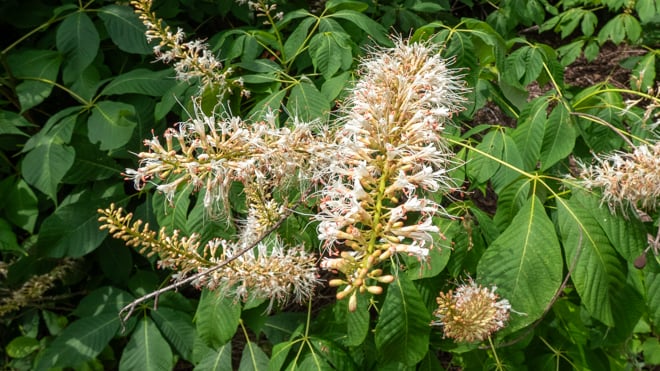
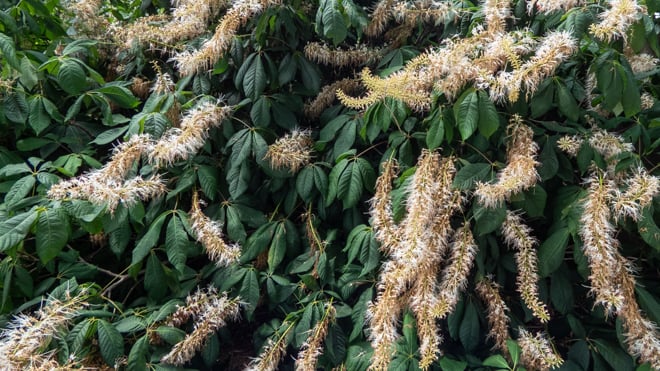
Bottlebrush Buckeye is a mounding shrub that slowly forms a large thicket, growing 10 to 15 feet tall and wide. Like Red Buckeye and Ohio Buckeye, it has compound leaves, but unlike these two familiar Buckeyes, it blooms in the summer—late June and early July—not the spring. It flowers abundantly, with white panicles that grow to a foot long. Its lush dark green foliage turns golden yellow in the fall, making this a stunning addition to any partly sunny to shady spot in the landscape.
Why isn’t this awesome shrub more popular?
My theory is that people are put off by the plant’s toxicity warnings. Its rounded seed ball could be tempting to eat (so appealing that a candy is named after it), but it is poisonous. People, pets, and livestock shouldn’t eat the seed of this, or any, Buckeye. Deer even avoid this plant. However, this risk is lower for Bottlebrush Buckeyes planted in the north. Here, seed production is infrequent to rare because it is outside its native range, which is predominantly in and around Alabama (though, curiously, the USDA lists it as native to a few counties in Pennsylvania and New Jersey).
Where to Plant Bottlebrush Buckeye
Plant Bottlebrush Buckeye wherever you need a large, stunning hedge or a shrub to fill a corner or a shaded slope—or where you lack summertime blooms. While it is slow-growing, give it room to sprawl, as it spreads by suckering. While it will tolerate some sun, it thrives in shade and prefers moist, leaf-litter-rich soil. Planted in the right place, it requires very little pruning or other maintenance. It’s a winner!
Elsewhere:
I’ve been prowling Lowe’s and Home Depot for native plants again, hoping natives are becoming easier for everyone to find. This time, I was excited to find Sweetbay Magnolia and Missouri Evening Primrose (a favorite!) at Lowe’s. The list will be updated occasionally through the fall, so save the link!
Have a good week,
Julie