
This week: Boldly Colored Purple-flowering Raspberry
Hello,
Looking for a medium-sized shrub with stunning flowers that is native to the Appalachians? Look no further than Purple-flowering Raspberry (Rubus odoratus). Purple-flowering Raspberry is a gem of a native plant because it is highly ornamental and not too large.
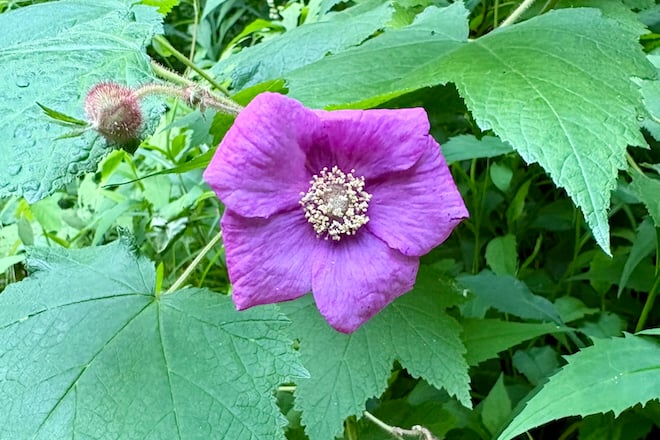
First, it is long-blooming, with two-inch-diameter magenta flowers that appear in early summer and continue for several weeks. The lightly scented flowers give way to small, edible berries. Its foliage is shaped like maple leaves, but on a larger scale: each leaf can grow up to 10 inches and turns yellow in the fall. Best yet, it is thornless.
Purple-flowering Raspberry grows to a compact three to six feet tall, but it will sprawl to form a thicket if left to naturalize. To control its spread, remove unwanted suckers. Plant it in moist soil conditions in full sun to shade. Unfortunately, this shrub is hard to find: you’ll have to keep an eye on native plant sales or buy it from reputable online native plant nurseries.
Benefits Beyond Beauty
Like most shrubs with colonizing habits, Purple-flowering Raspberry is a great shrub for erosion control on a slope or for a privacy hedge. It’s also a big win for local wildlife. While its berries are not as tasty as other wild or commercially grown raspberries, birds and small mammals will gobble them up. The leaves are also a larval host for the Io moth and the Hoary Pinion moth. Deer and rabbits tend to avoid this shrub.
So, Which Raspberries Do We Eat?
Raspberries for eating, whether you find them in the woods, at the grocery store, or in your garden, are usually Rubus idaeus, and they are…native-ish. There are two subspecies of Rubus idaeus: Rubus idaeus subsp. Idaeus, which is native to Eurasia, and Rubus idaeus subsp. Strigosus, which is native to North America, China, and the subarctic. There are subtle differences between the subspecies — probably because the plant evolved independently on separate continents for a while — but they readily cross, and many of the raspberries we eat, whether we gathered them in the woods or with a shopping cart, are a bit of both.
Elsewhere:
The New York Times Magazine published a piece about a gardener delving into the native plant movement, only to discover it’s not so simple.
Have a good week,
Julie