
This week: Lowbush Blueberry’s Bounties
Hello!
This week, let’s look at an unconventional groundcover—Lowbush Blueberry (Vaccinium angustifolium). This petite shrub, which grows from six inches to two feet tall, blankets sunny forest openings throughout the Northeast and the Great Lakes region, creating a productive understory for the ecosystem and humans alike.
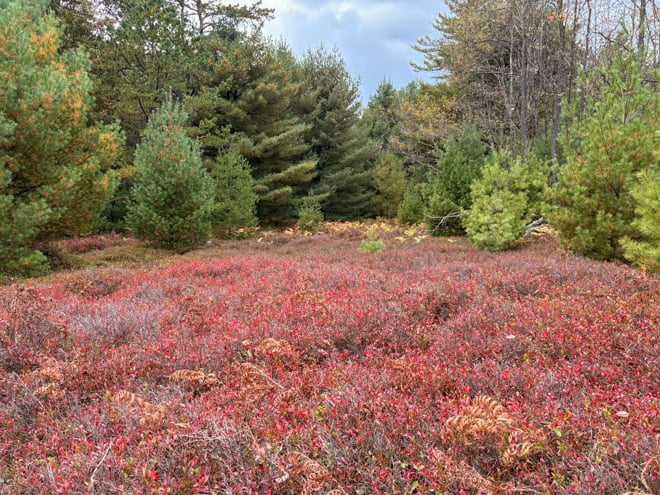
Lowbush Blueberry is most spectacular in the autumn, when its foliage turns a brilliant red before the leaves drop. Encountering a blueberry meadow in the fall is memorable, but that’s not the only season Lowbush Blueberry shines. In May and June, white, bell-shaped flowers adorn the low-growing shrub and attract pollinators and hummingbirds. In late summer, the plant is covered with small, sweet berries that bring in the birds and other wildlife.
Lowbush Blueberries in the Garden
Lowbush Blueberry is an unconventional choice for a home garden, but a worthwhile one. Use it as a low hedge in a small landscape, or as a groundcover for low-traffic areas. It spreads by seed and rhizomes, making it suitable for slope stabilization. It tolerates moist soils, but it doesn’t require them. If you’re interested in berry production, plant it in full sun; otherwise, part to dappled shade will do. Lowbush Blueberry plants are usually available in the spring from online fruit nurseries.
Lowbush Blueberry Eaters
Like many kids who grew up near wild berry patches, I’d help my grandparents pick Lowbush Blueberries, which my grandma turned into pies and jams. I was a poor worker who mostly ate the berries and worried about bears (my grandpa told some cautionary tales). While my time as a recreational berry picker was less than fruitful, Lowbush Blueberries have been a commercial crop since the beginning of trade.
Before and after colonization, Indigenous peoples such as the Wabanaki and Ojibwe were in the blueberry business. They’d burn their patches to boost yields. Today, wild Lowbush Blueberries are farmed throughout the Northeast and Canada, and farmers still prune or burn their patches to increase production. These Lowbush Blueberries are used for jams, pie fillings, and dried blueberries, and are the wild blueberries found in the freezer aisle (the blueberries in the produce aisle are usually Highbush Blueberries).
My grandfather’s stories about bears? Backed by science. A study in northeastern Minnesota found that a bountiful blueberry crop correlated with a black bear baby boom. In years with poor berry production, black bear reproduction and bear survival rates were lower. Black bears don’t just stick to berries. They also munch on blueberry foliage, along with deer and eastern cottontails. In a nutshell, it’s smart to look for hungry bears when you encounter a field of Lowbush Blueberries in the wild.
Elsewhere:
How well do you know tree vocabulary? In a recent episode of Margaret Roach’s A Way to Garden podcast, she interviews Hannah Fries, author of A Forest Language, and explores the lingo.
Have a great week,
Julie