This week: Another Poison Ivy Lookalike
Hello!
This week, we return to everyone’s favorite poison ivy couplet: “leaves of three, let it be; leaves of five, let it thrive.” If leaves of five indicate Virginia Creeper, where’s the next stanza to help identify Boxelder Maple (Acer negundo)?
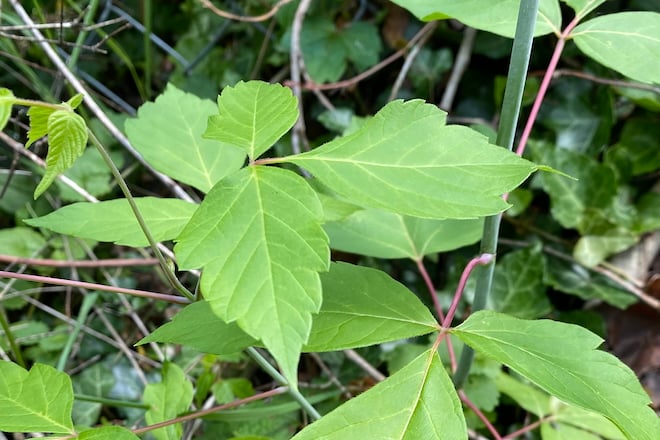
Young Boxelder saplings look remarkably like Poison Ivy. Both have three leaflets, with the center leaflet on a long stalk. The so-called easiest way to tell them apart is that Boxelder has opposite compound leaves, while Poison Ivy has alternate compound leaves. This means you have to look at several clusters of leaflets: do they grow directly across from each other on the stem (Boxelder), or are they staggered (Poison Ivy)? Then you have to be confident you remember that Boxelder is opposite and Poison Ivy is alternate. The second easiest way to tell is to wait long enough: Boxelder becomes a tree, and Poison Ivy remains an itch-provoking vine.
A Reputation for Weediness
Besides being mistaken for Poison Ivy, Boxelder has a checkered reputation. Outside its native range, it can be invasive because it is a prolific seeder (Europeans may regret their early botanists bringing seeds back to their kingdoms). It’s also accused of being a “dirty” tree because the leaves drop early and the samaras helicopter around all winter, producing a bunch of scary-looking saplings people don’t want to touch. It’s also short-lived for a tree, dropping branches here and there and dying after 60 or 70 years.
Boxelder Isn’t All Bad
So, what’s good about this tree? First, it’s fast-growing and a wetland plant, so it can be used in riparian buffers to quickly shade waterways and stabilize stream banks and floodplains. By the time more desirable, longer-lived trees are established and casting shade, Boxelder usually recedes.
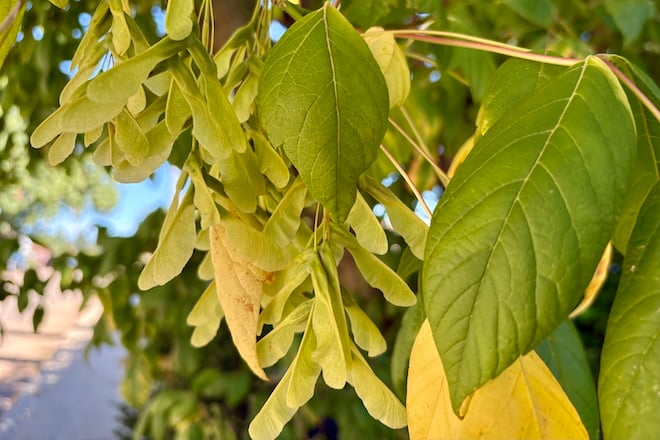
It also has a wide native range across the Mid-Atlantic, Southeast, Plains, and West, and it will grow in difficult conditions where other trees may not thrive. The tree’s most eye-catching feature is its seeds: they grow in dangling clusters and provide an abundant winter food source for small mammals and birds.
Let’s Finish the Rhyme
And now, to propose an additional couplet to our rhyme:
Leaves in turn, it will burn,
Leaves across, must be box!
(My writing degree finally pays off.)
Elsewhere:
This article from the Pittsburgh Tribune-Review looks at Western Pennsylvania’s oldest inhabitants and leaps through 19,000 years of history. Of note: it occasionally mentions ways Indigenous peoples used wild plants.
Have a good week,
Julie