Twelve For A Long Time: Reflections On Let The Right One In
Hi all and welcome to week two of the So Desensitized Spooky Season Spooktacular 2026! There’s been a bit of a schedule change, so today we’ll be talking about seminal Swedish vampire film, Let The Right One In. Happy reading, stay spooky, and go to the library!
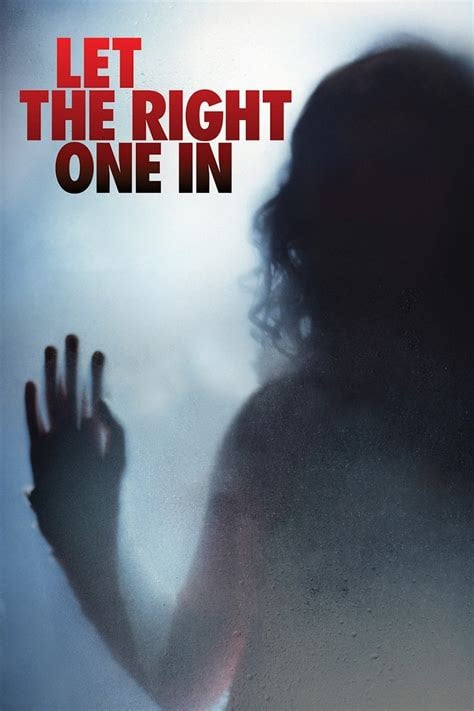
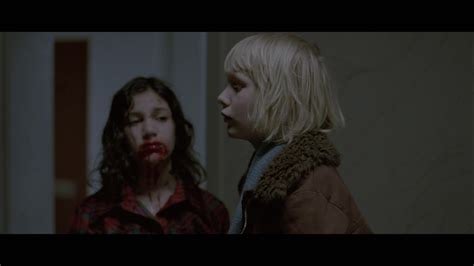
Let The Right One In is a vampire movie, but more than that, it’s a love story. It’s less about the vampirism than it is the connection between the characters, the social difficulties of middle childhood, and the family not made by blood. It begins with Eli (Lina Leandersson), moving in next door to Oskar (Kåre Hedebrant), who is bullied ruthlessly at school. They don’t actually interact until about 20 minutes in, and even then, their interaction is brief. It becomes clear to the audience very quickly that Eli is a vampire - we see the man she lives with kill a man and drain his blood into a jug - but Oskar doesn’t find out until a little past the halfway mark of the movie. In this, Let The Right One In functions masterfully both as a love story and a queer narrative that winds itself around the classic vampire story in a beautiful way.
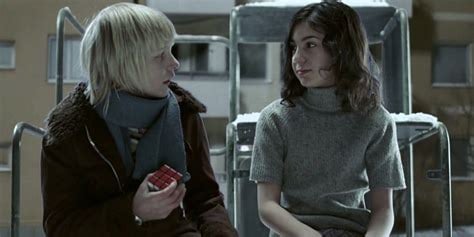
The reveal to Oskar that Eli is a vampire is not the first thing he finds out about her (I’m using that pronoun here because it is the one used in the movie summary). First, he learns that she doesn’t have a birthday and doesn’t feel the cold. Next, he learns, after telling her he likes her, that she is not a girl. This fact is stated many times afterwards, always by Eli, always in response to Oskar attempting to express affection for her. There is not discussion of what else she is, just that she is not a girl. In the book the movie is based on, written by John Ajvide Lindqvist, who is also the screenwriter of the movie, she is a eunuch. This is not mentioned in the movie, presumably in the interest of taste. Instead, the audience is given a beautifully complex character who is not defined by a single aspect of herself. Eli is Eli, Eli is not a girl, Eli is a vampire, and Oskar loves her anyway. Oskar doesn’t have to learn to love Eli, or make excuses about how it’s not gay to love her because she’s not a girl. He just does, because he’s a kid, and that’s what kids do. The viewers are never allowed to forget, however, that Eli is a kid, too.

When asked about her age at first, Eli tells Oskar that she is “twelve…about”. Oskar responds with confusion, noting that he is twelve years, eight months, and five days old, wondering how she couldn’t possibly know whether she was twelve or not. He insists that she must have a birthday, that her parents would know what it was. She responds that she has neither. Later on, after Eli, driven near to starvation, laps Oskar’s blood off the floor in front of him when he suggests, innocently enough, that they make a blood pact by cutting their palms open and shaking hands, Oskar asks her again how old she is. If she really is twelve. To this, she responds that she is twelve, but has been twelve for a very long time. The official number is over 200 years, though this doesn’t come up in the film. The important thing about this realization, though, is that Eli is, functionally, twelve. Not just her body, but her mind. She is eternally twelve years old in every way, she’s just been twelve for much longer than other twelve-year-olds.
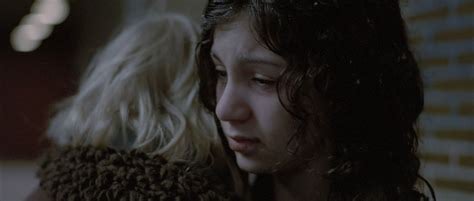
The phenomenon of a child vampire is well-established as a taboo in vampire movies, and for good reason. In Interview With The Vampire, Claudia de Point du Lac de Lioncourt is tormented by her aging mind as she is forced to inhabit a child’s body for all time, even as her mind develops and she gains understanding, desires, and personality that are asynchronous with her physical appearance. Eli, however, seems basically fine with always being twelve. From what I can tell, viewers are meant to believe that her brain stopped developing along with her body, the same stasis in effective death that preserved her height and development. Some people interpret Eli’s declaration that she is not a girl as meaning that she is an old woman, an ancient spirit bent on grooming Oskar to be a vampire with her, or some kind of sexual plaything. I don’t think that interpretation is accurate, and I will tell you why.
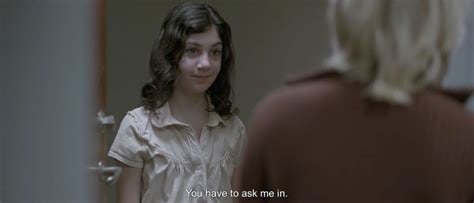
First, Let The Right One In is a coming of age story. Diablo Cody coined the term ‘coming of rage’ for her masterpiece Lisa Frankenstein, and I truly believe that applies here, as well. Let The Right One In is about Oskar and Eli learning to love themselves as they learn to love each other. Eli is impulsive and angry, but more than anything, she is afraid. Her violence stems from necessity, the knowledge that she herself will die if she does not kill others. At one point, she tells Oskar to “Be like me a little”, indicating that it is neccessary for him to use violence against his bullies, who do so out of simple meanness, and do not flinch at hurting him. Through Eli, Oskar learns to stand up for himself, to not simply take the life that has been handed him. Through Oskar, Eli learns to be sensitive, that she doesn’t have to be a creature of nothing but violence and destruction. They learn and unlearn their anger through each other, each coming into it in their own way as they fit into each other’s lives. I believe that Eli is still twelve mentally because, in this, she behaves like a twelve-year-old. She behaves almost exactly like Oskar and his classmates, she just carries more anger, fear, and pain than any of them.
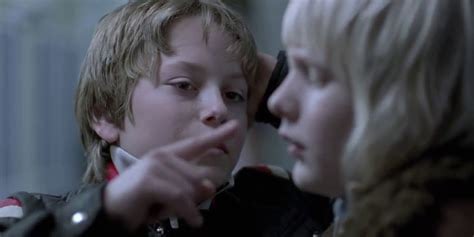
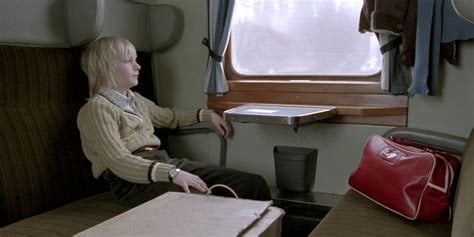
Another reason I don’t believe that Eli is secretly an old woman in a twelve-year-old body looking to groom Oskar for some reason or another is because she doesn’t turn him, and they only kiss once in the entire movie. The final scene sees Eli and Oskar on a train, Oskar looking out the windows as sun streams in off the snow, tapping morse code to Eli, in a trunk on the floor of the car. So even as they run away together, presumably to start a life far away from where Eli has ripped Oskar’s bullies literally limb from limb, Eli doesn’t turn him. She doesn’t condemn him to a life of being twelve forever, of always being hungry, of having to kill for sustenance. This, more than anything, indicates that what Eli has for Oskar is actually love, because she refuses to harm him in such a way, even if it would make her own life easier. She knows that his sensitivity would not be sustainable as a vampire, and shows her love for him by letting him keep it, even though it will make her life harder as he ages and she doesn’t. She doesn’t see him as soft anymore than he sees her as irredeemably violent. She just sees him as someone who loves her, and who she loves back. Also, again, because they are children, the most they do in the entire movie is kiss once, and lie in bed together a different time, after Eli has killed the man who lived with her (who functioned as her father, killing people to bring her food). If Eli were an old woman in a twelve-year-old’s body looking to groom a young boy, I would expect the script to have more outright manipulation and seduction instead of what it actually has, which is genuine wariness that sometimes veers into outright warning.
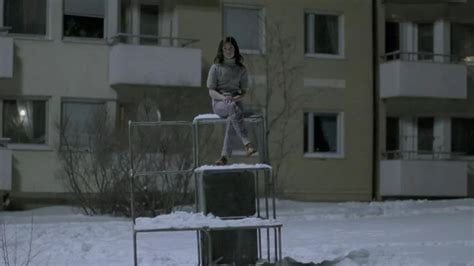
Both Oskar and Eli believe themselves to be unloveable, and prove each other wrong. Oskar knows that he is sensitive, soft, even, with a kind heart that makes him the target for bullying. Eli knows that she is violent and ancient, despite her age, and feels unknowable for it, repeatedly trying to warn Oskar off of liking her. She says that they can’t be friends, that she’s not a girl, that he shouldn’t like her, that she doesn’t have a birthday, all to warn him from getting too close and getting hurt. But he loves her anyway, just as she loves him. She is an eternally twelve-year-old vampire, forced to commit atrocities just to stay alive, and he is a twelve-year-old boy who will be thirteen soon, who is sensitive to violence, even as he faces it every day. In this, they are perfect for each other. They each let the other in, and, though viewers are divided on whether it was the right choice or not, they are happy. And that’s good enough for me.
Thanks for reading, all! I love this movie, and hope you all go and check it out! I got the DVD from the library (practicing what I preach), and I know it’s on Kanopy as well, which is free with a library card. Happy reading, stay spooky, and be glad you’re not twelve!