
Is a Degree Important in Technology in 2026 Amid AI?
Exploring the relevance of bachelor degrees in the tech job market amidst AI advances and future job predictions.

A few weeks ago, a professor from a prestigious University asked, “Do you think that a degree is still important today and will still be important in the future?”
He asked this in the context of trying to bridge awareness between the academic and corporate worlds. As a professor, he wanted their students to be job-ready after their internship and graduation. He also wanted to peer into the job outlook from a perspective of someone from the Technology workforce.
Many students and professionals have been asking on social media the same question. They want to know if they can still get a job despite not being able to finish their degree or if they will have a future in Tech at all.
And come to think of it, it’s way more than just a yes-or-no question. Let’s break it down further.

Inside:
Important, relevant, useful? Absolutely
Necessary? It depends
Four Futures for Jobs: AI & Talent
Future of Jobs
Conclusion
Important, relevant, useful? Absolutely
A bachelor’s degree is a credential that you gain for completing an undergraduate course of study. This is where you gain general knowledge during the first couple of years and select a major in the latter years to gain in-depth knowledge.
Your choice of study usually can help you take a related career after graduation, develop flexible or cross-functional skills to use in several careers, or allow you to pursue further studies.
To answer the professor’s question, ‘Is a degree important?’ Absolutely important today and in the future with the following ideas in mind. Note that this list covers just a few examples and is non-exhaustive:
Fundamental knowledge and skills gained from courses can be applied when the student joins the workforce;
Muscle memory of learning developed from routine studying, participating, researching, reporting are important and will be useful throughout a person’s career and lifetime;
A degree can enhance marketability and job security as some employers prefer candidates with formal education.
In online forum discussions, it’s common to see people mentioning that the name or type of academic institution may be instrumental in boosting someone’s career. Also, without a doubt, a student carries with them the prestige and reputation of graduating from the top 5 universities of their country.
Necessary? It depends
Taking an academic route. It is necessary to finish a bachelor’s when planning to pursue masters and PhD and/or further studies to gain post-graduate certificates or a second degree. It is also one of the basic requirements if you’re planning to pursue a career in academia.
Minimum qualification. Many companies still list a bachelor’s degree as part of their basic requirements.
University or college completion prestige. Once you’re in, the goal is to finish. The academia takes pride in their graduates and their graduates in turn, uphold their standards (most of the time, perhaps?).
On a macro level. The cultural aspect, country standards, and global trends. More on the global trends below.
Job Outlook
Now, let’s look at some snippets of the Future of Jobs reports published by the World Economic Forum (WEF).
In the Forum’s Future of Jobs Report of 2025, the skills outlook talks about the expected disruption of skills.
“Overall, employers expect 39% of workers’ core skills to change by 2030. One element contributing to this finding may be a growing focus on continuous learning, upskilling and reskilling programmes, enabling companies to better anticipate and manage future skill requirements.”
Four Futures for Jobs: AI & Talent
tl;dr Four scenarios that may affect the future of jobs involving AI and Talent: supercharged progress, the age of displacement, co-pilot economy, and stalled progress.
AI is changing the landscape of Technology and as it evolves, the skills gap is widening making it hard for the workforce and organizations to keep up (Google AI Agent Trends 2026). Google reported that the professional skills in Tech now expire in as short as 2 years.
As the world becomes increasingly data-driven, companies will be looking into maximizing their tools. They will want to anticipate change and plan scenarios to prepare for the new economy in 2030 (World Economic Forum, 2025).
Take a look at the Forum’s January 2026 White Paper Four Futures for Jobs in the New Economy: AI and Talent in 2030, where they highlighted four scenarios that include: supercharged progress, the age of displacement, co-pilot economy, and stalled progress.
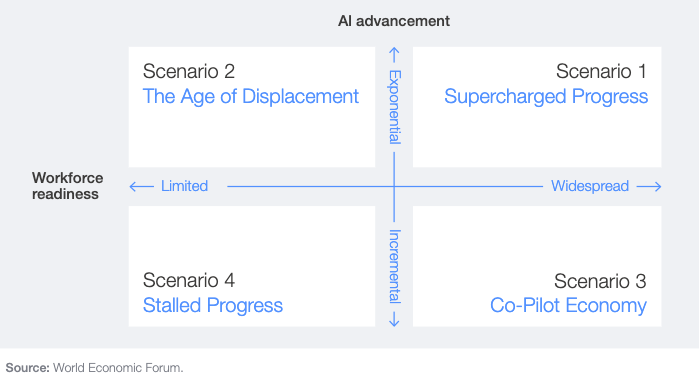
We’ll focus on the workforce section as it’s a main factor that may directly affect us.
The first scenario talks about exponential AI advancement and widespread workforce readiness. It narrates that many jobs common in the mid-2020s have disappeared or shrunk.
Those that have strong digital readiness managed to cut back unemployment as their workers oversee hundreds of “digital employees” and AI agents.
On the flipside, displacement and job quality decline are common across the board. “Many jobs have disappeared but new occupations emerge and scale fast.”
The second scenario is the age of displacement, whereby exponential AI advancement outpaces workforce readiness. AI and end-to-end automation displaces employees and workforce struggles to reskill and adapt. It also has become significantly cheaper to automate than reskill and upskill workers.
The third scenario being the co-pilot economy, shows that gradual AI progress and availability of AI-ready skillsets shift the focus towards augmentation rather than mass automation. After the hype, most industries see incremental transformation and AI skills have become common. AI is no longer a threat but an opportunity.
And the last scenario is stalled progress, in which incremental AI progress meets a workforce that lacks critical skills. Displacement hits mainly routine roles while skilled and manual occupations continue to increase.
Future of Jobs
Aligning these scenarios with the World Economic Forum Future of Jobs Report 2025, let us remind ourselves of the top trends to look out for until 2030:
Broadening digital access and advancements in technologies (e.g. AI & information processing, robotics and automation, energy generation, storage & distribution). These trends are expected to be driving the fastest-growing and fastest-declining roles and will fuel demand for technology skills: AI and big data, cybersecurity and technological literacy.
Increasing cost of living and general economic slowdown – these will impact job creation and increase the demand for creative thinking and resilience, flexibility, and agility skills.
Climate-change mitigation – driving demand for roles like renewable energy engineers, environmental engineers, and autonomous vehicle specialists.
Demographic shifts in the labor market: aging and declining working age populations mostly in higher-income countries and expanding working age populations mostly in lower-income countries. These trends drive an increase in demand for skills in talent management, teaching and mentoring, and motivation and self-awareness.
Geo-economic fragmentation and geopolitical tensions are expected to drive business model transformation
Conclusion
So, given the information and scenarios above and each individual circumstance, one can determine for themselves whether they will need a bachelor’s degree or not.
In some situations, it may not be necessary if the candidate learned the fundamentals of the track and took certifications. There are many opportunities to take training, bootcamps, and certifications nowadays. A degree is no longer the only path to employability as many employers give importance to demonstrable skills.
Nonetheless, in the new economy where change happens faster than ever, a bachelor’s degree may always come in handy plus the now non-negotiable upskilling (or reskilling) to keep up with the times.
Did you like this post? Let us know by sending us a message!
