
Careers in Cybersecurity: Career pathways
Let's talk about the rise of cyber threats and the booming cybersecurity career field

Data breaches were not so common in the past decades compared to the last couple of years. Nowadays, we hear about them in the news more regularly at an alarming rate.
As threats continue to grow, students eyeing Cybersecurity and Cybersecurity professionals may find a strong job outlook (Forbes, 2025).
Many students have been asking how to take this path. So, come find the answers to your burning questions in this article.

Inside:
What is Cybersecurity?
Cybersecurity Hiring Trends
Cybersecurity Certifications
Navigating Cybersecurity Pathways
In the global scene, the average cost of data breach reached USD 4.99M, a 12% increase from last year. According to IBM’s research, there was a 56% increase in AI-driven attacks from AI deepfake and AI-enabled malware.
They say that “racing to adopt agentic AI without strengthening security and governance for agents puts your data, people and reputation at risk.”
Former Philippine Secretary of ICT, Hon. Ivan Uy, stated in the WEF Global Cybersecurity Outlook of 2025, “The rapid advancements and increasing adoption of digital platforms globally is matched by an equally evolving cyberthreat landscape. It is essential that we work together to address this growing menace.” (WEF, 2025)
What is Cybersecurity?
Security is protection of a person, place, organization, or country against threats such as crimes or attacks by foreign countries (Cambridge Dictionary, 2026). You want to be safe and secure and have the freedom from danger or fear.
Relate that sense of security to computing and personal information, data, and systems. People and companies also want to protect and secure these.
Cybersecurity aims to “protect data, systems, and networks from unauthorized access, use, disclosure, disruption, modification, or destruction. In other words, you want to protect your data and systems from those who seek to misuse them, intentionally or unintentionally, or from those who should not have access to them at all.” (Andress, 2026)
“Racing to adopt agentic AI without strengthening security and governance for agents puts your data, people and reputation at risk.”
IBM, 2026
Cybersecurity Hiring Trends
Cybersecurity professionals keep critical data and information safe by preventing, mitigating, managing, and analyzing intrusions or breaches.
Cybersecurity skills belong to the fastest-growing skills category, next to AI and big data.
So if you’re an entry-level or junior-level talent, how do you think you can cut it?
ISC2 Cybersecurity Hiring Trends highlighted the following key findings when building entry-level and junior-level cybersecurity teams:
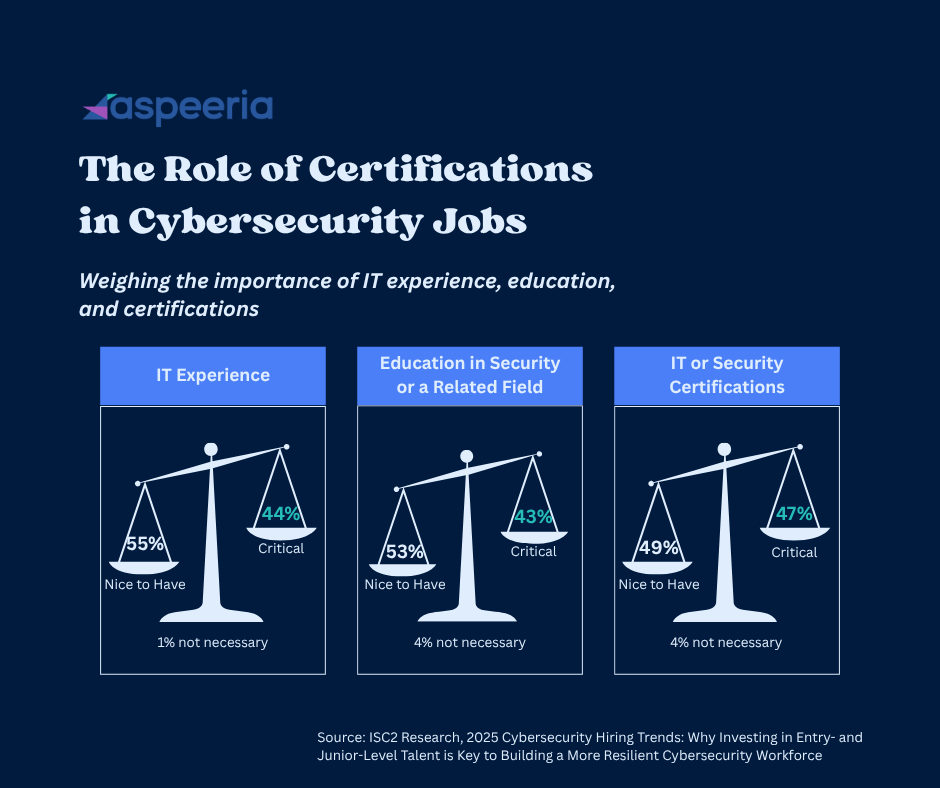
Security managers prioritize hands-on experience and certifications.
They consider internships and apprenticeships as powerful tools for identifying and recruiting fresh talent.
Hiring managers are concerned about attrition among entry- and junior-level team members but are willing to invest in their professional development.
Aside from talent coming from programs like computer science, IT, or cybersecurity, hiring managers also consider candidates from both IT and non-IT academic backgrounds.
Cybersecurity hiring managers value non-technical skills as much as technical skills; e.g. the ability to work in a team, problem-solving, and analytical thinking. Hiring managers are looking for talents who can collaborate, adapt, and tackle the complex problems in cybersecurity.
The challenge – security managers expect more from entry-level and junior-level cybersecurity professionals than this group can achieve.
Cybersecurity Certifications
Further studies such as Master of Science in Cybersecurity can be useful for leadership and research as well as when pursuing positions in the academe.
Cybersecurity certifications like CASP+ and Security+ from CompTIA, Certified in Cybersecurity from ISC2 and others are also useful. Security managers in some companies may look for these foundational certifications with or without a bachelor’s degree.
Navigating Cybersecurity Pathways
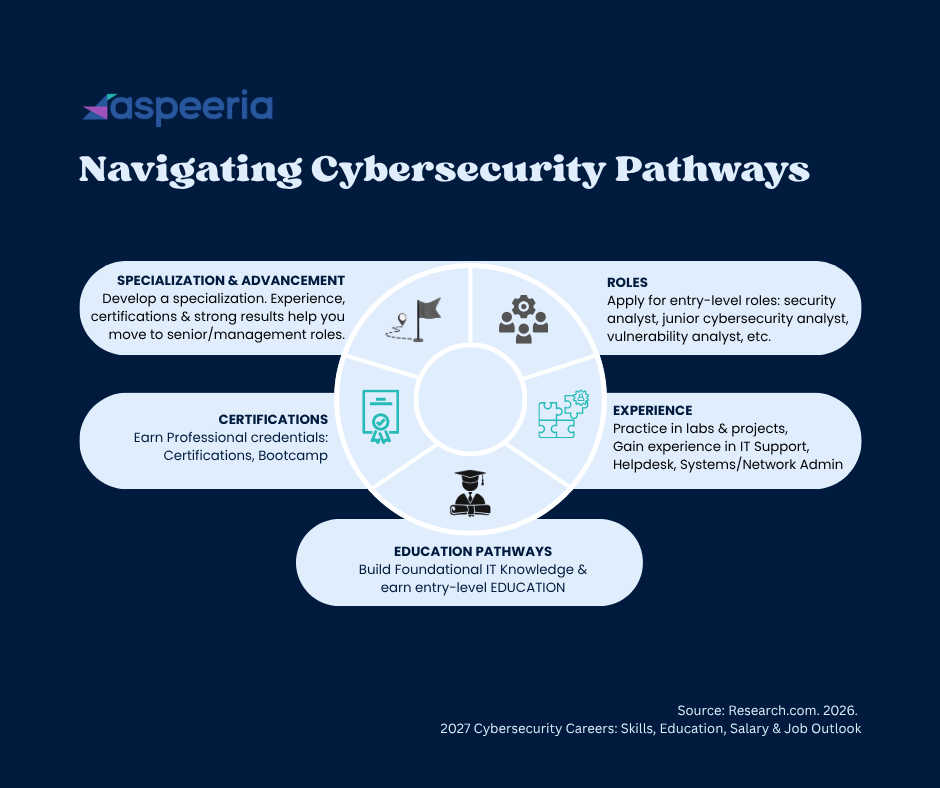
Dr. Imed Bouchrika shares a helpful step-by-step guide to getting started with a career in Cybersecurity.
Build foundational IT knowledge. Cybersecurity is built on understanding the systems you are trying to protect. Do not skip the basics .
Earn entry-level education or certification. Depending on your budget and situation, consider an associate degree, bachelor’s degree, certificate program, bootcamp, or foundational certification.
Practice in labs and projects. Turn theory into practice with hands-on labs, capture-the-flag exercises, security tools, etc.
Gain experience in roles like IT support, help desk, systems or network administration.
Apply for entry-level security roles, e.g. security analyst, SOC analyst, junior cybersecurity analyst, vulnerability analyst, or security operations technician.
Develop a specialization.
Pursue advanced responsibilities. Experience + certifications + strong results can help you move to higher roles such as senior analyst, lead specialist, architect, manager, consultant, or executive track.
The key is to build your knowledge and experiences and couple those with certifications. Employers want proof of your ability.
Cyberseek has an interactive tool that helps users figure their options for different Cybersecurity roles. Just click on roles and job titles to see the pathways you can take.
Sources:
NewsbytesPH, 2026 Phishing, data breaches surge in PH in first half of 2026
IBM, 2026 Cost of a Data Breach Report 2026
ISC2, 2025 2025 Cybersecurity Hiring Trends: Why Investing in Entry- and Junior-Level Talent is Key to Building a More Resilient Cybersecurity Workforce
Forbes, 2025 Careers In Cybersecurity: Which One Is Right For You?
ISC2, 2026 How to Start Your Path to a Cybersecurity Career
Andress, J., 2026. Foundations of Cybersecurity, 2nd edition. California: No Starch Press
WEF, 2025 World Economic Forum Global Cybersecurity Outlook 2025 Insight Report, page 14
Research.com, 2026 2027 Cybersecurity Careers: Skills, Education, Salary & Job Outlook
CyberSeek.org Cybersecurity Career Pathway
Did you like this post? Let us know by sending us a message!
