How Much Will Labor Lose By?
I am writing this post as an unabashed Labor partisan. Which might be surprising, given that I have quite a lot of things to criticise about the Labor government.1 But they’ve also done a lot of things I do like: investment in public infrastructure like railways, schools, and hospitals, which is the primary competence of state government and something I am not sure the opposition would do. I also approve of Labor standing up for the rights of transgender people, such as by introducing gender self-identification. In and of itself, the Liberal Party and One Nation’s opposition to transgender rights is enough to stop me from considering them as an option.
But I also don’t disapprove of Labor as much as your average bleeding-heart leftie. I think they’ve generally run a good and competent government over the twelve years, despite my noted-to-significant disagreements at times, and generally I think they deserve to be re-elected.
Well, I’d have said this at the start of the year. Despite myself, I still might vote for Labor in the lower house2, but I didn’t approve of the knifing of Jacinta Allan. At the time, I thought it was a panic move from a caucus that seemed to think it was certain to lose.3 The next few months under Ben Carroll have made me wonder if a leadership ballot would have been so bad after all. Carroll under Labor has run on, more or less, disavowing half of the agenda of the Andrews/Allan governments, while not offering any alternative vision of their own4 and campaigning almost exclusively on the threat of a Liberal-One Nation government. Not only has this become increasingly less credible as the Liberal Party climbs in polling, but it reminded me a lot of the disastrous WA Liberals campaign in 2021.
So I’ve seen a lot of leftie friends coping with the likely Labor loss — which, to be clear, I think is more or less certain5 — by saying that Labor needs renewal, that they’ve grown staid and complacent, and that a loss in 2026 might actually be better than a win for them.
So in this post, I wanted to look at what the magnitude of Labor’s loss might be, and who’ll be left to clean up the wreckage.
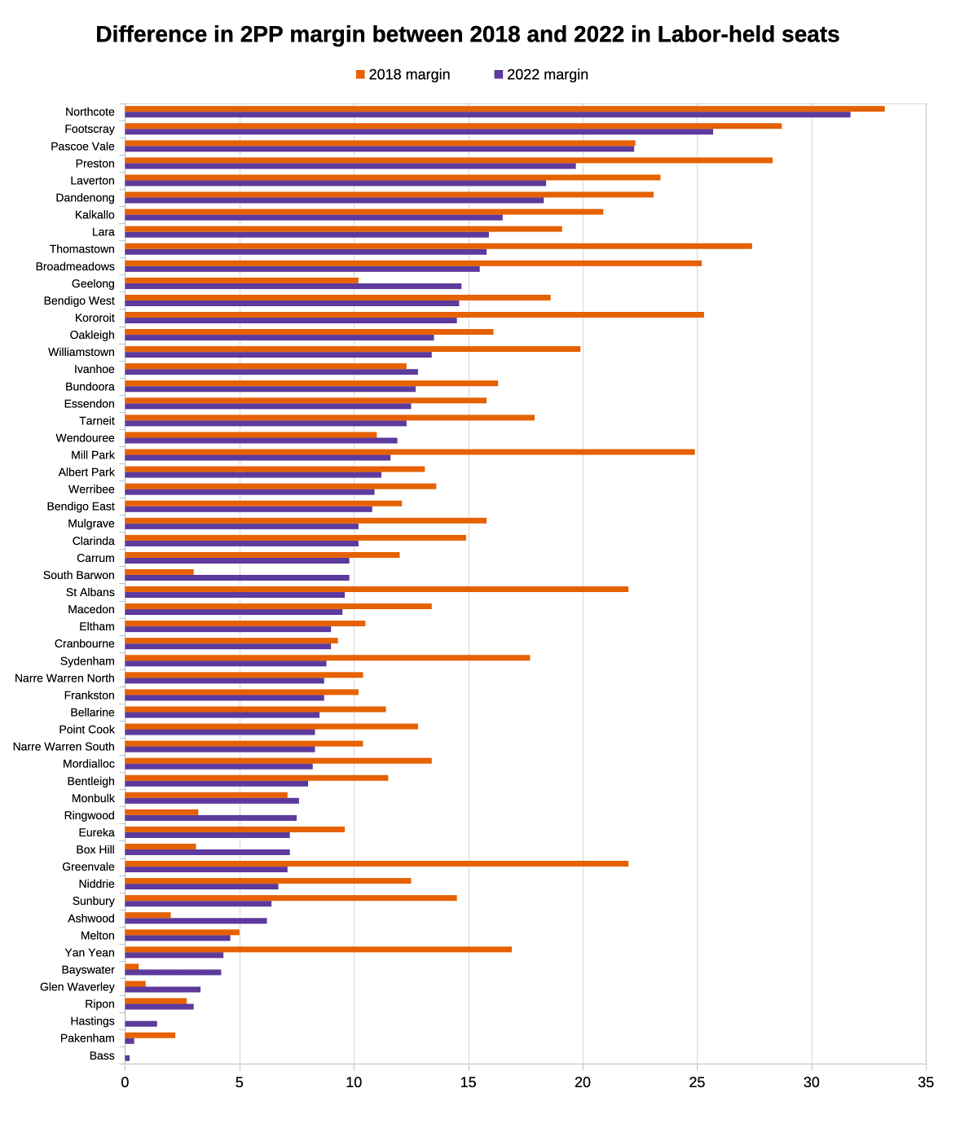
This is a pretty complicated chart, but it’s the easiest way I can think of to illustrate a point. Labor’s win in 2022 was on its face quite persuasive but concealed a pretty big swing against it in some of its key seats. In 2018, Labor’s safest seat on a two-candidate preferred (2CP) basis (excluding seats like Northcote and Footscray, which on this chart have massive two-party-preferred (2PP) margins but were much closer on a 2CP races against the Greens) was Thomastown, held by a 27.4% margin. In 2022 it was Laverton, held by a 18.4% margin.
Some eastern suburbs seats like Ashwood, Box Hill, and Ringwood took leaps towards being safer for Labor, but the most obvious trend here are margins in safe Labor seats being chopped down heavily: the largest in the growth seat of Greenvale, where Labor’s margin fell by more than 15%.
Subscribe nowThis created an interesting dynamic for Labor. It wasn’t left with a whole lot of terribly marginal seats but it did have a whole lot of seats just beyond that. Labor’s statewide 2PP vote in 2022 was 54.9%, giving them 56 out of 88 seats. A 4.9% uniform swing6 against them, bringing Labor down to 50-50 with the Coalition, would only see them lose eight seats. Even chucking in the four seats that the Greens would flip on such a swing, this still produces a result of 44 seats for Labor, 36 for the Coalition, and 8 for the Greens.
The 2022 electoral pendulum meant that Labor would be favoured with a small-to-medium swing against them, perhaps even liable to win while receiving less of the statewide 2PP. But a large swing against them?

The Poll Bludger’s polling average at the moment has Labor with an 8.5% swing against them, sitting at 46.7% of the 2PP. This is obviously severely complicated by the rise of One Nation, and to a lesser extent an increase for the Greens in some recent polls. But looking again at that chart, an 8.3% swing would see Labor lose 20 of its 56 seats on a uniform 2PP basis. To be clear, this assumes an 8.3% swing towards the Liberal Party in every seat in the state, and excludes the seats the Greens might otherwise contend in. I’ll hopefully deal with One Nation in a later blogpost, but this would see Labor go to 36 seats: almost certainly too little to contend for government, even if the Greens did spectacularly.
And recent polling suggests the picture might be even worse for Labor. As per Casey Briggs, latest 2PP results have shown the Coalition at around 55 to 56 per cent. The talk of the town of late was a shocker DemosAU poll showing Labor at 18%, albeit with a 44% 2PP result, likely in part due to a strong Greens vote of 17%. A 2PP of 56% for the Coalition would be an 11-point swing against Labor. Again, on a uniform 11-point 2PP swing, Labor loses the majority of its 56 seats, dropping 34 to go down to 22 seats. Again, this excludes seats the Greens might win such as Preston or Pascoe Vale, meaning it if anything paints too rosy a picture.
This would see Premier Ben Carroll lose his seat of Niddrie, as well as planning minister Sonya Kilkenny, police minister Paul Edbrooke, Bentleigh MP Nick Staikos, and other high-ranking members of the Labor Party.
Part of the problem is that Labor has very little extremely safe seats, which would theoretically be invulnerable to a massive swing against them. On the chart, Labor’s four strongest 2PP seats are close battles against the Greens, and beyond that there’s only 19 seats Labor holds with a 2PP margin of greater than 10%. It’s 6 beyond 15%.
Subscribe nowAnd again, the swing is not going to be uniform. I have been treating it like it might be, but odds are that it won’t. Labor is unlikely to get as massive a swing against them in the places they improved on in 2022, like some of the eastern suburbs seats, but they are likely to do even worse in places where they secured massive swings against them. Outer-suburban/exurban seats like Yan Yean, Greenvale, Broadmeadows, and Thomastown (yes, formerly the safest Labor seat in the state!) could be particularly vulnerable.
Now, I am not an election modeler. I don’t have some fancy Monte Carlo simulation to bust out here. If you want that, go to the fine folk at the Poll Bludger or AEF. I’m best at analysing election results after the fact, not before. But I am going to make some informed guesses here, and make some conclusions as a result of those guesses. This next section is going to be less statistics, more inference, so bear with me. But here’s a few assumptions I have:
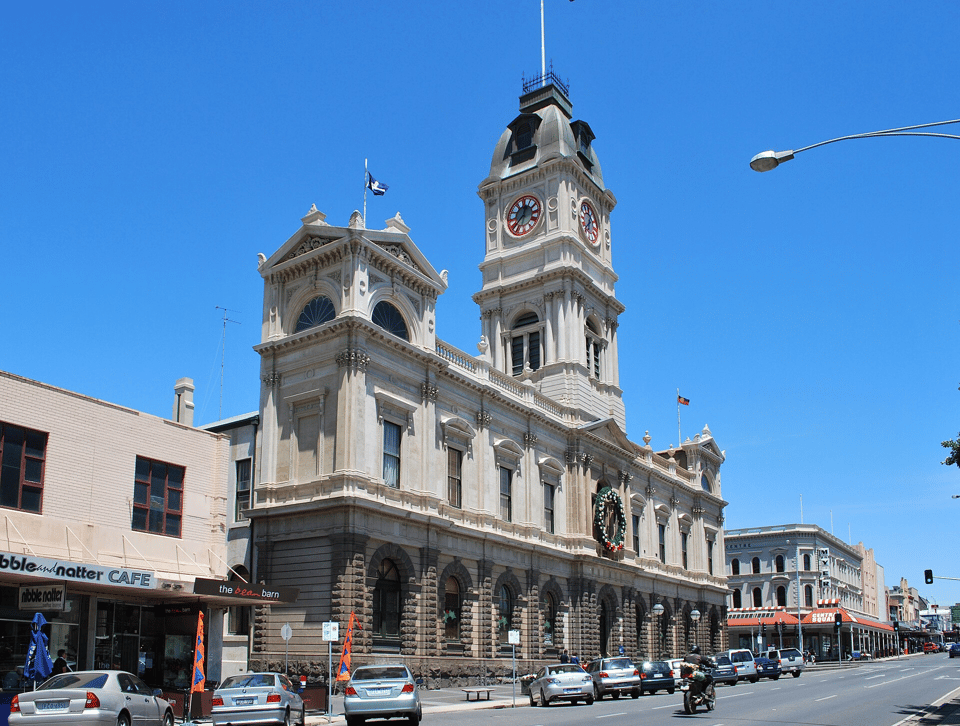
First, I think the swing against Labor will be pretty massive in the regions. The chart from above didn’t necessarily show evidence of a massive rural backlash in 2022, but I suspect it’s arrived now: the Western Renewables Link is heavily unpopular in certain parts of the western districts, and One Nation’s surge is likely to hit hardest in the country. I suspect One Nation takes decently from the Coalition, but a decent amount of its support is like to be pissed-off Labor voters. Labor is almost certainly toast in Bass, where sitting MP Jordan Crugnale is retiring on a 0.2% margin. Martha Haylett will too definitely lose Ripon with her 3% margin. A larger swing, the 11 point one cited earlier, would see Labor lose Eureka in the west, Bendigo East, Bellarine, Macedon, and South Barwon. These latter three seats are gentrifying to some degree, or just in general seem to me like places where One Nation wouldn’t catch on, but there’s really no reason why the Liberals shouldn’t win in places like these if they’re having a landslide year. The only seats left for Labor in the country would be Wendouree (based around Ballarat), Lara (based in north Geelong), and Bendigo West (I’ll give you one guess), and I suspect neither of these are very safe for Labor. I feel pretty confident in saying Labor will suffer a near wipeout in the regions. Geelong might be an exception to this, and perhaps in Bendigo West Labor’s Brenton Baldwin will be able to hold an admittedly strong 14.6% margin from 2022, but I think it’s shaping up to be a bloodbath in the country.
I also think Labor is likely in for trouble in the outer suburbs. There is a lot of resentment about crime7 and the same factors apply in the regions that might lead to a high One Nation vote. The party almost won the Adelaide seat of Light off Labor in this year’s South Australia election, in what was otherwise a landslide Labor win.
Labor is assuredly doing worse in Victoria, and there are a lot more Lights around. Seats like Kalkallo, Greenvale, Melton, Werribee, Narre Warrens North and South, Pakenham, are all very similar to Light in profile, all not seats where the Liberal Party has a lot of organisational structure but which assuredly feel rather neglected by Labor and are likely ready to vote for One Nation.
Some, myself included, have been skeptical about this because of how diverse some of these seats are. Surely Greenvale, one of the most Muslim seats in the state, won’t back Pauline Hanson’s One Nation? Especially not if they’re standing a candidate who’s said laughably racist and sexist things on the internet years ago?
Well, I think the numbers One Nation is going to get in migrant communities might shock some people. Certainly there’s no shortage of racist whites in these areas, but I think there’s also a good number of people who feel pissed off and are ready to take a stab at any alternative. Greens aren’t visible enough, Victorian Socialists too radical, so I think there’s a good chance it’ll be One Nation.
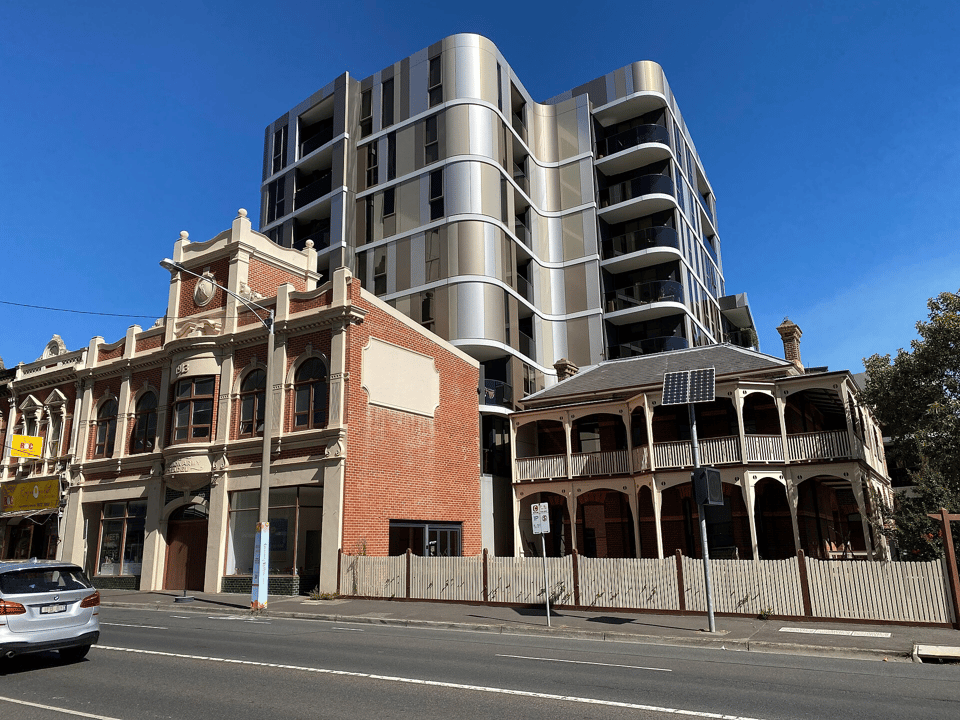
Finally, I think the swing against Labor will be relatively muted in the wealthy suburbs and cities. As the election comes closer there does seem to be an increasing air of inevitability with regards to Jess Wilson’s Liberal Victoria, but I suspect if the campaign against a Liberal-One Nation government makes sense to run anywhere, it’s here. Sophie Torney, an independent running against Jess Wilson in Kew (who will lose) is standing against the prospect of a One Nation-supported government, which I don’t doubt is most potent here.
There’s a significant moneyed class in these areas, not just of stiff-upper-lip Tories who would never vote One Nation to save their life, but a burgeoning upper-middle class, and a large population of first and second generation migrants, who likely don’t have the same economic concerns as exurban migrants and are far less likely to overlook One Nation’s racist policy stances.
The selection of Jess Wilson as leader seems designed to me to appear to this group of people, and I think with a different leader the Liberal Party would likely be struggling a lot more right now. You simply cannot win government without contending in the leafy suburbs.
The problem for Labor is that their very safest seats aren’t here. Glen Waverley, Bayswater, Ashwood, and Box Hill are all held by margins of less than 8%, meaning they’re probably goners if the polls are remotely correct. The closest I can class in this category as truly safe is Oakleigh at 13.5%, and even then that’s more working-class than I had really imagined in this category.
So, where does that leave Labor? In a pretty dire state, I suspect! 11 Labor lower house MPs are retiring at this election, and I think Labor will certainly lose most of these, which limits the opportunity to bring in new talent. Going from the safest seats on down, I think the Greens will struggle more against Labor due to not being the beneficiary of Liberal preferences, but I’d be surprised if Labor won Pascoe Vale, and I suspect the Greens might win Preston too. Northcote in my mind is more up in the air, while Footscray is a total mess. I’d slightly favour Labor’s Katie Hall there.
Laverton and Dandenong, Labor’s two safest seats on a 2CP basis, are likely to stay with it, I suspect. This should ensure the re-election of deputy premier Gabrielle Williams and Sarah Connolly. Kalkallo and Thomastown in the outer north will be very close, I think, but I’d be surprised to see Labor lose either. I wouldn’t be surprised if Broadmeadows emerges as the safest Labor seat post-election: more than average of the anti-Labor vote is like to end up on its left, I think, and will probably funnel back to them through preferences.
Subscribe nowThen there’s Geelong and Lara. I suspect Lara will be particularly vulnerable to One Nation but my gut there says Labor. Geelong I suspect will flip, if only as a function of the massive swing. The Bendigos East and West are interesting: after a cashed-up campaign, Nationals candidate Andrew Lethlean made the federal seat of Bendigo marginal in 2025, and won a majority of the 2CP in the booths covering Bendigo East. I suspect Lethlean will flip Bendigo East but West might just hold for Labor, if barely.
We’re at eight Labor seats so far but it doesn’t look much rosier elsewhere. I honestly think Labor might lose Kororoit in the outer west: sitting MP Luba Grigorovitch was involved in a minor scandal over giving character references in court to basically anyone who asked, and the seat is one of Melbourne’s most infrastructure poor.8
Oakleigh I think will stay Labor, Williamstown also should, if only because of the disendorsement of the Liberal candidate there.9 Ivanhoe will be saved by a strong preference flow from the Greens, and I think similar is true for Bundoora. But from there on? :::shrugs:::
I’m not going to go seat by seat anymore but to say that I would be surprised to see Labor win more than 30 seats, and am probably expecting them to win around 15-20 seats. On a bad night, 10. Out of those eleven retiring MPs, I expect none but Maree Edwards in Bendigo West, and potentially Danny Pearson in Essendon, to be succeeded by Labor candidates. In the upper house, Labor is only likely to return one new MLC: Kate Maxfield, former Labor candidate in Morwell, standing in the Western Victoria Region. This may be momentarily confusing to any readers with an understanding of Victorian geography, but it gets even worse: Tom McIntosh, sitting MLC for Eastern Victoria, is standing for Northern Metropolitan. Enver Erdogan, who has represented Melbourne suburbs for all of his political career, is standing as Labor’s lead candidate in Eastern Victoria.
I don’t suspect Labor will quite reach the lows of 2012 Queensland, where Anna Bligh’s Labor retained only 7 out of 89 seats, but I do think the party will be decimated and headless. The potential for renewal will be quite minimal given that many new candidates will likely lose their seats. If you asked me right now I would probably say Gabrielle Williams becomes leader, but who knows. In all likelihood, Victoria will elect a majority Liberal government in ten days, and if you want it (like I do) to be a one-term government, you’ll need to hope the rump of Labor is able to line up behind a coherent vision and a sensible leader.
Or that the Liberal Party totally implodes in on itself. Not terribly unlikely.
Primarily, the shocking turnaround on bail laws and selling off public assets and public housing. ↩
I agree with my local MP on a lot of policy and she has been personally effective. ↩
Jacinta Allan’s personal approval ratings were somewhere between Keir Starmer and the bubonic plague at the time of her resignation, but I think the Labor brand could have held up enough to keep them competitive. Well within your rights to mock me for this take but I stand by it. ↩
Unless you’re a big fan of urban bus reform or tightening bail laws. ↩
I’m reminded of the line from deeply corrupt Louisiana governor Edwin Edwards: “the only way I can lose this election is if I'm caught in bed with either a dead girl or a live boy”. ↩
As in, applying a 4.9% swing across every electorate. This is not realistic, as swings would almost certainly differ from region to region and seat to seat, but it is a good way to approximate election results. ↩
I think mainly confected, but what can you do. ↩
Although Labor has built a lot out here. ↩
I have a niggling feeling he might win. I’m not comfortable enough in it to predict it but I could see it happening. ↩