Can Victorian Socialists Win a Seat?
Looking at past preference behaviour and election results to see if it might actually be third time lucky for Victorian Socialists in the upper house of Victoria's Parliament.
Even though Labor is gearing up for a historic loss, things aren’t all bad for the left in Victoria.
Well, yes, they are. The Liberal/National Coalition will likely secure a stonking majority in the lower house, the Coalition and One Nation will have the numbers to pass whatever they want in the upper, and overall the coming Parliament of Victoria is shaping up to be the most conservative in a generation.
But things aren’t all that bad for some left-wing parties. After all, did you see how well Ellen Sandell did in the leaders’ debate? And the Greens could pick up a bunch of lower house seats!
In case you can’t tell, I have found this rhetoric a bit tiring. But it’s not untrue. If you believe the polls (per BludgerTrack, the Greens are at 15.3% statewide), the Greens are shaping up for their best result ever, likely at least contending for a seat in each upper house region and probably on track to increase their lower house representation, which currently sits at a rather piddly three.1
And then there’s Victorian Socialists. The furthest left political party in Victoria today, they are standing candidates in all 88 districts of the Legislative Assembly, and are aiming to win representation upstairs in the Legislative Council in their third election.
A recent YouGov MRP poll, one of the few to report the party’s results individually, gave hope to these dreams. Statewide, about 4 per cent of voters said they would give Victorian Socialists their first preference, rising to 7 and 8 per cent in the party’s target regions of Western and Northern Metropolitan.
So, can they actually do it?
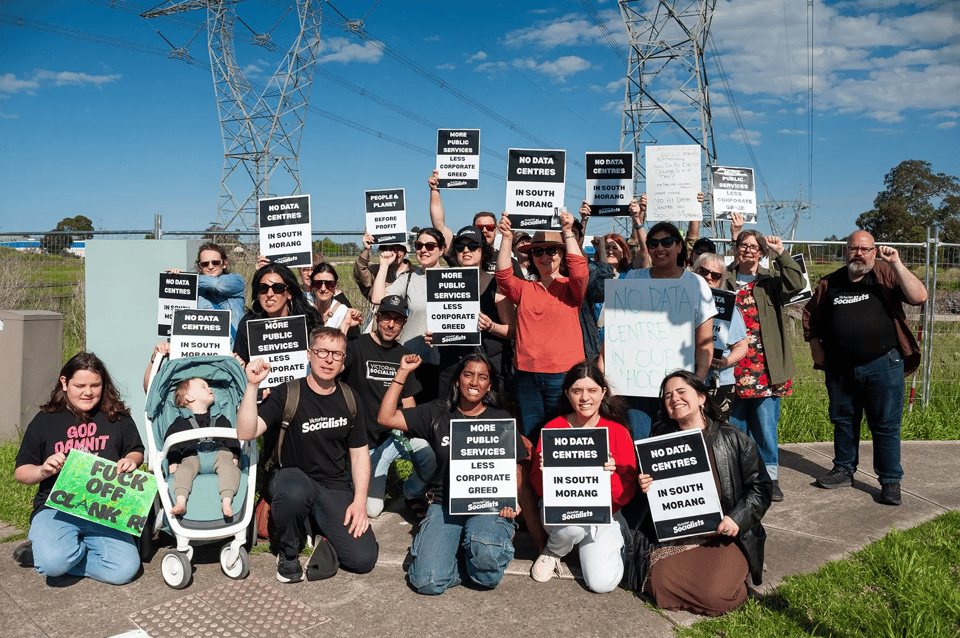
To reiterate, the main hopes for Victorian Socialists seem to be the Northern and Western Metropolitan regions of the Legislative Council, Victoria’s upper house. In 2018 the party stood Stephen Jolly in Northern Metropolitan, and in 2022 Jerome Small. The party didn’t much try in Western Metropolitan in 2018, but in 2022 their ticket was headed by Liz Walsh.
This year, their ticket in Northern Metropolitan is headed by Omar Hassan, and in Western Metropolitan it’s headed by Anneke Demanuele. I would say that both of these candidates have potentially a decent shot at being elected, and thus could be the first socialist legislators in Victoria’s parliament in generations. But I’d like to take a look at the previous data to see just how likely it is that either will actually win their seats.

First of all, it’s worth noting the structural changes in Victorian Socialists’ favour: group voting tickets have been abolished. Prior to this, you had two options for voting in state elections: number one box above the line, or number all of the boxes for individual candidates below the line. You could decide where your preferences were allocated with the latter, but this was incredibly time consuming, so understandably most voters went with the former. This meant that their preferences were allocated by an ordered list submitted by the party they voted for.
But the Legislative Council is still elected through a region system, which disadvantages Victorian Socialists. There are eight multi-member regions, which each elect five representatives each. This is great for a party like the Greens: if you’re polling 10% statewide, this will pretty reliably get you one seat in most regions, giving you 8 out of 40 seats. That YouGov MRP has Victorian Socialists at 4% statewide, which probably isn’t enough to secure any seats without a very concentrated distribution of votes.
Thankfully, Victorian Socialists does have this: outside of their two target regions, they’re polling 2-3%, but they are doing better than that in Northern and Western Metropolitan. This is a pattern that has held true at the last few state elections, as I’m about to discuss. But it’s worth noting that an all-of-state region of 40 seats, which is used in New South Wales and Western Australia, but could not have been adopted here without a constitutional amendment, would have helped Victorian Socialists more than the current system.
Anyway, onto a look at the results.
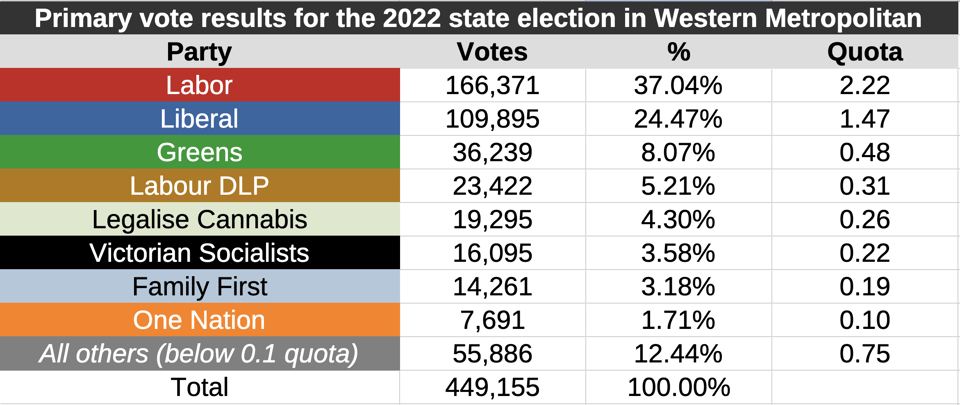
So we’re looking at Western Metropolitan first, in part because it’s the region I have the least familiarity with, and also because it requires me to look at the least election results.
First off, a quick explanation on quotas: they basically indicate how many seats a party is entitled to. Given that the vast majority of voters go above-the-line, these basically equate to direct entitlements to each party: i:e, once Labor’s first candidate has filled a quota, it goes straight to their second candidate. There are exceptions, but they’re not particularly relevant for our cases, although they will come up. More or less, one quota equals 16.7% of the vote.
I’ve collapsed all the parties who received a relatively miniscule amount of the vote into one row. Together they’re quite significant, but individually none were above 1.5%, and include such lowlights as the Angry Victorians Party, the Companions and Pets Party, and Sack Dan Andrews Restore Democracy.2
So here, two Labor and one Liberal candidates were elected more or less immediately. At the point at which Victorian Socialists were excluded from the count, there were four other candidates left in the hunt: Bernadette Thomas of the Greens, David Ettershank of Legalise Cannabis, Trung Luu of the Liberal Party, and Bernie Finn of Labour DLP.
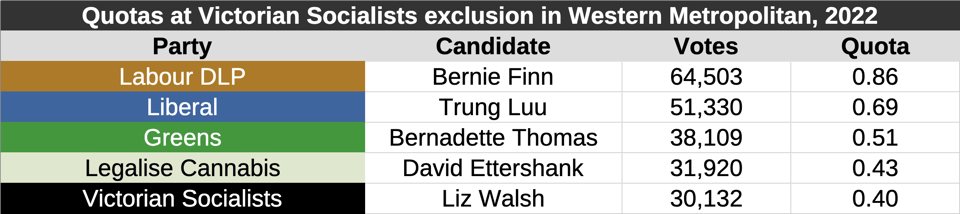
Victorian Socialists gained a decent bit here from other left-leaning parties: namely from Animal Justice and Labor. But it wasn’t quite enough to keep them in the hunt: if Victorian Socialists had done a bit better, they would have overtaken Legalise Cannabis, received most of their preferences, then been elected from the Greens’ preferences. As you can tell, the Greens didn’t gain very much in this count, which is almost certainly an artifact of group voting tickets: with voters deciding their preferences, more of the Labor vote would have sprayed to them over Victorian Socialists in all likelihood.
Instead, Legalise Cannabis benefited from Victorian Socialists preferences (the party had them second, ahead of the Greens) and were elected off the Greens’ elimination. The final seat was filled by Liberal Trung Luu off the surplus of Ettershank, by a margin of 210 (!!!) votes against Bernie Finn.
The end of group voting tickets in Western Metropolitan is both a blessing and a curse for Victorian Socialists. In a vaguely proportional system, the seat won by Legalise Cannabis in 2022 would have gone to the Greens. This year, the Greens almost certainly will win a seat in Western Metropolitan…but Labor is less assured of two, which creates an opening for Victorian Socialists.
Subscribe nowAt this point, I must acknowledge that I am indebted to actual psephologist Kevin Bonham’s analysis of prospects in the Legislative Council in 2026. He reckons that Western Metropolitan’s final seat is likely to be filled by either a third Liberal or a second Labor candidate, with some chances of a minor party victory.
I do tend to agree with this, but this blog post is about Victorian Socialists, so let me detail my thoughts on them. I think their upper house vote will rise from the 3.58% in 2022, to somewhere in the area of 5%. I think 7% is a bit generous but it wouldn’t surprise me too much. But the difficulty is that’s still quite a bit far off from a quota. Outside of perhaps Legalise Cannabis, the only major sources of preferences for Victorian Socialists are likely to be Labor and the Greens. And both of these parties (Labor, Greens), are preferencing Victorian Socialists second over each other3 on their how-to-vote cards in Western Metropolitan.
However, these how-to-vote cards will not be universally followed. I would suspect that Labor voters might be more likely to preference the Greens over Victorian Socialists than the Greens might be for Labor. To make matters worse, if the Greens do win a seat, as I think they will, they’ll likely have a relatively small surplus to distribute to Victorian Socialists. I think Victorian Socialists are probably unlikely to overtake Labor on preferences to nab the last seat in Western Metropolitan, all things considered, although it is a live possibility.
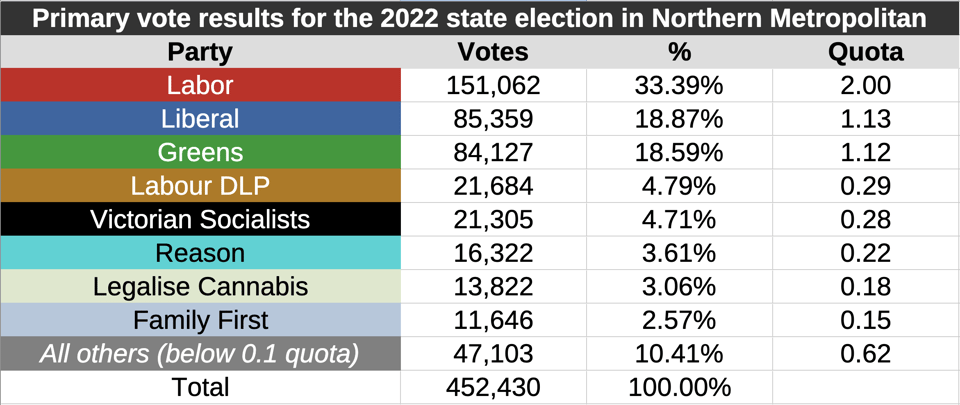
These results at the 2022 state election in Northern Metropolitan elected lead candidates from Labor, Liberal, and the Greens immediately. Enver Erdogan, the second candidate for Labor, was not elected immediately, given that Labor’s quota was exactly two, and the number of below-the-line votes meant he didn’t have exactly one quota after the surpluses of the elected three candidates were distributed: he had 72,691 votes, which makes up 0.96 of a quota.
Because of group voting tickets, it took an unusually long amount of time for Erdogan to reach quota, but he did so on the exclusion of the second Liberal candidate, Owen Guest, at which time all of the lead candidates from Labour DLP, Victorian Socialists, Reason, Legalise Cannabis, and Family First remained in the count. From there, Andrew Hale of Legalise Cannabis was eliminated next, followed by Imad Hirmiz of Family First, and now we reach the point where Victorian Socialists were on the chopping block.

The race in Northern Metropolitan was far less close for Victorian Socialists in 2022, who gained less in the count than they did in Western Metropolitan. Almost every micro-party in Western Metropolitan preferenced disgraced ex-Labor MLC Adem Somyurek, now standing for Labour DLP, who had the good fortune to be listed to the left of the Labor Party on the ballot, which may have helped them in picking up confused ALP voters.
Looking at the group voting tickets of parties that didn’t just go straight to Somyurek, the Animal Justice Party preferenced Victorian Socialists, and the Greens, Labor, Legalise Cannabis, and the Angry Victorians Party4 both preferenced Reason. Unlike in Western Metropolitan, Victorian Socialists were clearly screwed over by group voting tickets here. Yes, Fiona Patten was a popular local MLC of two terms who had enough of a profile to poll a respectable primary vote, but her receiving 100% of Greens, Labor, and Legalise Cannabis preferences was clearly confected, and a decent chunk of that, though probably not a majority, would have gone to Victorian Socialists with the absence of group voting tickets.
In a sense, though, it’s a moot point: as you can tell, neither Reason nor Victorian Socialists had enough to overtake Somyurek’s unholy preference spiral, and on Small’s exclusion Somyurek was immediately elected.
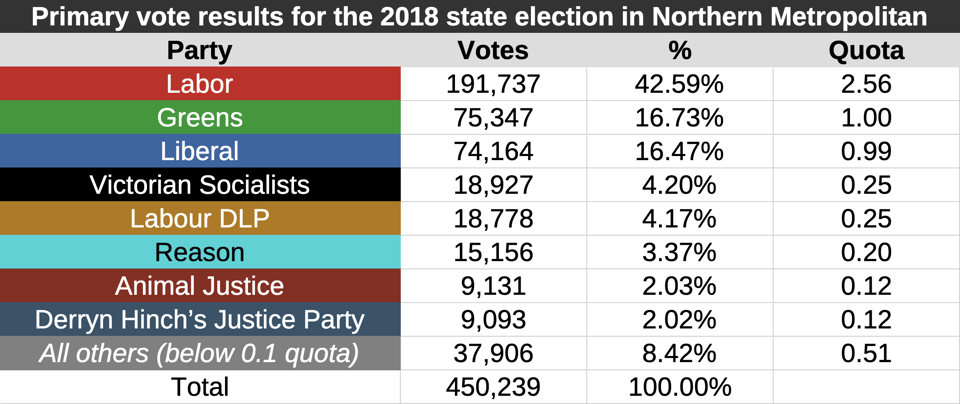
Looking at Northern Metropolitan means that we can also go back to 2018, the first election contested by Victorian Socialists. Northern Metropolitan was the only region they really tried in, standing then-local councillor Stephen Jolly5 as their lead candidate. Lead Labor candidates Jenny Mikakos and Nazih Elasmar are immediately elected. Samantha Ratnam is elected on the preferences of Campbell Gome, the lowest polling of the five Greens candidates.6
Again due to group voting tickets, Liberal Craig Ondarchie takes comically long to be elected, despite his party polling, for emphasis, 0.99 of a quota. He is not even elected on the elimination of all the other Liberal candidates! This is where things stand before Stephen Jolly are eliminated:
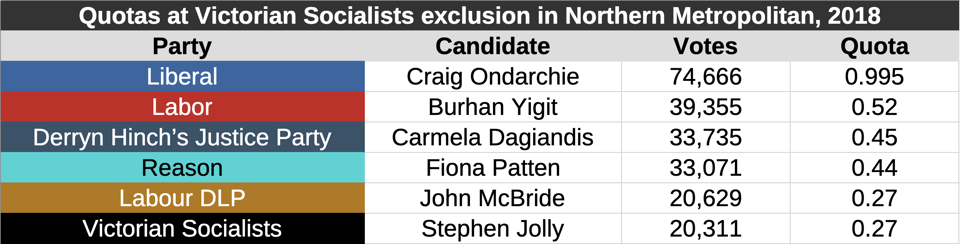
The Victorian Socialists and Labour DLP gained little votes throughout preference distribution. Both Carmela Dagiandis and Fiona Patten were the beneficiaries of preference spirals7, while the two major party candidates are stubbornly sitting on the exact same quota — or in Yigit’s place, even less due to below-the-line vote leakage to other parties — they had at the start.
In any case, the Victorian Socialists here had a much bigger hurdle to leap over given the remaining competition. Simply overtaking McBride wouldn’t have done it because they’d then get knocked out before Patten. The only hope here would have been doing well enough to overtake Patten, at which case they’d have gotten enough of her preferences to overtake Labor and win the fifth seat.
In the end, Ondarchie was elected after McBride of Labour DLP’s elimination, which also put both Diagiandis and Patten ahead of Labor’s Burhan Yigit. Yigit’s preferences then elected Patten.
Without group voting tickets, the result in 2018 almost certainly would have seen 3 Labor seats, 1 Liberal, and 1 Green.
So, what does all this mean for Victorian Socialists’ chances in Northern Metropolitan this year? I’d say they’re the best they’ve had in their history. Whereas group voting tickets had a neutral-to-positive effect for them in Western Metropolitan (where their vote was always weaker), they were undoubtedly harming them in Northern Metropolitan. Again looking at Bonham’s writeup, he reckons that Northern Metropolitan this year is likely to have one seat each for Liberal, Labor, One Nation and the Greens, with the final a close race between Labor, the Greens, and Victorian Socialists.
I would agree with this. Labor’s vote has held up relatively well here over the last few elections but given that it looks to be cratering statewide I would think they’d be lucky to get more than 1.5 of a quota this time around. I don’t know that One Nation will reach a quota but I suspect either minor right preferences like Family First or Liberal surpluses will see their lead candidate, Please Explain cartoonist Mark Nicholson, elected.
The right would struggle to pick up a third seat, though, and here’s where the Greens come in. In 2022 they had a not-insignificant surplus which, while not at all enough to put them in contention for a second seat, helped boost Reason above Victorian Socialists. There is no Reason this time, and I suspect Victorian Socialists will face little competition among minor parties like Labour DLP and Legalise Cannabis.
But here’s the thing. If the Labor vote is cratering and a not-insignficant amount of Fiona Patten voters are looking for a new party, where does that all go to? I think the main beneficiary here is likely to be the Greens, not Victorian Socialists, to the point that I would likely say the chance of two left-of-Labor seats in Northern Metropolitan is extremely high. This is not a perfect approximation, but the combined Greens/Reason/Victorian Socialists quota in 2022 was 1.62, enough to put them in the hunt in GVT and make them competitive without it.
Again, like in Western Metropolitan, both Labor and the Greens have preferenced the Victorian Socialists well — Labor has given them a second preference, while the Greens have put them third below Socialist Alliance, who are almost certainly not in contention for a Legislative Council seat. But I don’t expect these cards to be as uniformly followed as you might think.
Given the new preference system, Victorian Socialists will likely struggle to gain a significant amount of preferences throughout the count. They will have the aforementioned Socialist Alliance, yes, but who else? The problem is that they need to stay ahead of either Labor or the Greens to actually pick up their preferences, and if it’s Labor who goes first (as I suspect it will be) they’d want to be a good bit ahead of the Greens to be confident in victory.
The 8% figure in Northern Metropolitan on YouGov’s MRP is likely, I think, an overestimation, but even a 6-7% result would immediately put Victorian Socialists in contention for an upper house seat. If Victorian Socialists are trailing the Greens for a second seat I suspect it’s likely game, set, match, and even if they’re a bit ahead they could still be overtaken. But if the Greens have something like 1.35 quotas, and Victorian Socialists have 0.6 quotas, it seems pretty likely that the count would favour Omar Hassan of Victorian Socialists, and the people of Northern Metropolitan could elect the first socialist legislator in recent Australian history.
I mean technically it’s only two at the moment — Sandell’s Melbourne and Gabrielle de Vietri’s Richmond — but I’m including Brunswick, vacated by the death of Dr Tim Read, and excluding Prahran, currently held by the Liberal Party after a by-election in 2025. ↩
Keen readers may recognise Sack Dan Andrews Restore Democracy, as it is led by the same Tosh-Jake Finnigan who was just litigated against by the Greens for distributing deceptive how-to-vote cards in Prahran. ↩
Labor has preferenced Legalise Cannabis third and the Greens fourth, the Greens Australian Democrats third and Labor fourth. ↩
I have no idea why the Angry Victorians Party, a right-wing conspiracist party led by Heston Russell, preferenced the Reason Party, who are centre-left progressives, aside from a distaste for Glenn Druery. ↩
What is there to even say about Stephen Jolly? Christ. ↩
The Greens do have over 1.00 of a quota — 1.004, to be exact — but not all of that was with Ratnam at count’s start. ↩
Patten has claimed to be opposed to Glenn Druery’s way of politics. The Reason Party in 2018 received preferences from Vote 1 Local Jobs, Voluntary Euthanasia Party, the Victorian Socialists, Labor, and Animal Justice. This is broadly ideologically aligned but the former two seemed to me a product of a preference deal (Reason were second on both HTVs there.) ↩