The Gospel of Service Journalism
If your journalism doesn't serve your readers, who does it serve, exactly?
If your journalism doesn't serve your readers, who does it serve, exactly?
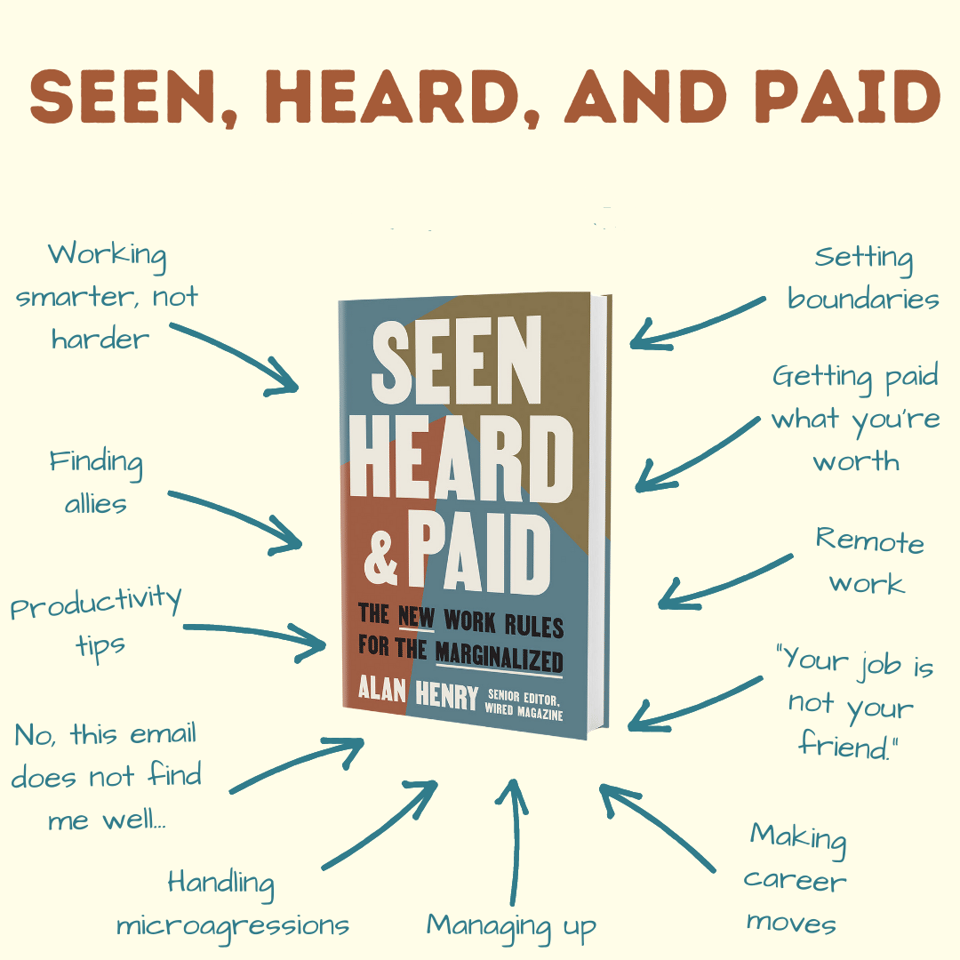
Hello and welcome back to Productivity, Without Privilege! I’m your host, Alan Henry, and my book, Seen, Heard, and Paid: The New Work Rules for the Marginalized, is an excellent addition to your own summer reading list, if you haven't picked it up yet. If you already have a copy, consider supporting me and this newsletter by either sending me a tip here or subscribing to my Patreon, which gives you early access to this newsletter, among other perks.
This time I want to chat a bit about "service journalism." In a lot of ways, service is the backbone of modern journalism—it's the kind that tells a reader something they specifically need to know, or some way to take action on an issue in their lives. Depending on the publication, it could be (and in my opinion, should be) integral to the publication's editorial mission, regardless of the subjects it covers. In others, it's sidelined to the usual commerce projects, bundled with affiliate links and listicles that tell you what to buy so the publication gets a cut of the purchase.
Neither approach is inherently bad, but I find that depending on the publication and its stated values, its masthead could look down on service journalism as little more than a way to make money, or it can be an all-encompassing approach that aims to leave your reader smarter, more informed, and more understanding of the world around them than they started. I don't think it'll be a surprise to any of you that I vastly prefer the latter.
***
When I worked at The New York Times, I had a conversation over coffee with the then-National Desk editor about the importance of service journalism. He and I commiserated over how important it was to cover news and important issues with clarity and context, and both of us dreamt of better tools to put stories on the page in front of our readers that also had sidebars or annotations that offered valuable historical context and additional reporting on some of the topics covered in the piece. That way, we hoped, someone could read a buzzy news story about something a politician said or did, but also learn more about how that politician has voted in the past, and our prior coverage of said topic over time, so a reader could learn more about their elected official as well as how truthful or well-documented the topic has been in history.
It was a great conversation, and while we never really got anywhere with those ideas, that philosophy has stayed core to the way I approach journalism as a discipline. I say it time and time again: "If your journalism doesn't serve your readers, who does it serve, exactly?"
Unfortunately, the answer that many publications don't want to say out loud is usually advertisers, shareholders, journalism award committees, and, too often, the ego and esteem of the journalist or publication itself. Worse, I find that even some of the most talented and respected journalists I know often fall into this trap; one I became acutely aware of during my time at The Times and also to an extent at WIRED, where something becomes important because we covered it, not because we were covering it because it was important.
While I definitely believe in the power of the platform, I always felt that it was a bit backward to try and make something into a big story, especially when it was something that everyone else was, on some level, already familiar with, especially when it came from Black culture or queer culture or even youth culture. After all, there's no faster way to make sure something is no longer interesting to the people who invented it than by parachuting in and acting like you've discovered something interesting without paying the appropriate credit to the people who created it.
***
So if you're a writer, and you're interested in making sure that your work is servicey, you have two options:
The first is to fully embrace "service journalism" as most publications define it. That means focusing on stories that help readers make buying decisions, offer them tips and tricks to improve their lives, and maybe even recommend specific tools. Consider it a kind of educational journalism, where you use your position as a journalist to act in your reader's place, helping them answer questions they may never even have known they had. Make no mistake, this was my trajectory, and it's immensely rewarding, but it's not without its downsides.
This is all fine as long as a publication believes in it, and to be honest, the way that the web has moved in the past several years (as in, centralizing information in the hands of platforms and not publications; AI chatbots and not experts or websites) has made the approach less profitable and sustainable than it used to be. I've been at several publications that loved service journalism in theory but had little patience for it in practice, mostly because service, when done this way, builds dedicated readers and an audience that appreciates you, but it may not necessarily earn awards, create a ton of buzz on social media or among competing journalists, or pull in tons of subscription or sponsorship dollars (although, when well done, it can absolutely pull in affiliate revenue that can stand the test of time). That means the publication's commitment to it is often short-lived and prone to mismanagement by people who don't understand how important it is, while those who need it most cry out for more.
The second is to embrace the principles of service journalism in everything you write, and I find this method is not only the most powerful but also the most enduring. Whatever you choose to cover or beat you prefer to follow, when you write, try to put yourself in your reader's mindset. While you're writing, ask yourself what a reader would want to know about this story. What additional context do they need to understand what you're reporting on? What background information could clarify the story you're writing about, and where should that information be in the story? Who benefits from the thing you're writing, and who suffers because of it? Does your work comfort the afflicted and afflict the comfortable, to use the old saying?
In short, ask yourself: Who is this story for? You probably already ask yourself the basics, like what this story is about and why it is important, but when every English teacher ever told you to consider your audience before putting pen to paper, they weren't talking about demographics necessarily. They wanted you to consider who'll read your work and why it will matter to them. This approach is usually far more palatable to editors who couldn't care less about "service," and will get your work considered on beats that people consider far from it. If anything, it's a lesson I think more people could take, even when covering things like business and politics. Especially business and politics, two coverage areas that have long left their mission to educate and inform readers in favor of currying favor and access, or treating real-world issues and human lives the same way sports journalists talk about two teams or leagues facing off for a championship.
***
If there's any specific area of journalism I could go on and on about, it's this one. It's too important, and too important to the future of journalism, to be left to journalism leaders who look backward rather than to the future, and who lust after long-gone audiences and their habits, overlooking how people consume news and media today (and how they will in the future).
I'm not the only person paying attention to this, either. Even as local journalism is on life support across the country, with more outlets being acquired by massive media companies backed by private equity, the most successful projects are learning that success comes from going back to basics.
Things as simple as "what's happening in my community" and "what's going on at the city council meetings" are more important than ever, and there are fewer journalists covering them (for a variety of factors I don't have time or space to get into here). Even things like "here's who to call about those potholes" or "here are all the new restaurants opening downtown" are powerful gateways for people looking for a good, practical reason to subscribe to a local pub. Especially over the all-too-common "here's a story regurgitating what police told us," or "these five wealthy residents have friends in leadership, so we're covering their complaints about a thing that will make thousands of lives better."
So at the end of the day, just try to remember the purpose of this profession in the first place, and why it's so important, before you let yourself get caught up and carried away in the current of self-importance and privileged access.

How 99 MPH Winds Left Gary in the Dark for Nearly Two Weeks, by Calvin Davis: The fine folks at Capital B News have been the only ones, as far as I can tell, that have regularly and consistently covered the fact that thousands of people in Gary, Indiana, have been without power for weeks because of both a powerful thunderstorm and the absolute incompetence and lackluster response from both state officials and the local energy utility. Don't get me wrong, I'm sure some people are working hard to restore power, but this story goes through exactly how this happened, and why the citizens of Gary—who, as you can probably tell, are Black—have had to suffer for so long. You can be sure those utilities will make sure those bill auto-payments go through on time, though. If you're interested in ways you can help, this piece from Block Club Chicago is full of ways to lend a hand.
Meta Glasses Are a Workplace Menace, by Mia Sato: Who could have possibly predicted that strapping a camera to someone's face and letting them record everything and everyone they see at all times, in public and in private, could lead to problems? Well, the answer is everyone. People from privacy activists to ordinary workers have been sounding the alarm about camera-enabled smart glasses since the Google Glass "Glasshole" days, and let's not pretend that people still use the tiny cameras on our mobile devices to be assholes, to this very day. And sure enough, everything we've predicted has come true: from people terrorizing retail and customer service employees and recording their "pranks" to go viral on social media, to far more surreptitious and almost certainly illegal uses of them. This story at The Verge goes into detail, and includes conversations with people who have and are actively being harmed by the invasion of pervert glasses, including how people who know they have power and privilege over others, whether they're retail workers or their own employees, are happy to walk on them so they can have their new toy on their face. And, of course, companies like Meta get to rake in the money all the while, pretending they didn't know these harms were coming, or that they're happening in real time.
South of Midnight Is a Master Class in Cultural Appreciation, by Jennifer Lufau: South of Midnight charmed me from its first reveal trailer, and now that I own it (thanks to a Black streamer friend of mine, and if you're reading this, thank you—I still plan to stream it myself), it's very high on my gaming backlog list. Sure, representation is part of it, but having watched another friend play the game through and experiencing the story secondhand, I can tell you my love for it goes much deeper, and blissfully, Jennifer Lufau, a French Black woman, explains why in this piece at Mothership (which I'm glad to see commissioned an actual Black person to write about this game). Oh, and if you do want to watch me play it, follow me over on Twitch! It's been a while since I went live, but I want to fix that as soon as I have time.

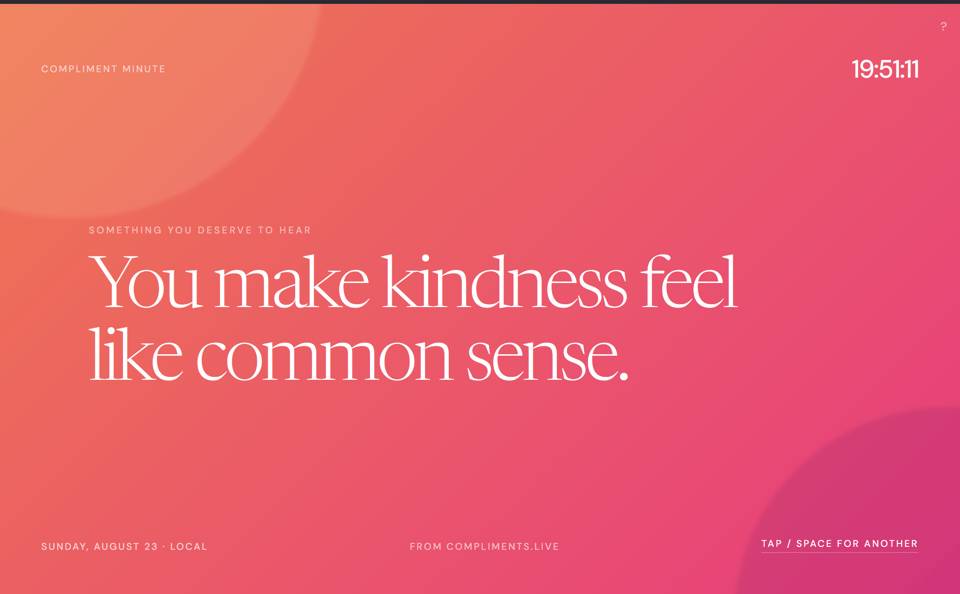
It's been a while since I've used any kind of special homepage beyond my browser's default blank tab page, mostly because I used to have a browser extension I loved that was bought by a shady developer and turned into adware. (Side note, watch out for those old or abandoned browser add-ons, kids.) But Compliment Minute, one of many amazing creations by Luke Steuber, is absolutely my new favorite new tab/new window page.
It's pretty simple, and it's not an add-on or anything: it's just a URL. If your browser lets you set a specific website to open when you open a new tab or window (and they all do), all you have to do is add it there.
Once you have, every new window is a positive reminder. Something you deserve to hear, as the site puts it, along with the time, and you can always tap or click the window (or press space) to see a new one. Simple, elegant, and truly, truly helpful. Give it a try.
***
That's all for this edition of Productivity, Without Privilege. If you enjoyed the newsletter, consider supporting me by dropping me a tip here or by subscribing to my Patreon for early access to the newsletter and my other projects. I promise, your support makes it all possible. I’ll see you back here soon.


