How To Deal With Workplace Abuse Disguised as Meetings
Some people are just verbal communicators, but others use "let's chat" as malicious cover.
Some people are just verbal communicators, but others use "let's chat" as malicious cover.
Here's something I think you can relate to: Every job has people who know little, but are very willing to share their opinions without actually asking people who do know for theirs. For example, I spend hours every week talking to folks who are not journalists, happy to tell me what kind of journalism they think would do well. They don't ask what's worked in my experience; they don't propose ideas; they simply tell. And while I've covered a lot of the reasons why they feel comfortable doing that in my book, that's not what I want to cover today.
Hi! I'm still Alan Henry, author of Seen, Heard, and Paid: The New Work Rules for the Marginalized, and I'm pretty stressed out! You probably are too. Also, consider supporting me and this newsletter by sending me a tip here or subscribing to my Patreon, which gives you early access to this newsletter and other perks.
Today, I want to talk about how those kinds of people tend to work, which usually involves pulling you into a meeting. They want to "touch base," "pick your brain," "sync," or whatever other corporate lingo they prefer, but what they really want is to avoid accountability.
Remember, good meetings have all of the trademarks that you probably only see rarely (which is even more evidence that most meetings are a waste of time): they have agendas, they have action items and specific time to address them, they're properly led by the owner of the meeting instead of becoming a directionless forum of talking heads, and they only invite people who need to be there and not just people who just want to hear their own voices.
In short, they're proof that no, this meeting could not have just been an email, because by the end, you've actually accomplished something, or agreed upon some action that needs to be taken, by whom, and by when.
Bad meetings, on the other hand, are the ones you're probably familiar with: They're directionless, have no real agenda other than the broad topic of the meeting, are usually spent bringing people up to speed on things that have already happened instead of what needs to happen, and often serve to make someone—usually a leader or someone with the privilege to tune out—feel better about a project than they actually help anyone get things done. Even worse, they can devolve into talking matches where participants jockey to make themselves seem productive and engaged to the other people in the room, regardless of whether the work itself is getting done.
Then there are the worst ones: meetings where you're stressed going in because it's less of a conversation and more of an excuse to corner you.
You probably know what I mean here. Sometimes it's impossible to avoid; it's your boss or another manager you can't duck, or ask to have your actual boss included on to protect you (and remember, a good boss will protect you from things like that if they're aware of them). In those cases, you have to fall back on probably the most powerful weapon you have in the workplace: data.
Remember your work diary? This is a good time to pull that out in your defense. This is a good time to have specifics on hand, such as "I have a document for that already; I shared it with you," or "We discussed that a week ago and you said…” I find that people who can't function without meetings are also the type who don't remember previous conversations, won't read updates or emails addressed to them, and are generally so disorganized that, if a marginalized person were the same way, they'd be fired.
You and I don't have that privilege, so you probably have the data to use here, and remember, data is power.
Your work diary is a powerful tool in these meetings in the other direction, too. When someone wants to corner you into agreeing to do something they want, or to do your work the way they want it done, document it. Then share it after your meeting with all the appropriate people who probably should have been in the conversation to begin with. If you can, before you agree to anything, document the conversation and instead of committing, say that you'll bring up their request with the others—or even just that you'll chat with your boss about it and go from there.
What you want to do here is defuse the situation without necessarily becoming combative or defensive, both of which play into them rather than you. They may want you to get defensive so they can talk about how difficult you are to work with, or view your hesitation to do what they want as you being obtuse and obstructing progress on the project. Instead, come into those conversations willing to chat, but committed to the proper process and making sure everyone is on the same page.
As with everything like this, the problem is systemic, while your reaction to it is individual. Until workplace abuse and toxic colleagues are actual issues that companies are willing to hold people accountable for, those of us without the privilege to push others around have to look out for each other and use whatever tools we can to protect ourselves. That doesn't make it right, and it doesn't make it right that you have to put in effort to adapt to those kinds of people.
Just remember, though, that your anger and frustration are justified, even if you can't share them openly with the people giving you a hard time and correct their behavior.

‘An Embodiment of White Fears’: How Zombies Went From Haitian Spiritual Tradition to Hollywood Monsters, by Soraya Nadia McDonald: This is the kind of documentary that's so important, but also the kind of thing that will make people uninterested in their own social literacy throw up their hands and say, "Why do you make everything about race?" (Spoiler: because it is.) The documentary discussed in this piece goes over how the concept of zombies started off as a part of Haitian spirituality, and ended up co-opted into pop culture as an expression of the fears white people have about their spaces being "invaded" by the other, dedicated to turning them into a twisted version of themselves. The piece is an interesting read, and the documentary sounds interesting too.
The Global Rise of Electoral Dictatorships. Is the U.S. Next? Midterms Could Decide, by Ibram X. Kendi: This examination of the rise of electoral dictatorships should be essential reading for anyone interested in modern politics. It describes how popular the strategy of suppressing—either through violence or intimidation—opposition political parties and candidates has become; in many countries, it has led to de facto single-party and single-leader states, places where constitutions are hurriedly amended to allow a particular leader to stay in power for as long as they like, or allow specific parties to obtain a lock on power they never have to relinquish. In short, the kinds of things that we used to look at other countries and sadly shake our heads at are becoming more common everywhere, including here at home. A quick look at the gutting of the Voting Rights Act and gerrymandering spree across the South are great examples of how American democracy is sliding in a similar direction.
Time to De-Privatize, by Robert Kuttner: I'm old enough to have seen a number of once venerable and useful institutions that we, as the taxpaying public, have relied on for ages get slowly and painfully dissected by profit-seeking institutions and carved into entities with the sole directive of increasing profit for shareholders, when once their priority was to provide a valuable or even necessary service to the public. This piece in The American Prospect argues that the staunch belief that business can do anything more efficiently and effectively than a publicly owned alternative has caused irreparable harm to both the US government and the public interest, and that this belief needs to be reversed as soon as possible. It's full of specific examples, but I can see no better culmination of this post-Reagan butchering than the current administration, where public funds are up for grabs to anyone with the ability to grovel for them, the right political perspective, or the right connections, merit and capability be damned.

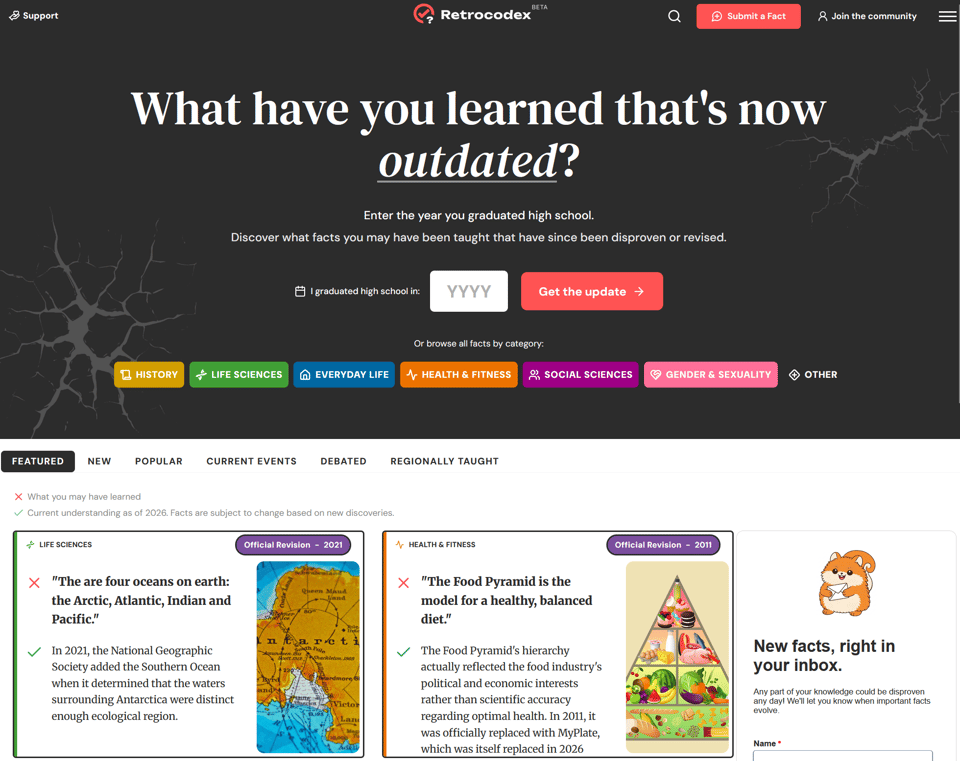
Listen, I'm not exactly the youngest person in the world, which means I learned a lot in school as a child—and even in college as an adult—that has since been debunked or updated by new information and discoveries. In some cases, I keep up with those developments myself (ah, cosmology, my love), but in other cases, like archeology or medicine, lots of things that I heard at some point in the past are just no longer true, and repeating them does everyone a disservice (no, we do not, and never have, used only 10% of our brains!)
Retrocodex is a site dedicated to correcting those old misconceptions, like bats being blind (while they do use echolocation, it's not because they can't see - most bats can see just fine!) You can type in the year you graduated high school at the top of the homepage, and the site will pull together a list of things that may have been part of school curriculum when you graduated, or were just considered common knowledge at the time, and then lets you know what we've learned since then. The older you are (I can hear my bones creaking), the more you have to catch up on. There are even toggles for things like folk wisdom, urban legends, and media claims, like the disinformation and misinformation we're all so familiar with today.
It's a fun little project, and many of the updated facts on the site are probably common knowledge to a lot of you, but they do seem to be adding new ones. They also have an email newsletter you can sign up for if you want new ones delivered right to you. For now though, I'm happy to bookmark this one and check back from time to time and see what's been added.
***
That's all for this edition of Productivity, Without Privilege. If you enjoyed the newsletter, consider supporting me by dropping me a tip here or by subscribing to my Patreon for early access to the newsletter and my other projects. I promise, your support makes it all possible. I’ll see you back here soon.


