|
|
MODEL
SEISMIC
2026-09-21
Grok 4.7 — xAI's most capable model for coding and knowledge work
xAI's Grok 4.7 lifts coding and engineering scores over Grok 4.6 while holding the same $2/$6 price and 500K context.
What is it?
Grok 4.7 replaces Grok 4.6 as xAI's top Grok model, released 21 September 2026. xAI built it on a larger base model than 4.6 and ran more reinforcement learning on harder, longer-running tasks, saying the result is better at checking its own work and managing long context.
How does it work?
The extra reinforcement learning targets self-verification, so the model tests its own output before moving on. Reasoning effort is a dial — low, medium, high (the default), or xhigh — and Grok 4.7 supports function calling, web search, X search, and code execution.
Why does it matter?
xAI kept the same $2 per million input tokens and $6 per million output tokens it charged for Grok 4.6, so teams already paying for 4.6 get the gains without a budget change. Grok 4.7 moves Terminal-Bench 4.0 from 20.3% to 38.0% and GitHub Copilot added it the same day.
Who is it for?
Teams running coding agents, and anyone who was already using Grok 4.6 via xAI API, Cursor, or GitHub Copilot.
|
|

|
|
MODEL
MAJOR
2026-09-21
MiMo-V2.6 — Xiaomi's trillion-parameter model ships under MIT
Xiaomi released MiMo-V2.6 with open MIT weights, a 1M-token context, and cybersecurity scores far above its own V2.5 line.
What is it?
Three new models join Xiaomi's MiMo line: a trillion-parameter Pro built for long-horizon and cybersecurity work, a cheaper full-modality Flash, and an UltraSpeed build of Pro that Xiaomi says runs up to 20x faster. Weights are on Hugging Face under the MIT license.
How does it work?
The Pro model is a sparse mixture of experts — 1.02 trillion total parameters with 42 billion active per token, 384 routed experts of which 8 fire per token, and a 1M-token context. Xiaomi credits the gains to scaled reinforcement learning over 1,568-prompt batches with 16 rollouts per step.
Why does it matter?
An MIT license on a trillion-parameter omni-modal model is unusual — teams can self-host, fine-tune, and ship it commercially with no usage restrictions. On Terminal Bench 2.1, Pro reaches 89.9%, and on CyberGym it jumps to 94% from just 40% for MiMo-V2.5 Pro.
Who is it for?
Teams self-hosting open-weight frontier models, especially those working on cybersecurity, long-horizon agents, or multimodal pipelines.
|
|

|
|
REPO
MAJOR
2026-09-22
vLLM v0.30.0 — engine restarts skip the disk with a GPU weight cache
Fast Start keeps post-quantized weights resident in GPU memory, so a restarting vLLM engine maps them instead of reloading them.
What is it?
Fast Start is the headline addition: a persistent per-GPU daemon that holds post-quantized, tensor-parallel-sharded weights in GPU memory. Engines started with --load-format ipc_cache map those weights over CUDA IPC rather than reading a checkpoint off disk.
How does it work?
Garbage collection is frozen during CUDA graph capture, cutting capture time from 12s to 2s and engine init from 28.9s to 8.2s on an H200. A new HiSparse tier spills KV pages to pinned host memory when a sparse-MLA model fills GPU, then serves top-k misses from a per-request GPU hot buffer.
Why does it matter?
Restart cost is what makes autoscaling a serving fleet expensive. Mapping cached weights removes most of it — useful for anyone who redeploys often or runs RL loops that tear engines down between steps. Note: scale-out endpoints are now opt-in via --enable-scale-out.
Who is it for?
Inference and platform engineers running LLM serving fleets, autoscaling deployments, or RL training loops that frequently restart the engine.
|
|

|
|
ECOSYSTEM
MAJOR
2026-09-21
Advisory Group on Mathematics and AI — nine mathematicians advise OpenAI
Nine mathematicians now advise OpenAI on how its AI math results reach the public — with no power to slow the research down.
What is it?
The Advisory Group on Mathematics and Artificial Intelligence is a new independent body of nine mathematicians hosted at the Institute for Advanced Study in Princeton. Members are unpaid, work independently of any AI company, and are free to go public with concerns.
How does it work?
Review and release timing is the group's main job — it helps OpenAI judge how significant a new mathematical result is and advises on how and when to publish. OpenAI states one boundary plainly: the group will not advise it on how to pace its internal research.
Why does it matter?
Mathematicians get a named channel into OpenAI after 25 Fields Medallists signed an open letter calling out misalignment between AI labs and the math community. OpenAI paired the announcement with a claim that an internal model has already resolved more than 100 open problems.
Who is it for?
Mathematicians and AI research watchers following the question of how AI-generated proofs reach peer review — and how fast labs are moving on hard mathematics.
|
|
|
|
MODEL
MAJOR
2026-09-20
Hemmingway-1 — a 27B open model tuned for everyday messages
A 27B open model that answers a request for an email with the email, and nothing else.
What is it?
Hemmingway-1 hands back the message you asked for instead of three options, a preamble, and a paragraph explaining the options. Altworld trained the 27B open-weight model on the writing people do all the time — the note to a landlord, the reply to a coworker, the message that keeps coming out wrong.
How does it work?
Underneath is a fine-tune of Qwen3.8-27B with a 262,144-token context window. Altworld scored it by blind head-to-head matchups on 80 real requests, each judged by a model that was not among those being compared.
Why does it matter?
EQ-Bench 4 — the one benchmark that isn't Altworld's own — put Hemmingway-1 third, ahead of GPT-5.5 and Claude Opus 4.8, just twelve points off the top. A 27B model landing there means a single consumer GPU can cover routine message drafting with no API bill.
Who is it for?
People who draft a lot of routine messages and anyone running writing models locally. Apache-2.0 license means commercial use is allowed.
|
|
|
|
ARTICLE
NOTABLE
2026-09-20
Colin Breck — AI-drafted proposals cost the reader more than they save the writer
The case that generated prose shifts the cost of thinking from the person writing to every person reading.
What is it?
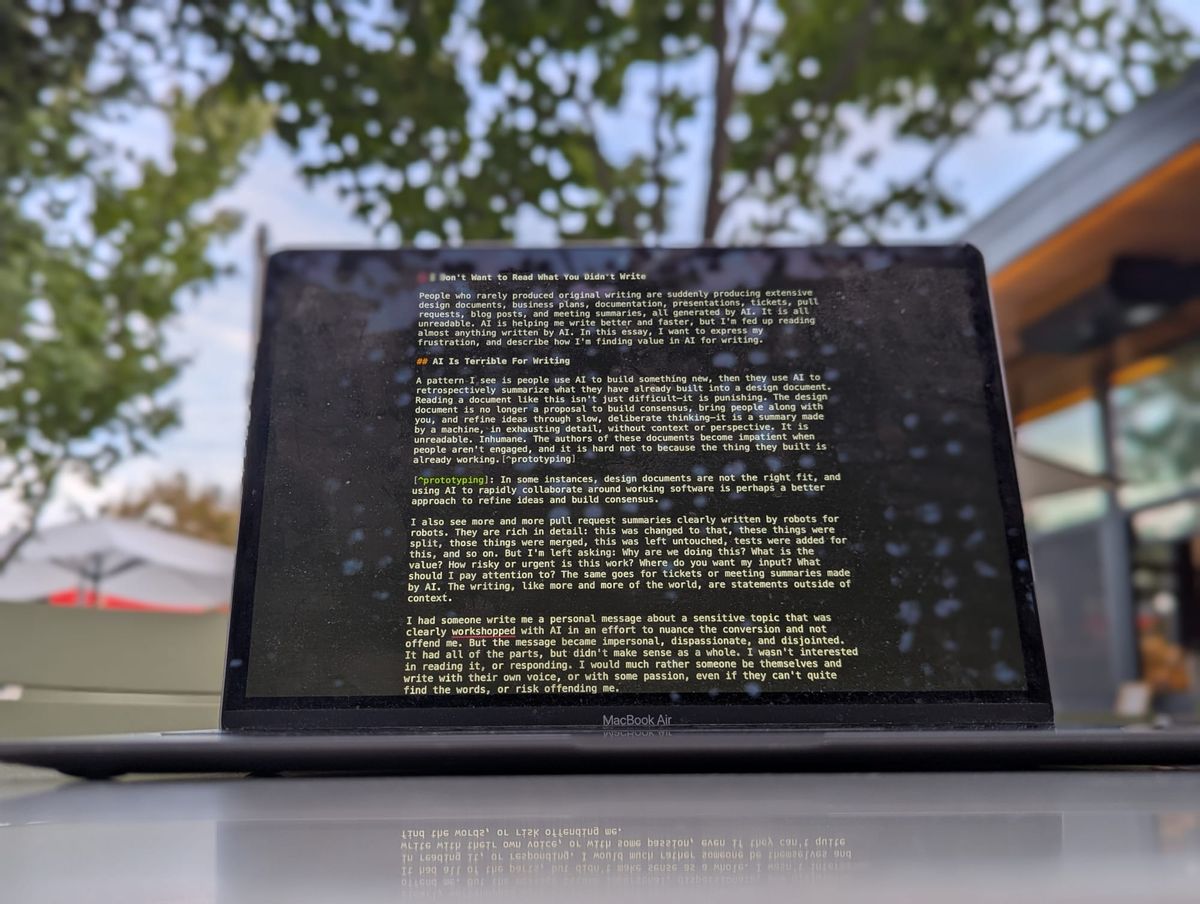
Colin Breck's argument is about what a reader loses, not about whether a model writes well. He describes colleagues now circulating long AI-generated design proposals and calls the result unreadable: the reader has none of the context that let the author decide what mattered.
How does it work?
Breck separates two uses: generating a draft is out, because the act of choosing what to say is the thinking itself. Using a model as an editor or fact-checker is in, as long as the human keeps control of every sentence.
Why does it matter?
This is the reader-side half of an argument the field keeps having from the writer's side. Breck aims at internal documents — the design proposal, the status update, the thing a team is obliged to read. His proposal is a norm rather than a ban: own the draft, then let the model check it. The post reached 785 points on Hacker News.
Who is it for?
Engineers and managers who write or review design documents, and anyone thinking about where to draw the line on AI-assisted writing at work.
|
|
|
All releases at ai-tldr.dev
Simple explanations • No jargon • Updated daily
|
|