|
|
TOOL
MAJOR
Sep 19, 2026
OpenClaw 2026.9.5 — plugins hot-reload and GPT Live joins your calls
Plugins now install while the Gateway keeps running, and OpenClaw 2026.9.5 can sit in a meeting or a phone call with you.
What is it?
Plugin hot reloading arrives in OpenClaw 2026.9.5: a plugin installs without a Gateway restart, so the agent stays up while you add to it. The same release adds GPT Live for meetings and phone calls, read-only conversation sharing, and shared browser pages you can work on next to the agent.
How does it work?
Updates in 2026.9.5 are atomic — the installer checks the next version before switching over. Guided specialist teams turn multi-agent setup into a wizard that creates named roles such as chief of staff, researcher and writer, generating an avatar for each one during setup.
Why does it matter?
A self-hosted gateway that restarts for every plugin is one your team notices. Hot reloading removes that pause, and the atomic update check removes the other common outage — a release that reveals its problems only after it is already installed.
Who is it for?
Self-hosters and teams running OpenClaw gateways. This release lands 4,179 pull requests from 502 contributing accounts.
|
|
|
|
SECURITY
MAJOR
Sep 20, 2026
OpenAI's __obi cookie — ChatGPT accounts tracked across advertiser sites
A signed ChatGPT identifier follows users onto advertiser websites, a threat-intel report finds.
What is it?
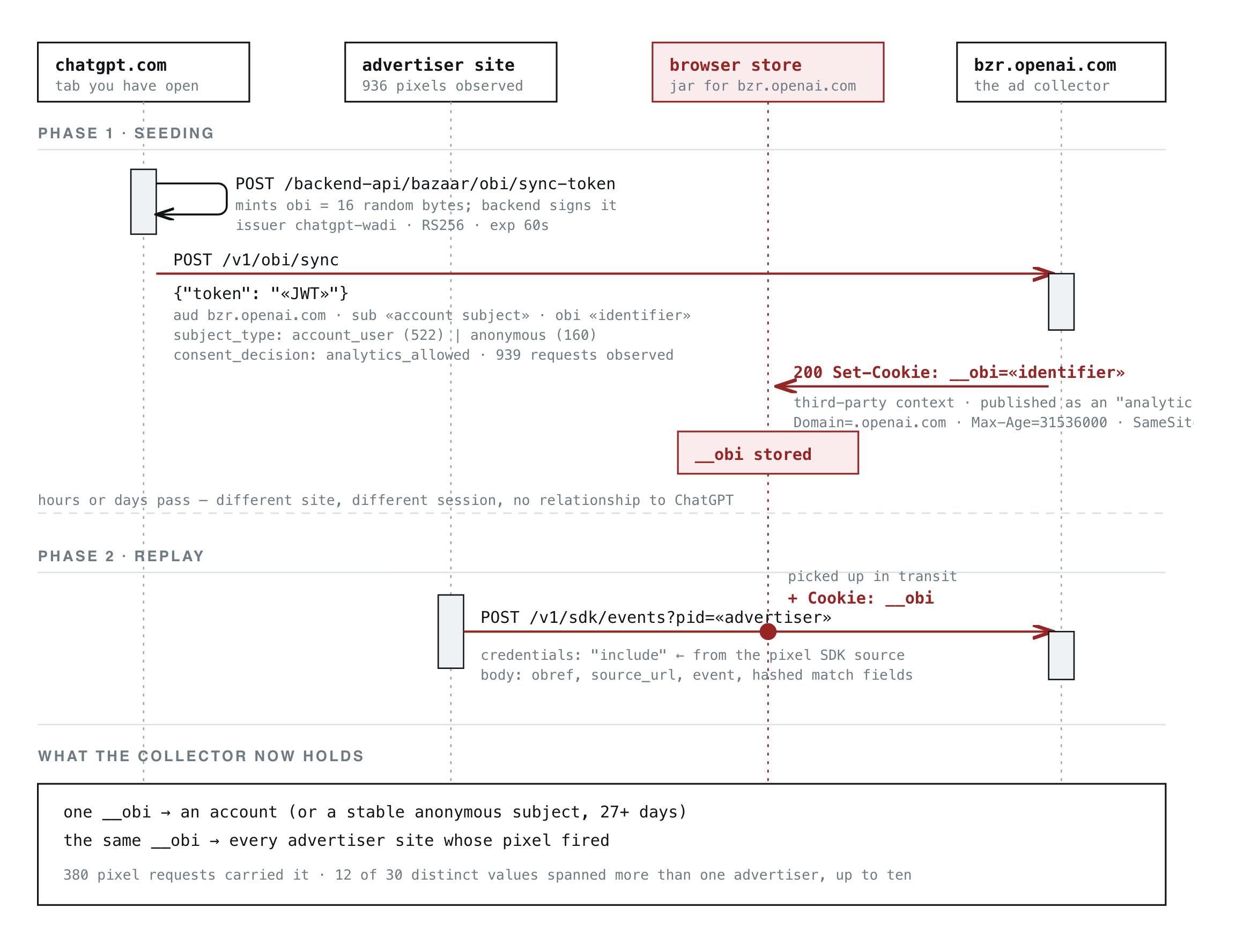
__obi is a cross-site tracking cookie OpenAI sets on .openai.com with a one-year expiry, bound to the signed-in ChatGPT account. Buchodi's Threat Intel published a teardown showing the cookie riding along whenever a user lands on an advertiser site that runs OpenAI's pixel — and OpenAI labels it an analytics cookie, so declining marketing consent does not stop it.
How does it work?
ChatGPT generates a 16-byte random identifier, gets it signed as an RS256 JWT bound to the account, then sets it as the __obi cookie with SameSite=None and Secure so browsers send it cross-site. Any page running OpenAI's advertiser pixel then ships __obi back to OpenAI together with whatever the pixel scraped — including email, phone number and postal code.
Why does it matter?
Of 932 decoded tokens, 736 pointed at a ChatGPT account; the pixel was seen on 12 commercial sites including Chewy, Wayfair, HelloFresh and Coursera. People tell a chat assistant things they would not post on social media — that data now flows to the ad ecosystem.
Who is it for?
ChatGPT users and privacy engineers. OpenAI acknowledged the findings but has not answered questions about how consent is handled.
|
|

|
|
MODEL
MAJOR
Sep 20, 2026
Qwen-Image-2.1 — a 7B open image model on a research-only license
Alibaba's Qwen team ships a 7B image generator that edits from ten reference images, under a non-commercial license.
What is it?
Native transparency is the headline change: Qwen-Image-2.1 generates and edits RGBA images directly, so an object can sit on a transparent layer instead of a painted-in background. One 7B model covers both text-to-image generation and image editing, drawing on up to 10 reference images per edit.
How does it work?
The visual generation component is 7B parameters across 32 Single-Stream DiT layers. Edits are steered locally — circle a region, paint on it, or hand the model a separate mask. It ships as a diffusers pipeline called QwenImage21Pipeline.
Why does it matter?
The license is the catch: Qwen-Image-2.1 ships under the Qwen Research License (non-commercial only), while the earlier Qwen-Image was Apache 2.0. For researchers the trade is a small model reported to run on a consumer RTX 3090, with transparency and multi-reference editing that usually need a hosted API.
Who is it for?
Researchers and hobbyists generating or editing images locally. Commercial users must apply to Qwen for a separate license.
|
|

|
|
TOOL
MAJOR
Sep 20, 2026
AX v0.3.0 — Google's agent orchestrator moves task state to Redis
Google's open agent orchestrator splits into three services and keeps task state in Redis instead of Kubernetes.
What is it?
AX v0.3.0 splits Google's open agent orchestrator into three separate services — an API front end, a reconciler, and a sandboxed task runner — replacing the single CLI with an embedded Python harness. Task state moves from Kubernetes custom resources to Redis Streams to handle millions of short-lived tasks.
How does it work?
Jobs are declared as YAML manifests built from four primitives covering the sandbox, its pre-wired Git repos and MCP servers, its outbound network allowlist, and model credentials. You apply a manifest the way you apply a Kubernetes object, then watch, suspend or resume the running task from the CLI.
Why does it matter?
Kubernetes custom resources backed by etcd were not built for the churn of millions of short-lived coding-agent jobs. Redis Streams removes that ceiling. The trade-off: v0.3.0 deletes the old Python harness and ATE client, so anyone on v0.2.x faces a real migration.
Who is it for?
Platform and infrastructure engineers running coding agents at scale. Apache-2.0, written in Go.
|
|
|
|
TOOL
MAJOR
Sep 20, 2026
Pirate Face — open model weights turned into magnet links
Pirate Face mirrors open Hugging Face models as checksum-verified torrents, so the weights stay downloadable after the original is pulled.
What is it?
Pirate Face turns open model weights into BitTorrent magnet links. The site lists more than 669,000 eligible Hugging Face models — LLMs, image models, audio models and datasets — and gives each one a magnet link anyone can download and seed. Only Apache-2.0 and MIT weights are mirrored.
How does it work?
Every file in a torrent carries its official Hugging Face SHA-256 fingerprint, so a copy from any peer has to match the original byte for byte. An HTTPS web seed pointing at Hugging Face is built into each torrent — when Hugging Face stops serving the file, the swarm keeps serving it.
Why does it matter?
Open weights do disappear: repos get gated, relicensed or deleted, and work that depended on them stops being reproducible. A magnet link with a published hash gives researchers a copy no single host can withdraw, and the hash prevents quietly swapping in different weights.
Who is it for?
Researchers and self-hosters who want a censorship-resistant archive of open model weights.
|
|
|
|
BENCHMARK
MAJOR
Sep 19, 2026
Brood War Bench — Codex Astra wins all 18 of its StarCraft games
A round-robin StarCraft: Brood War tournament where 19 AI agent setups play each other instead of solving coding tasks.
What is it?
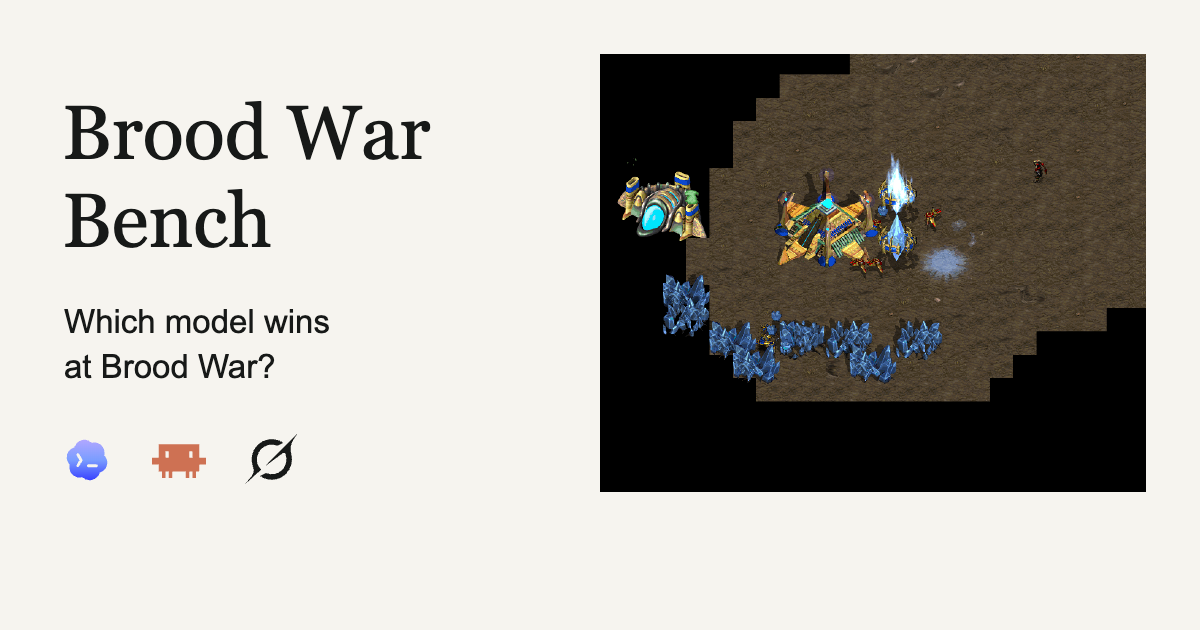
Brood War Bench scores AI agents on a real-time strategy game rather than a coding or reasoning test. Ben Swerdlow ran a round-robin in which 19 model setups faced each other; the leaderboard lists wins, losses, actions per minute and dollar cost per game.
How does it work?
Matchups ran in parallel on Freestyle VMs, which saved game-engine data and agent logs. The clock never stops while a model thinks — slow reasoning is punished in real time. In one game Grok 4.6 generated 11,138 reasoning tokens but issued only six command batches across 43 minutes.
Why does it matter?
Most agent evals let a model take as long as it likes. Real-time play removes that cushion, so Brood War Bench measures how well a model converts thinking into timely action — and the cost column prices it from $0.16 to $21.07 a game. Codex Astra at xhigh went 18-0 (100%); Claude Haiku went 0-18.
Who is it for?
Agent researchers and eval builders looking for a benchmark that tests real-time decision-making rather than correctness.
|
|
|
All releases at ai-tldr.dev
Simple explanations • No jargon • Updated daily
|
|