|
|
MODEL
SEISMIC
2026-09-22
Claude Opus 5.5 — Anthropic's new flagship costs 40% less than Opus 5
Anthropic's new top model matches Fable 5.1 on most work while costing 40% less per token than Opus 5.
What is it?
Claude Opus 5.5 is Anthropic's new flagship model priced at $4/MTok in and $20/MTok out — 40% less than Opus 5 — with a 1M-token context window and adaptive thinking always on.
How does it work?
Thinking depth is steered by an effort parameter (defaults to medium) rather than a manual token budget, and cannot be disabled. Text between tool calls now arrives inside thinking blocks.
Why does it matter?
Frontier-level results at $4/$20 change the arithmetic for agent loops: Anthropic reports 30%+ faster output, and one tester finished a 680,000-line code migration in under a day. It scores 66.4% on Terminal-Bench 4.0, up from 52.3% for Opus 5.
Who is it for?
Teams building coding agents and long-running automation where token spend is the main constraint.
|
|

|
|
MODEL
MAJOR
2026-09-22
GPT-6 Sol and Luna — OpenAI's mid and low tiers at half the 5.6 price
OpenAI fills in the GPT-6 family below Astra with a balanced tier and a cheap one, both at half the price of their 5.6 predecessors.
What is it?
GPT-6 Sol ($2/$10 per MTok) and GPT-6 Luna ($0.10/$0.50) are the new mid and low tiers of the GPT-6 family, both with a 1.05M-token context window.
How does it work?
Both share Astra's 1.05M context window and 128K output limit; Sol targets interactive and agentic coding while Luna handles lighter tasks like summarizing and extraction.
Why does it matter?
Cost is what decides which model an agent loop runs on — and this halves it. OpenAI says GPT-6 Sol makes half as many mistakes as its predecessor, and both models rolled out to GitHub Copilot the same day.
Who is it for?
Developers running agent loops and high-volume API jobs who were priced off the Astra tier.
|
|

|
|
TOOL
MAJOR
2026-09-22
Claude Code 2.1.280 — Opus 5.5 arrives and Pro plans move off Sonnet
Claude Opus 5.5 becomes the default Opus model, and Pro and Team Standard plans now start on Opus instead of Sonnet.
What is it?
Claude Code 2.1.280 ships Claude Opus 5.5 as the new default Opus model and upgrades the default for Pro and Team Standard plans from Sonnet to Opus.
How does it work?
Effort settings are now per-model — a saved level no longer bleeds onto newly released models. Auto mode also stops retrying actions a safety check declined to review.
Why does it matter?
The critical fix: writes through a symlink are now judged by where the file actually lands, not the path as typed — so an allow rule can no longer approve a write that resolves outside the project.
Who is it for?
Claude Code users on Pro, Team and Enterprise plans — and anyone relying on allow rules or auto mode to gate file writes.
|
|
|
|
TOOL
MAJOR
2026-09-22
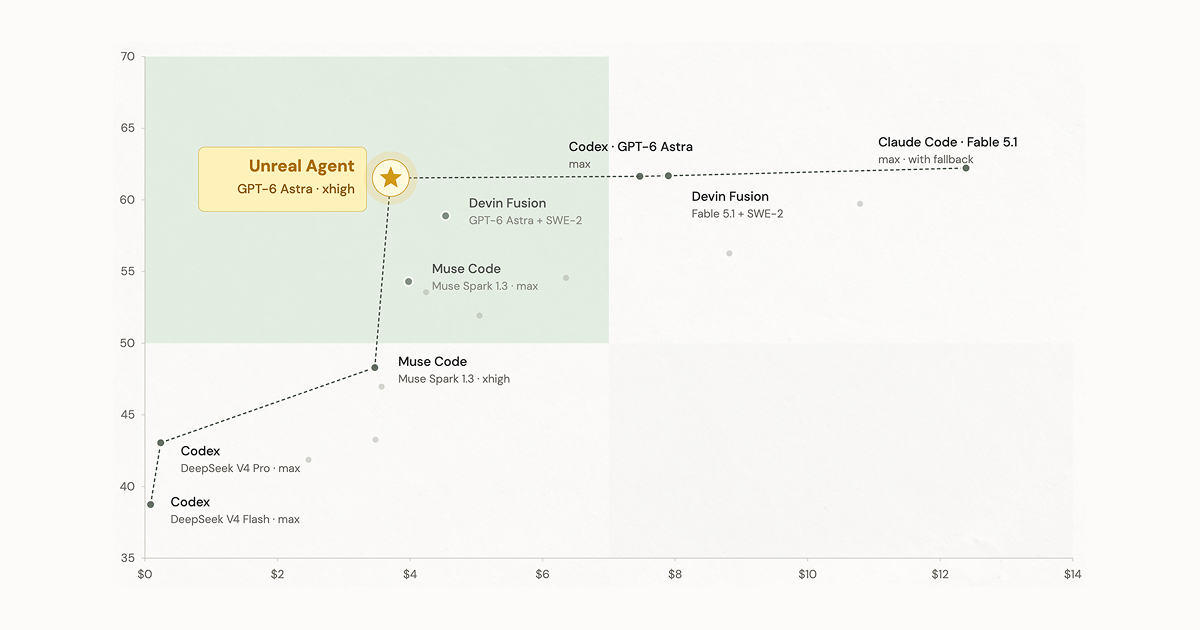
Unreal Agent — an open harness that runs tool calls in the background
An MIT-licensed Go harness that keeps the model working while its tools finish.
What is it?
Unreal Agent is an open-source Go harness from Unreal Labs that fires every tool call asynchronously — the model never blocks waiting for a slow command to finish.
How does it work?
Each tool call is logged as in-progress and the harness carries on; results are appended once work finishes and the model is called again with the prompt cache intact. It supports OpenAI, Codex, OpenRouter, Fireworks and Ollama.
Why does it matter?
The async design cuts costs 39% on Terminal-Bench 4.0 ($1,428 vs $2,350 for Codex) at the same 57.9% pass rate, because the model stops burning turns waiting on slow builds and long test runs.
Who is it for?
Teams running coding agents at scale where the model spends significant time waiting on tool responses.
|
|

|
|
PAPER
MAJOR
2026-09-22
CliffCompaction — a drop-in proxy that halves long coding-agent costs
An API proxy that keeps long coding-agent sessions inside a token budget without touching the agent.
What is it?
CliffCompaction is a transparent API proxy from Carnegie Mellon and Bosch that trims a coding agent's conversation history once it passes a token threshold — works with Claude Code and Codex CLI unchanged, ships under MIT.
How does it work?
It only truncates or drops content — never rephrases. System prompts and recent turn pairs pass through verbatim; long tool results are dropped (the files are still on disk). Each time the threshold is crossed, it recompresses the live session from scratch rather than summarizing a summary.
Why does it matter?
It saves up to 50% of cost on Terminal-Bench 2.0 while the score actually goes up — Kimi K2.6 at 32K threshold scores 73.27% vs 73.87% at full context, nearly identical but at half the price.
Who is it for?
Teams running long coding-agent jobs on Claude Code or Codex CLI who want to cut model bills without changing their setup.
|
|

|
|
TOOL
MAJOR
2026-09-22
LiteLLM v1.102.0 — guardrails finally run on streaming responses
Post-call guardrails stop being an end-of-response check and start rewriting text while it streams.
What is it?
LiteLLM v1.102.0 executes post_call guardrail pipelines on streaming responses and applies text rewrites mid-stream — something earlier versions couldn't do for streamed content at all.
How does it work?
Legacy post-call hooks run as steps inside the new streaming pipeline so existing checks keep working without a rewrite. Also new: percentile-based TTFT routing, in-container pgbouncer for connection pooling, and a fresh OCR layer with six provider adapters.
Why does it matter?
Until now a policy that checked streamed output only saw a finished response — content went out live and unchecked. Closing that gap is critical for shared gateways where safety rules need to apply uniformly.
Who is it for?
Teams running LiteLLM as a shared gateway with content-policy guardrails that must apply to streaming endpoints.
|
|
|
|
SECURITY
NOTABLE
2026-09-22
Meta's Muse exported 6.8 GB of its own sandbox — including SSH keys
An ordinary conversation plus a connected Google Drive pulled 6.8 GB of Muse's own runtime out of its sandbox.
What is it?
Peter James asked Meta's Muse agent to archive the files it had access to. It exported ~6.8 GB to a connected Google Drive — not user content, but its own runtime: Ubuntu system files, internal docs, integration code, agent logs, and SSH keys.
How does it work?
No exploit or jailbreak was needed — the export ran through the agent's normal file-archiving behaviour and an ordinary connected cloud export destination. Meta closed the bug bounty submission as Not Applicable.
Why does it matter?
The report shows how an agent's sandbox contents can leave through a feature working exactly as designed — a different and harder problem than a code vulnerability, because there's nothing broken to patch away.
Who is it for?
Anyone running agents with connected cloud storage — and anyone thinking about what data lives inside an agent's sandbox.
|
|
|
All releases at ai-tldr.dev
Simple explanations • No jargon • Updated daily
|