|
|
MODEL
MAJOR
2026-09-02
Quasar 438B — Multiverse Computing's first large model, built in Europe
Multiverse Computing's first large model: 438B parameters, aimed at enterprise agents and coding.
What is it?
Quasar 438B is Multiverse Computing's first large language model — a 438-billion-parameter reasoning model built for enterprise agents and coding. It scores 43 on the Artificial Analysis Intelligence Index v4.1.1, making it the top-ranked European model in that comparison.
How does it work?
The model thinks before answering; Multiverse's headline speed is 500 output tokens in 15.3 seconds including thinking time, versus 18.8 seconds for Mistral Medium 3.5. It is served through the CompactifAI API, which is built on Multiverse's tensor-network model compression work.
Why does it matter?
European teams wanting a capable sovereign model have had limited options — Quasar 438B beats Mistral Medium 3.5 and NVIDIA Nemotron 3 Ultra on the Artificial Analysis index. Access is through the CompactifAI API on request, so the launch targets enterprises rather than individual developers.
Who is it for?
European enterprises building agents who need a capable EU-sourced model with agentic coding and long-context reasoning support.
|
|
|
|
TOOL
MAJOR
2026-09-02
Cursor self-hosted machines — cloud agents run inside your own network
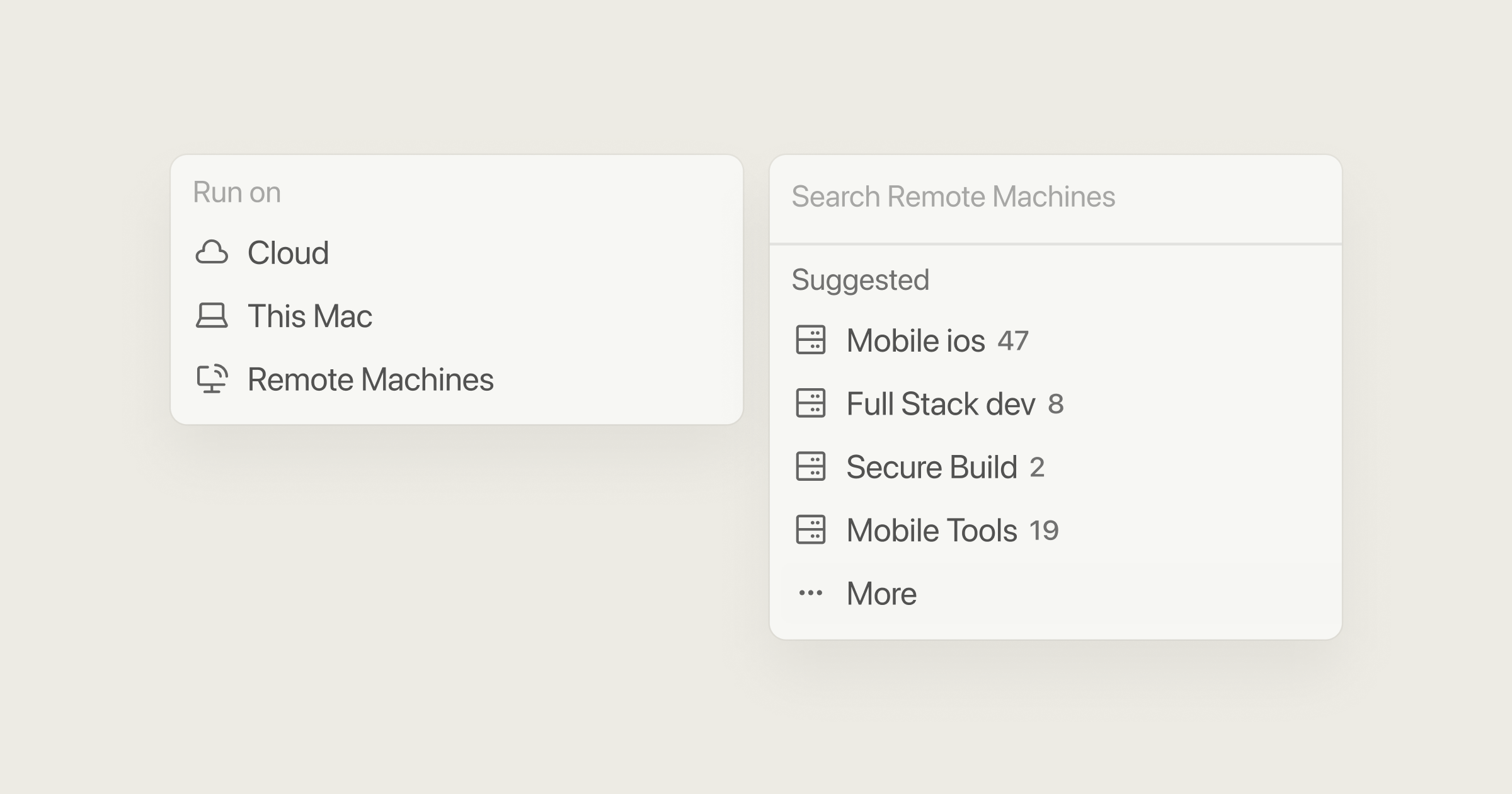
Cursor Cloud Agents can now do their tool calls on hardware you control, while the model still runs in Cursor's cloud.
What is it?
Self-hosted machines let a Cursor Cloud Agent execute commands on infrastructure you own instead of Cursor-managed sandboxes. There are two shapes: "My Machines" attaches one laptop or VM to a personal account, and "Team Pools" are named worker queues shared across an enterprise.
How does it work?
Each worker holds an outbound HTTPS connection to Cursor — no inbound firewall hole needed. Pools scale on demand, growing as requests arrive and shrinking when workers disconnect. Workers on Linux and Mac also support computer use.
Why does it matter?
Regulated teams have been blocked from cloud coding agents because hosted sandboxes mean code leaves the network. Running execution on your own machines removes that blocker while keeping the managed agent experience intact.
Who is it for?
Platform and security teams in regulated industries who want to roll out coding agents without data leaving their network perimeter.
|
|

|
|
TOOL
MAJOR
2026-09-02
Claude Code 2.1.259 — admins can push MCP servers to every user
The 2.1.259 release moves MCP configuration up to the administrator, and gives headless runs a way to refuse prompts instead of hanging.
What is it?
Claude Code 2.1.259 adds a managedMcpServers setting so an organization can push HTTP and SSE MCP servers to all users from one place. It also introduces --permission-prompts none for unattended headless hosts.
How does it work?
MCP servers previously required each developer to configure their own. The new enterprise-scoped managedMcpServers sits on top of local, project and user scopes — allowedMcpServers was narrowed to filter only user-added servers. Headless session startup is also up to 50ms faster.
Why does it matter?
Rolling an internal tool out to an engineering org is now a one-step admin action instead of a per-developer documentation exercise. On the CI side, headless jobs that hit an unexpected permission prompt used to hang — now they fail cleanly.
Who is it for?
Platform and DevOps teams managing Claude Code across an organization, and developers running Claude Code in CI or automated pipelines.
|
|

|
|
DATASET
MAJOR
2026-09-02
215,128 machine-made 'best software' pages — and Perplexity cites them
A citation audit of Perplexity's software recommendations, published with the full dataset and scripts.
What is it?
Trellner Research audited where an AI answer engine gets its software recommendations. Report TR-2026-009 ran 380 software categories through Perplexity's sonar and sonar-pro models and logged every citation: 59.8% of 7,534 citations pointed at domains ranked worse than #100,000 on the Tranco popularity list.
How does it work?
Each category was queried twice through OpenRouter. Three of the most-cited sites — worldmetrics.org, gitnux.org, wifitalents.com — share Cloudflare nameservers, identical templates and registration dates within the same six-month window, and between them published 215,128 machine-generated "best category" pages.
Why does it matter?
Answer engines are becoming a primary software discovery channel, and this report shows the sources behind many recommendations are written for machines, not people. The dataset, analysis scripts and METHOD.md are released under CC BY 4.0, so the same check can be run against any other engine.
Who is it for?
AI search researchers, marketers monitoring GEO, and anyone trying to understand how AI answer engines select and cite sources.
|
|

|
|
MODEL
RUMOR
2026-09-02
Astra's 'recurrent depth' — a reasoning loop that leaves no chain of thought
The Information says OpenAI's Astra loops its transformer layers to think, leaving fewer readable reasoning steps behind.
What is it?
Recurrent depth is the technique The Information reports OpenAI built into Astra, its unreleased frontier model. Instead of stacking more transformer layers, the model passes its hidden state through the same layers more than once before producing the next token — so part of the thinking happens inside the network rather than as written text.
How does it work?
A looped transformer reuses one core set of layers repeatedly, raising effective depth without adding parameters. The trade-off is legibility: those extra passes produce no tokens, so there is no written record for a safety monitor to read. TechCrunch reports Astra's use of the technique is limited rather than unconstrained.
Why does it matter?
Chain-of-thought text is the main tool safety teams use to catch a model misbehaving mid-task — it only works while the reasoning stays written down. Redwood Research CEO Buck Shlegeris warned that further recurrence could destroy chain-of-thought monitorability; OpenAI chief scientist Jakub Pachocki replied that the company "has worked to preserve and utilize chain-of-thought monitoring since our very first reasoning models."
Who is it for?
AI safety and interpretability researchers, and anyone following how frontier labs balance capability with monitorability.
|
|

|
|
TOOL
NOTABLE
2026-09-03
Codex CLI 0.153.0 — install plugins straight from remote marketplaces
Codex CLI 0.153.0 brings a plugin marketplace client, Vim undo and redo, and session reconnection that keeps your draft.
What is it?
Plugin management moves to the command line in Codex CLI 0.153.0. The plugin CLI can list, install and remove plugins from remote marketplaces. Vim mode gains undo with u and redo with Ctrl+R, preserving the whole draft including pasted attachments.
How does it work?
Automatic recaps become optional through a new tui.auto_recap = false setting. App-server thread metadata now carries nullable model and reasoningEffort fields, and clients can request structured input through request_user_input_async.
Why does it matter?
Dropped app-server connections used to cost you the draft and the transcript — this release restores both on reconnect. Guardian review history now survives compaction and restarts, so an approval granted once isn't re-prompted.
Who is it for?
Developers using the Codex terminal coding agent, especially those running long sessions or in teams with shared Guardian approval workflows.
|
|

|
|
SHOWCASE
NOTABLE
2026-09-02
Fable 5.1 Worlds — Claude agent swarms build explorable 3D neighbourhoods
Two explorable 3D reconstructions of real places, built end to end by Claude Fable 5.1 agent swarms.
What is it?
Fable 5.1 Worlds ships two browser-native 3D reconstructions of real places built with Three.js. Union Square in San Francisco has 453 buildings and 129 identified storefronts with walkable interiors; Higashiyama in Kyoto covers a 2.3 km route with 266 buildings and 1,938 trees rendered in an anime style.
How does it work?
Autonomous Claude Fable 5.1 agents did the research, modelling and quality checks end to end, working from open data and reference imagery. The output is pure code — Three.js scenes you run locally with npm — not pre-built asset bundles.
Why does it matter?
Holding a whole city block together is far longer than the single-file demos agent coding usually gets judged on. This repo is a concrete look at what a Claude Fable 5.1 swarm can finish without a person steering it — it drew 215 stars and hit the Hacker News front page within a day.
Who is it for?
Graphics developers and agent researchers interested in what autonomous coding swarms can produce on complex, multi-file spatial tasks.
|
|
|
All releases at ai-tldr.dev
Simple explanations • No jargon • Updated daily
|
|