|
|
MODEL
SEISMIC
2026-09-03
GPT-6 Astra — OpenAI's computer-use model starts rolling out
OpenAI's new frontier model drives software like a person does, and it is the first to hit the company's Critical cyber bar.
What is it?
GPT-6 Astra operates software instead of explaining how to operate it — clicking through browsers, filling forms, updating spreadsheets, editing CRM records, and driving engineering apps. OpenAI calls it the world's best computer-use model and state of the art on browser use, software engineering, and cybersecurity.
How does it work?
Astra works through the same screens and controls a person sees, so one run can finish a multi-step job end to end. It came out of OpenAI's largest training run to date — the first to use more than 100,000 GPUs at the Stargate site in Texas.
Why does it matter?
Astra scores 74.1% on DeepSWE v1.1 and is the first OpenAI model to reach the Critical cybersecurity threshold, meaning access is staged via the Daybreak enterprise program first. The useful measure is now price per finished task, not price per token.
Who is it for?
Teams automating browser and desktop work. Enterprise Daybreak customers get first access; ChatGPT Plus, Pro, and the API follow within days.
|
|
|
|
BENCHMARK
MAJOR
2026-09-03
GPT-6 Astra on ARC-AGI-3 — 99.9% with a provider adapter harness
ARC Prize's own run puts GPT-6 Astra at 99.9% on ARC-AGI-3, but only when the harness can carry the model's hidden reasoning state.
What is it?
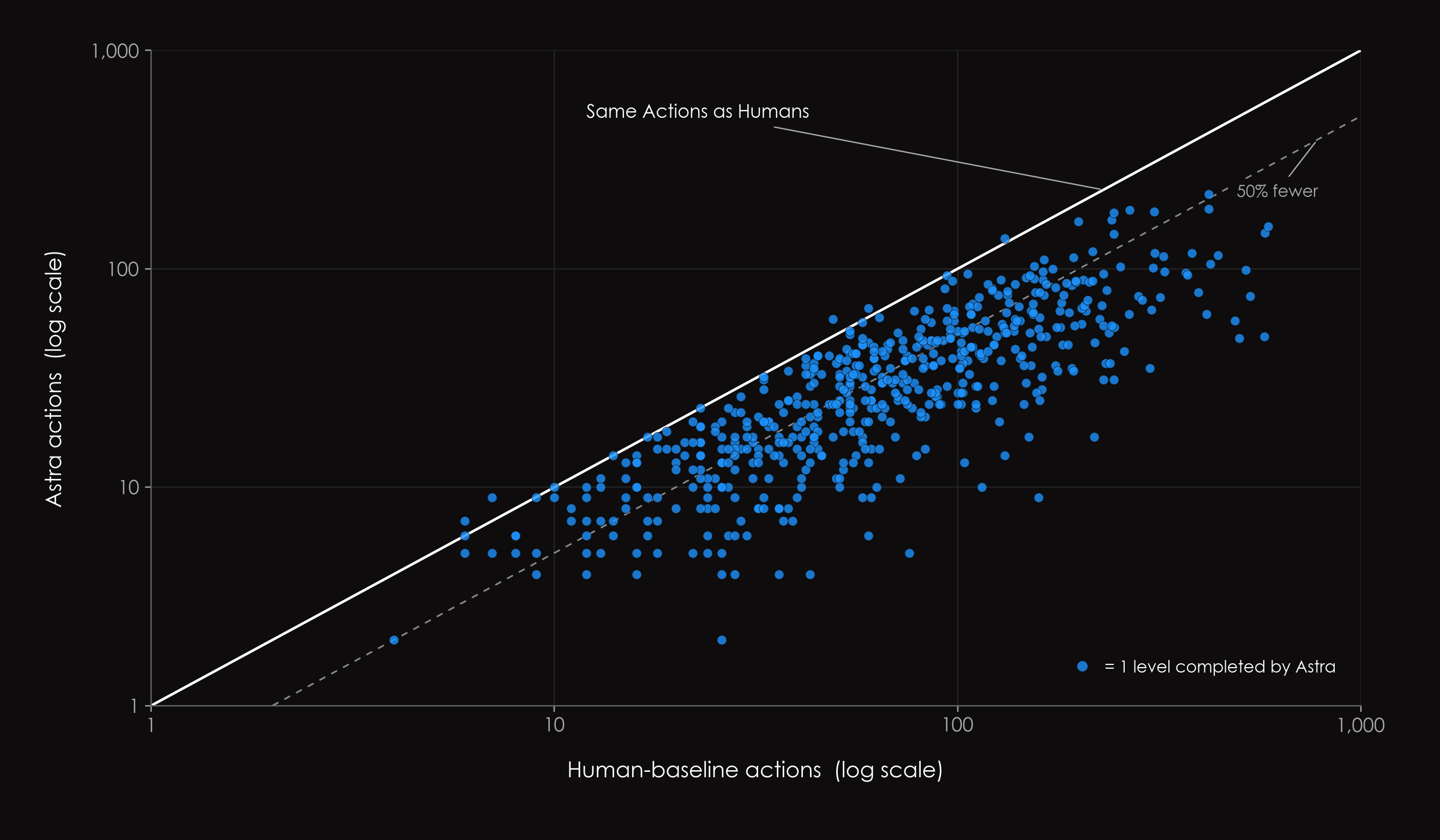
ARC Prize measured GPT-6 Astra on ARC-AGI-3 — a benchmark that drops an agent into unfamiliar turn-based game environments with no instructions. Astra hit 62.7% through the standard harness and 99.9% through a Provider Adapter harness.
How does it work?
The standard harness is provider-neutral — a model decides what to write into visible notes. The Provider Adapter harness lets Astra use vendor-specific features: preserving opaque reasoning state between requests and compacting long conversations.
Why does it matter?
Astra used fewer actions than the human baseline on 96% of levels, but the two runs cost ~$19,000 and ~$26,098 respectively. ARC Prize is explicit: saturating this benchmark would not be proof of AGI.
Who is it for?
People tracking agentic benchmarks and AI capability research.
|
|

|
|
MODEL
MAJOR
2026-09-03
K2 Horizon — six fully open models, from 0.9B to 375B
Six Apache-2.0 models that share one recipe, published with the training data and code behind them.
What is it?
K2 Horizon ships six models at once — 0.9B, 3.7B, 7B, 32B, 36B-A4B and 375B-A23B — each sized for a different deployment, from a constrained device to a multi-GPU rack, all under Apache-2.0.
How does it work?
Every size shares the same architecture, vocabulary and training recipe. Each was pretrained on ~20 trillion tokens (~10 trillion synthetic), then post-trained on 100M+ generated tasks. The 36B-A4B uses Mixture-of-Value Attention for efficient sparse inference.
Why does it matter?
Unlike most "open" releases that stop at weights, IFM also publishes training code, data mixtures, intermediate checkpoints and evaluation logs. The 375B flagship hits 70.2% on Terminal-Bench 2.1 and 42.6% on SWE-bench Pro.
Who is it for?
Researchers and teams that want a single model family that scales from on-device to multi-GPU without rewriting anything.
|
|
|
MODEL
MAJOR
2026-09-03
WeatherNext 3 — DeepMind's weather model goes hourly at 5km
DeepMind's global forecast model moves from 6-hour, 25km predictions to hourly ones at 5km.
What is it?
WeatherNext 3 forecasts the whole planet hour by hour at 5-kilometer resolution for surface variables — about five times sharper than WeatherNext 2, which ran on a 25km grid in 6-hour steps.
How does it work?
The finer grid is paired with continuous ingestion of live geostationary satellite data, which keeps the model's starting state current — a key factor for short-range precipitation accuracy.
Why does it matter?
For medium-range precipitation, WeatherNext 3 improves CRPS scores by up to 60% against NASA's IMERG data and up to 50% more accurate longer-range rain forecasts, with the biggest gains in historically underserved regions.
Who is it for?
Developers and researchers building on weather data — available via Google Search, Gemini, Maps, Earth Engine, BigQuery and the Maps Platform Weather API.
|
|

|
|
MODEL
MAJOR
2026-09-04
LLaDA-Image — a 6B open image generator with a 4-step turbo variant
A 6B diffusion model from Ant Group that writes images from text, edits them from a reference, and publishes its training recipe.
What is it?
LLaDA-Image is a 6B open-weight model from Ant Group's inclusionAI covering text-to-image generation, reference-image editing, and bilingual text rendering. Two checkpoints ship: a 50-step base model and a distilled 4-step Turbo variant.
How does it work?
A 6B diffusion transformer pairs with a frozen vision-language module; training ran on 220M samples (98M real images) using parameter-free RMSNorm and the Muon optimizer. The Turbo checkpoint is distilled from the base to cut sampling from 50 steps to 4.
Why does it matter?
Unlike most image model releases that stop at weights, LLaDA-Image also ships the training code and recipes, enabling labs to retrain rather than just fine-tune a black box. FP8 copies of both checkpoints reduce memory requirements.
Who is it for?
Teams building image generation and editing pipelines who want a fully reproducible open-source foundation.
|
|

|
|
TOOL
MAJOR
2026-09-03
Claude Code 2.1.260 — a live diff panel and a permission-rule security fix
Claude Code 2.1.260 puts a live diff beside the conversation and repairs permission rules that quietly left folders writable.
What is it?
A new /diff command opens a fullscreen panel showing uncommitted changes beside the conversation as Claude edits. The release also adds prompt-cache miss diagnostics to /cost and brings /advisor to headless sessions.
How does it work?
The key security fix: permission rules whose paths contain parentheses were being misread as regex grouping and silently dropped, leaving those folders writable. Version 2.1.260 parses them correctly, and also reverts a 2.1.259 regression that blocked ordinary Bash commands.
Why does it matter?
A folder you marked read-only was actually writable if its path contained a parenthesis — a silent security gap. This update is worth taking even if the new features don't interest you. Auto-compact now also triggers before the 1M-token limit on Opus and Fable sessions.
Who is it for?
Claude Code users and platform teams — install with npm i -g @anthropic-ai/[email protected].
|
|
|
|
DATASET
NOTABLE
2026-09-03
Agentic Task Ecosystem — Cohere Labs maps 696,291 AI tools to job tasks
Cohere Labs released ATE, an open dataset that links almost 700,000 MCP tools to the job tasks they can actually finish.
What is it?
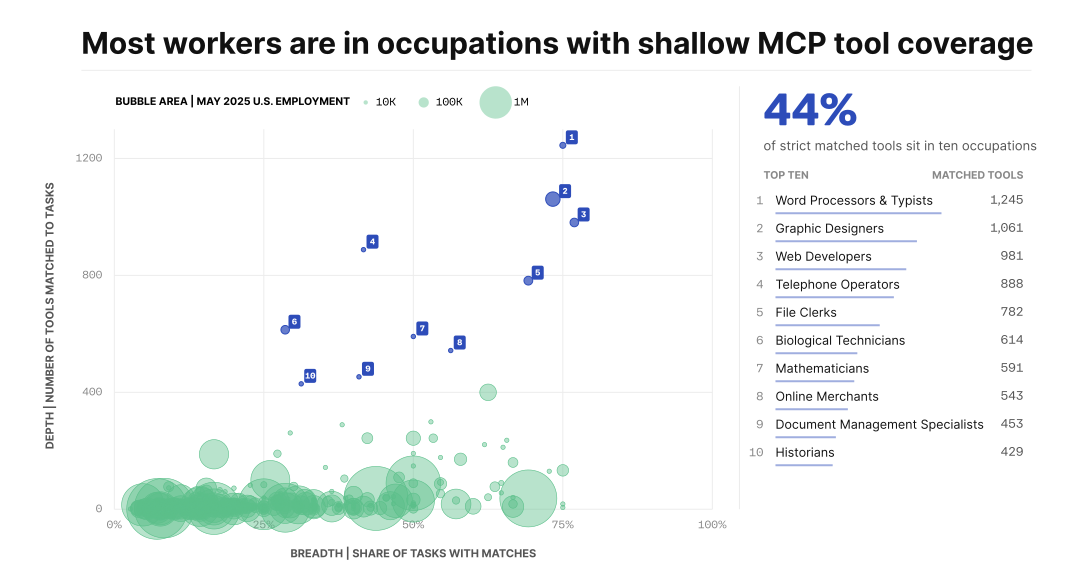
The Agentic Task Ecosystem dataset catalogues 696,291 AI tools from 123,069 public MCP servers and maps each to tasks in O*NET, the U.S. occupational database. Cohere Labs calls it the largest open dataset of its kind.
How does it work?
A tool qualifies only if it completes a recorded work task from start to finish — not if it merely helps. Under that strict test, only 2.6% of the nearly 700,000 tools make the cut, and each is matched to O*NET tasks with a quality score.
Why does it matter?
419 of the 923 U.S. occupations in the data have no agentic tool at all, and the tools that exist cluster around information work. The data shows technical feasibility — not worker demand — is what drives where tooling appears.
Who is it for?
Agent builders and AI policy researchers — available on Hugging Face as Parquet files via load_dataset("CohereLabs/ATE").
|
|
|
All releases at ai-tldr.dev
Simple explanations • No jargon • Updated daily
|
|