
|
|
TOOL
MAJOR
2026-10-30
ChatGPT violence safeguards — chats can end, teens lose weapons details
OpenAI tightens ChatGPT's violence rules: chats can be ended, mass-attack details are limited, and teens get no practical weapons info.
What is it?
OpenAI announced new violence-prevention safeguards for ChatGPT on 30 October 2026. ChatGPT can now end a chat when someone seems fixated on seriously harming another person.
How does it work?
ChatGPT uses short summaries of earlier warning signs, so later requests get more careful answers. Repeated violent fixation may lead OpenAI to pause an account.
Why does it matter?
Teen accounts get stricter defaults, and everyone gets less detail on past mass attacks. A public Community Safety Report starts in early 2027.
Who is it for?
Parents, educators, trust-and-safety teams and ChatGPT users.
|
|

|
|
ECOSYSTEM
MAJOR
2026-10-30
AI training opt-out token — one robots.txt rule for OpenAI and Google
A single robots.txt group can now tell several AI providers not to train on a site, instead of one rule per crawler.
What is it?
A new IETF Internet-Draft adds a shared policy token, __usage_ai-training, to robots.txt. OpenAI said it will honor it and Google plans to support it.
How does it work?
A site writes an ordinary robots.txt group whose User-Agent line is the token, then uses normal Disallow and Allow paths. No new syntax is needed.
Why does it matter?
Publishers no longer need to list every AI crawler by name. Neither company has shipped it yet, and it is a draft, not an IETF standard.
Who is it for?
Website owners, publishers, SEO and web platform teams.
|
|

|
|
SECURITY
MAJOR
2026-10-29
Claude Code extension 2.1.313 — tampered build carried an SSH backdoor
A modified Claude Code extension, version 2.1.313, planted an SSH backdoor on developer machines through the Cursor marketplace.
What is it?
Cursor says a malicious Anthropic.claude-code 2.1.313 build, not made by Anthropic, was live in its marketplace for about 11 hours on 29 October. At most 5,000 users were affected.
How does it work?
The injected code adds an attacker SSH key labeled svc-telemetry and opens a reverse SSH tunnel. It also installs persistence on macOS and Windows.
Why does it matter?
Uninstalling the extension does not remove the key or persistence scripts, so affected developers must clean up by hand and rotate credentials. Cursor says the attacker server is offline.
Who is it for?
Developers who use Claude Code in Cursor or other VS Code forks.
|
|
|
|
MODEL
MAJOR
2026-10-29
Mistral Large 4 open weights — Le Chonk lands on Hugging Face
Mistral's trillion-parameter flagship is now downloadable, with better agent and coding scores than the preview.
What is it?
Mistral AI released the weights of Mistral Large 4 (Le Chonk) on October 29, 2026, three weeks after the API-only preview. It had three more weeks of reinforcement learning.
How does it work?
A sparse mixture-of-experts with about 1T parameters, roughly 49B active per token, reading text and images with a 1M-token context. FP8 and NVFP4 checkpoints are on Hugging Face with vLLM and SGLang recipes.
Why does it matter?
Teams can run a frontier-class model on their own hardware. Mistral reports 41% on Terminal-Bench 4.0, up 13 points from the preview.
Who is it for?
Self-hosting teams, security teams, European enterprises.
|
|
|
|
RESOURCE
MAJOR
2026-10-29
OpenAI Model Spec update — five core values, and the model is now 'GPT'
OpenAI rewrote its public rulebook for model behavior around five values instead of a long list of rules.
What is it?
The 29 October 2026 Model Spec is organized around faithfulness to human intent, harm minimization, honesty and transparency, human agency, and care.
How does it work?
OpenAI sets boundaries, developers direct apps inside them, and users direct the work inside those. Most rules are overridable defaults, with firm limits only where needed.
Why does it matter?
It sets the defaults ChatGPT and the API work toward. Most style rules are retired, and OpenAI says its current models do not yet fully match the new Spec.
Who is it for?
Developers building on OpenAI models and AI policy researchers.
|
|

|
|
MODEL
SEISMIC
2026-10-28
Gemini 4 Carbon — Google's new frontier model, first for cyber defenders
Google's Gemini 4 Carbon tops the Artificial Analysis index and sets new security scores, but only cyber defenders get it at launch.
What is it?
The second Gemini 4 model, announced 28 October 2026. Google calls it its strongest, with top cybersecurity and long-horizon coding abilities.
How does it work?
Google reports 88.2% on SEC-bench Pro for finding vulnerabilities, 54.8% on ExploitGym and 71.0% on CWE-bench for patching, all without guardrails.
Why does it matter?
It ranks #1 on Artificial Analysis Intelligence Index v5.0 with 59. Security teams get a head start through the Fairwind Program; there is no public API date yet.
Who is it for?
Security teams, critical-infrastructure operators, frontier-model watchers.
|
|
|
|
TOOL
MAJOR
2026-10-28
GitHub Copilot Fusion — Copilot now picks and combines models for you
GitHub Copilot Fusion replaces the model picker with routing: one model, a cheap-first cascade, or a draft-and-review loop.
What is it?
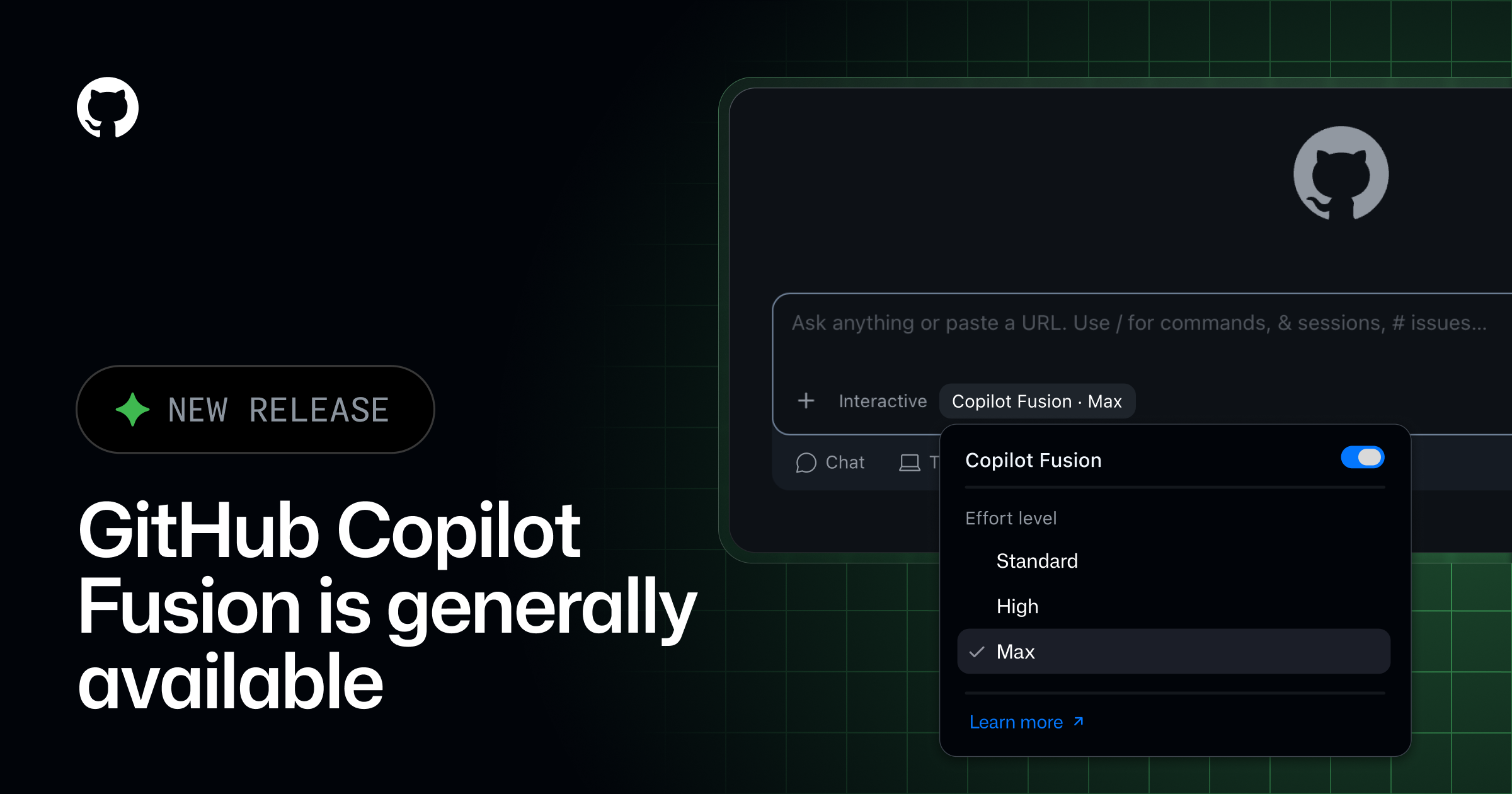
Copilot Fusion became generally available on 28 October 2026 on all Copilot plans. You pick Fusion plus an effort level (Standard, High or Max) instead of a model.
How does it work?
Fusion runs a task in one of three patterns: Single, Cascade (a cheap model drafts, a stronger one steps in if a check fails) or Critique (draft, review, revise).
Why does it matter?
GitHub says Fusion Max is within two points of Claude Code with Opus 5.5 Max on the Artificial Analysis Coding Agent Index at about half the cost. Admins keep model-policy control.
Who is it for?
Copilot users and the admins who manage Copilot model policy.
|
|
|
All releases at ai-tldr.dev
Simple explanations • No jargon • Updated daily
|
|