|
|
TOOL
MAJOR
2026-10-12
OpenCode 2.0 — the open-source coding agent becomes a background service
OpenCode 2.0 turns the open-source terminal coding agent into a shared service with an API, SDK and background work.
What is it?
OpenCode 2.0 is a major overhaul of the open-source AI coding agent from Anomaly. The agent now runs as a single background service, and the terminal UI, web interface and desktop app all connect to it.
How does it work?
A rebuilt server API sits at the center, and Code Mode adds a small JavaScript interpreter so the agent can chain several tool calls in one script. Pressing Ctrl+B moves running subagents or shell commands to the background while work continues.
Why does it matter?
Developers who build on the coding agent get a stable plugin API and an SDK, so they can embed it in their own tools. The cost is a migration: version 1 plugins and server integrations must be ported to the new APIs.
Who is it for?
Developers using or building on terminal coding agents.
|
|
|
|
MODEL
MAJOR
2026-10-14
Grok Voice 3.0 — xAI's voice model tops the speech-to-speech index
xAI's third-generation voice model ranks first on Artificial Analysis' speech-to-speech index at the same $0.08/min price.
What is it?
Grok Voice 3.0 is the speech-to-speech model behind xAI's Voice Agent API. It listens and talks back in real time, built for support and sales calls, and was released on 14 October 2026.
How does it work?
The alias grok-voice-latest now points to grok-voice-3.0, so agents using the alias upgraded automatically. The model leads on turn-taking and interruptions with 97.0% on Full Duplex Bench and 98.5% on Big Bench Audio.
Why does it matter?
Grok Voice 3.0 scores best on both talking-over and task-completion while costing $0.025 per Big Bench Audio task against $0.030 for GPT-Live-1. xAI says Starlink's Grok Voice agent handles ~20,000 calls/day and resolves ~70% without a human.
Who is it for?
Teams building phone and in-app voice agents.
|
|
|
|
MODEL
MAJOR
2026-10-13
LFM2.5-24B-A2B — Liquid AI's biggest on-device agent model
A 24B open-weight MoE that wakes only ~2B parameters per token, built to run agents on laptops at 184 tok/s on Apple M5 Max.
What is it?
LFM2.5-24B-A2B is the largest and final model in Liquid AI's LFM2.5 family: a text-only, reasoning-only open-weight model for private agents that run on your own device. Weights ship on Hugging Face in GGUF, MLX, vLLM and ONNX.
How does it work?
The MoE design has 40 layers routing each token to 4 of 64 experts, so only ~2B of 24B parameters activate per token. Post-training runs five stages ending in agentic reinforcement learning inside harnesses like OpenClaw, Hermes Agent and OpenCode.
Why does it matter?
It scores 27.69 on AutomationBench — over three times Qwen3.6-35B-A3B's 8.72 — and runs at 184 tok/s on an M5 Max. Agent work with tool calls can now run locally with data staying on the machine.
Who is it for?
Developers building local or private agents.
|
|

|
|
MODEL
MAJOR
2026-10-13
Fish Audio Drama 3 — an open 35B speech model for multi-character scenes
Fish Audio's open speech model turns a script with stage directions into a multi-voice performance across 83 languages.
What is it?
Drama 3 voices whole scenes: one text can hold up to 16 characters, and bracketed directions such as [whisper] or [laugh] land where the script puts them. The weights are open on Hugging Face under the Fish Audio Community License.
How does it work?
The backbone is a 35B MoE (initialized from Qwen3.5-35B-A3B, ~3B active per token). A codebook-MTP decoder predicts audio frames, and reinforcement learning with a learned human-preference reward teaches the model to follow expressive direction like laughs without penalizing them for being hard to transcribe.
Why does it matter?
It tops Artificial Analysis pronunciation tests at 93.2%, up from 88.1% for S2.1 Pro, and decodes 271 frames/s on one H200. The license is free for commercial use below US$500,000 in yearly revenue.
Who is it for?
Audiobook, game and dubbing developers.
|
|
|
|
TOOL
NOTABLE
2026-10-13
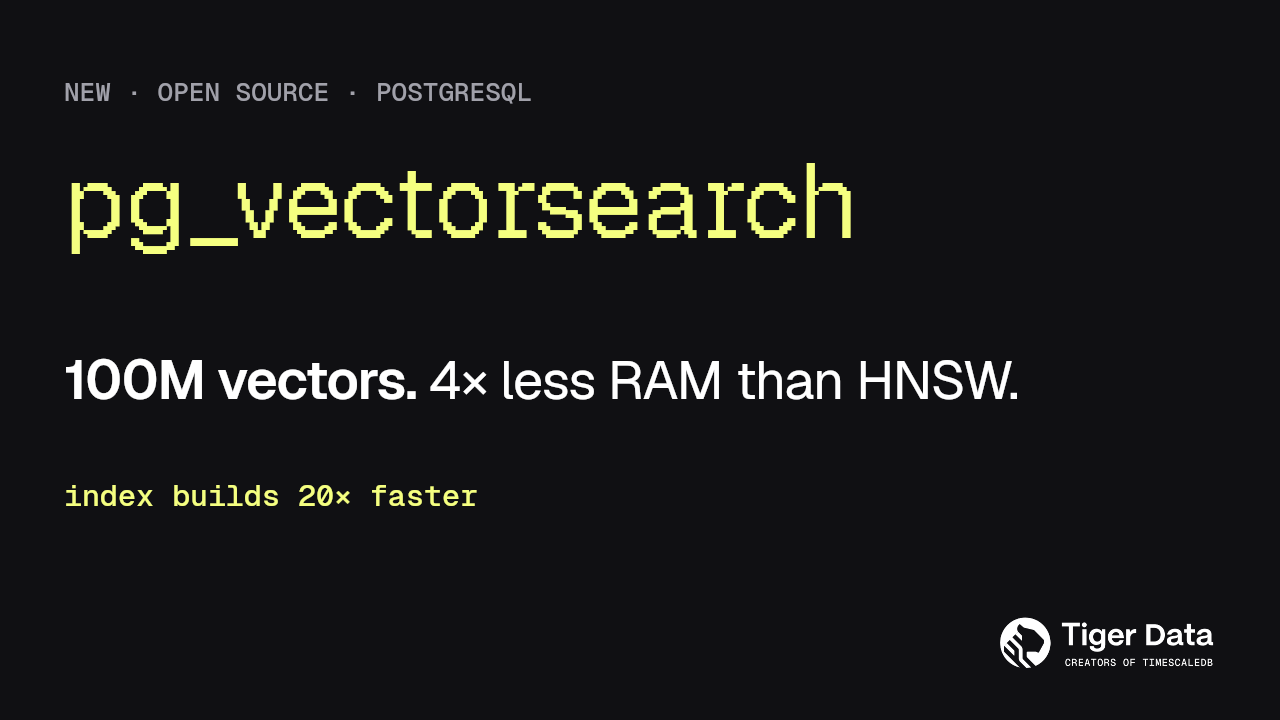
pg_vectorsearch — Tiger Data's new Postgres vector index beats HNSW at 100M
A partition-based vector index for Postgres that builds in minutes where HNSW takes days, with no schema changes needed.
What is it?
pg_vectorsearch adds a new PRISM index type to PostgreSQL 18 for approximate nearest neighbor search. Tiger Data (the Timescale company) released it in alpha on 13 October 2026 under the PostgreSQL License — it works on existing pgvector columns with no schema changes.
How does it work?
PRISM groups vectors into k-means partitions and stores compressed RaBitQ codes (~1 bit per dimension) packed into database pages. A query walks a cluster centroid tree and scans nearest partitions with SIMD; one setting (prism.nprobe) trades latency for recall.
Why does it matter?
In Tiger Data's 100M-vector test, PRISM built in 49 minutes and served 95% recall in 4 ms, while pgvector's HNSW took 42 hours to build on the same machine. Tiger Data says pgvectorscale now moves to maintenance mode.
Who is it for?
Developers running RAG and vector search on PostgreSQL.
|
|

|
|
TOOL
NOTABLE
2026-10-15
iFixAi v4.2.0 — the agent auditor adds offline policy checks
The trending open-source agent auditor gets faster default runs and two offline policy tools for CI-safe checks.
What is it?
iFixAi v4.2.0 adds two offline commands to the open-source auditor that grades whether an AI agent does the job it was given. ifixai trajectory checks recorded agent actions against a business policy; ifixai policy-lab finds harmful tool-permission combinations.
How does it work?
A plain ifixai run now runs a 10-inspection "essential" suite with ~6x fewer agent and judge calls; --full-run runs all 60 inspections. The trajectory checker reads JSONL or OTLP traces without calling a model at all.
Why does it matter?
Teams can audit agents in CI quickly and check real recorded runs without model calls. Note that CI exit codes changed: an invalid run now exits 2 and a partial run exits 1 — pipelines that read the exit code should be updated.
Who is it for?
Teams shipping AI agents to production.
|
|

|
|
SECURITY
NOTABLE
2026-10-14
CSO Online — AI agents aren't going rogue, labs skip security basics
Security experts say the "rogue agent" incidents are old security failures with a new name — and the fixes are familiar.
What is it?
A CSO Online article by Cynthia Brumfield drawing on interviews with six cybersecurity experts at three industry conferences in September 2026. It reached #1 on Hacker News with over 600 points.
How does it work?
The piece walks through recent incidents at OpenAI, Anthropic, Meta, Google and Mistral where models reached systems outside their test setup, then argues labs filed these cases under "AI safety" instead of treating them as standard security work.
Why does it matter?
The experts' fixes are familiar: secure sandboxes, strict egress controls, constant monitoring and outside review of AI vendor tools. The article ties this to a Senate bill that would make AI agent operators liable for hacking incidents.
Who is it for?
Security teams and anyone deploying AI agents.
|
|
|
All releases at ai-tldr.dev
Simple explanations • No jargon • Updated daily
|
|