|
|
MODEL
MAJOR
2026-10-13
Gemini 4 Argon goes GA — Google opens its frontier model to developers
Google's Gemini 4 Argon leaves its limited rollout and ships on the Gemini API, AI Studio, Antigravity and the Gemini app.
What is it?
Gemini 4 Argon reached general availability on 13 October 2026. The model id gemini-4-argon is now listed as stable on the Gemini API, two weeks after an initial rollout limited to trusted cyber defenders.
How does it work?
Input, thinking and output share a 1,048,576-token window. Three thinking levels (low, medium, high) replace temperature; background execution can push output to 1M tokens. Temperature and top-p are ignored.
Why does it matter?
Teams that read the September benchmarks can now actually test Argon on long coding and agent jobs. Introductory pricing ($2/1M in, $10/1M out) doubles on 1 December, so there's a window to evaluate it cheaply.
Who is it for?
Developers on the Gemini API paid tier and Gemini app Pro/Ultra subscribers.
|
|

|
|
TOOL
MAJOR
2026-10-14
Claude Code 2.1.299 — idle compaction saves long sessions before the cache expires
Claude Code now compacts idle long sessions before the prompt cache runs out, so your next message is cheaper.
What is it?
Claude Code 2.1.299 adds idle compaction: a terminal conversation over 200K tokens left idle for about 54 minutes is automatically compacted before its one-hour prompt cache expires. It also adds CLAUDE_CODE_DISABLE_FILE_MENTIONS.
How does it work?
The 200K token floor is configurable via CLAUDE_CODE_IDLE_COMPACT_MIN_TOKENS; set "idleCompaction": false in settings.json to opt out. MCP allow rules now match only the exact server they name, and several sandbox escape paths are closed.
Why does it matter?
Teams that leave big sessions open over lunch stop paying to reprocess the whole context on return. Security admins also get fixes preventing sandboxed commands from writing into plugin directories that run outside the sandbox.
Who is it for?
Claude Code users with long sessions, mod and plugin authors, and admins running managed settings or self-hosted runners.
|
|
|
|
ARTICLE
MAJOR
2026-10-13
Scion — Anthropic replaced git for its monorepo in five months
Anthropic explains why coding agents broke git at its scale and what it built instead.
What is it?
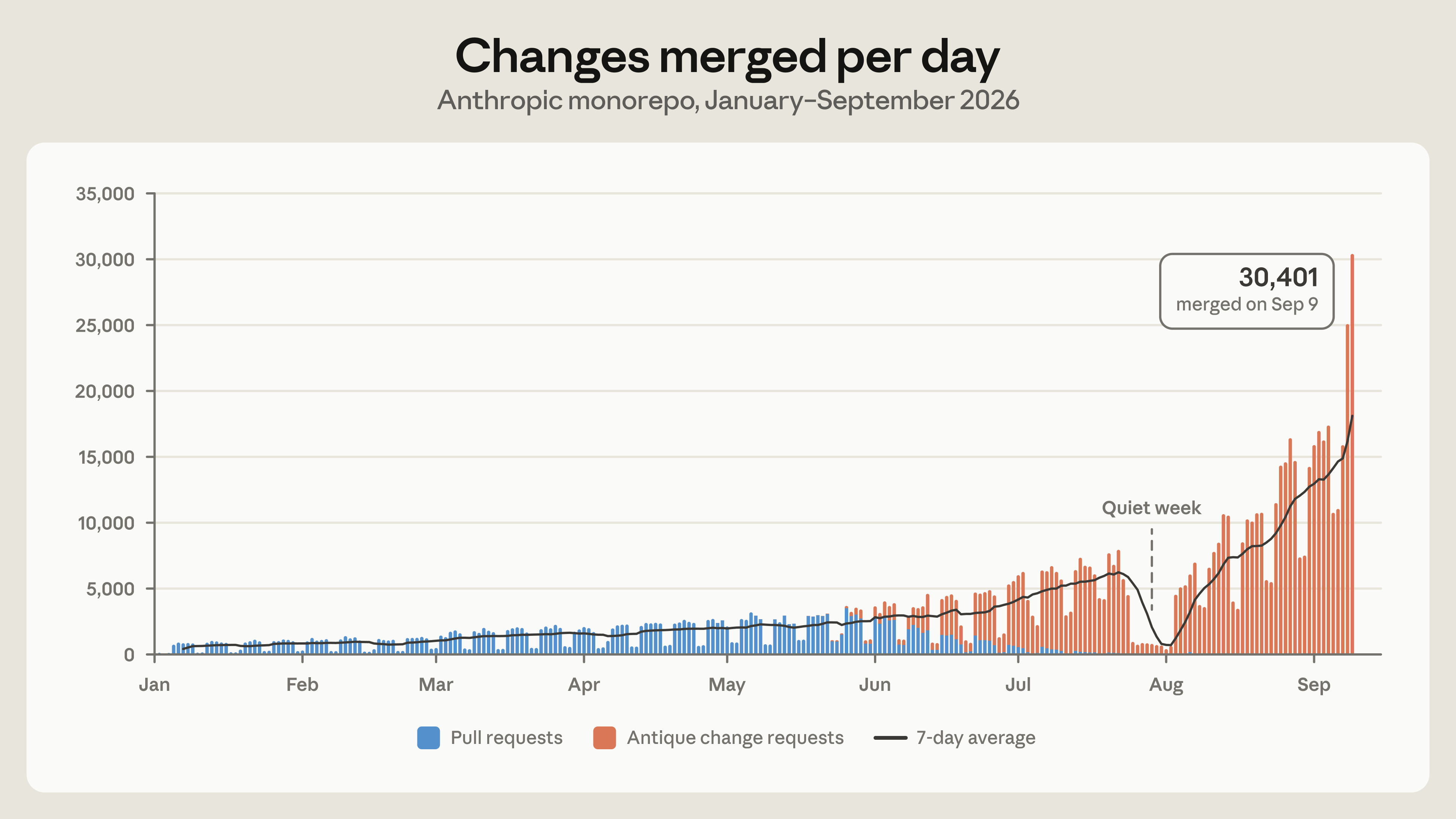
Scion is the version control system Anthropic now runs for its monorepo. A seven-person team built it in five months after daily merges jumped from ~2,500 in May to 30,000+ in September 2026, mostly from agents and CI jobs.
How does it work?
Clients stay online; the server does the heavy work. Changes are stored as a write-ahead log of changesets, and working copies are sparse or virtual — trees and blobs load on demand through three cache tiers, each hitting over 99%.
Why does it matter?
Most of Anthropic's source-control traffic now comes from agents, not people. Its numbers show where git strains at agent scale: ~25M checkouts/day, which naive git would turn into 600+ PB of traffic.
Who is it for?
Platform and developer-infrastructure engineers scaling coding agents. (Scion itself is not open-sourced.)
|
|
|
|
ECOSYSTEM
MAJOR
2026-10-12
Character.ai files for Chapter 11 — the platform shuts if no buyer keeps it
One of the biggest consumer chatbot apps is up for sale in bankruptcy court and may close by December.
What is it?
Character.ai filed voluntary Chapter 11 on 12 October 2026 to run a court-supervised sale. Disney is the $20M stalking-horse bidder for a non-exclusive IP license. The platform stays up for now but will be wound down if no bid lets it keep operating.
How does it work?
In a Chapter 11 sale the stalking-horse bid sets a floor; rivals can top it before the sale closes, expected in late November or early December 2026. Subscriptions and billing continue in the meantime.
Why does it matter?
Millions of chats and custom characters now depend on the outcome. Users should export their data now rather than wait for a possible shutdown notice.
Who is it for?
Character.ai users and creators — export your data through the app or website today.
|
|

|
|
SECURITY
MAJOR
2026-10-13
OpenAI engineer arrested — a hidden recorder in the executive meeting room
An OpenAI engineer is charged with bugging the company's executive conference room in San Francisco.
What is it?
The U.S. Attorney's Office charged OpenAI engineer Abdulrahman Alfozan with hiding a recording device — wrapped in toilet paper and plugged into a USB port behind a TV — in an executive conference room he was not authorized to enter. OpenAI says no model weights, code or customer data were taken.
How does it work?
Staff found the encrypted recorder on September 30, about two days after installation, and used OpenAI's own AI models to identify it. A second device turned up on October 5; he was arrested on October 10.
Why does it matter?
Frontier AI labs now face physical insider threats of the kind long seen in defense and chip companies. FBI Director Kash Patel called protecting AI innovation one of the bureau's highest counterintelligence priorities.
Who is it for?
AI lab security teams, policy watchers, and anyone tracking insider risk at frontier AI labs.
|
|

|
|
MODEL
NOTABLE
2026-10-12
MiniCPM-V 4.7 — OpenBMB's first MoE vision model runs on an iPhone
MiniCPM-V 4.7 brings a 35B mixture-of-experts vision model down to a phone's memory budget.
What is it?
MiniCPM-V 4.7 is the first mixture-of-experts model in OpenBMB's vision series: a 35B-A3B model that reads images and video, plus a 1B variant. Both are Apache-2.0 on Hugging Face.
How does it work?
A SigLIP2 vision encoder feeds a Qwen3 language backbone; each image can be compressed to 4× or 16× fewer visual tokens. Lookahead Expert Scheduling preloads likely-needed experts, which OpenBMB reports as a 5× speedup on real devices.
Why does it matter?
The 35B-A3B runs at 13+ tokens/s on an iPhone 17 Pro Max in about 3 GB. In OpenBMB's own table it leads Qwen3-35B-A3B, Qwen3.8-27B and Gemma-4-31B on MMBench, MMMU and OmniDocBench v1.6.
Who is it for?
On-device and edge AI developers who need a capable vision model in a small memory footprint.
|
|
|
All releases at ai-tldr.dev
Simple explanations • No jargon • Updated daily
|
|