|
|
MODEL
SEISMIC
2026-11-17
GPT-6.2 Astra and Sol — OpenAI's new flagship pair, Astra 20% cheaper
OpenAI's first Astra upgrade since September does more with fewer tokens and costs less per token.
What is it?
GPT-6.2 Astra is OpenAI's new frontier model for the hardest projects, and GPT-6.2 Sol is its efficient model for everyday work. Both write fewer output tokens per task.
How does it work?
Gains in visual reasoning and computer use let the models build reconciling spreadsheets and work in CAD and simulation tools. Both take text and images and have a 1.05M-token context.
Why does it matter?
Astra drops to $8 / $40 per 1M tokens, 20% below GPT-6 Astra, while Sol stays at $2 / $10. OpenAI also rates both Critical for cyber, so tighter safeguards apply.
Who is it for?
Developers and teams running long coding and office agents.
|
|

|
|
MODEL
MAJOR
2026-11-20
Inkling 2 Mini — Thinking Machines' 26.4B looped open model for local use
A small open MoE that loops its middle layers to reason better without paying for more stored weights.
What is it?
Inkling 2 Mini is the smallest model in Thinking Machines Lab's second Inkling generation, released with Apache 2.0 weights. It has 26.4B total and 3.4B active parameters and supports up to 1M tokens of context.
How does it work?
It stores 24 layers, and the two middle blocks run three times per token, so 24 stored layers act like 48. Most weights ship in NVFP4.
Why does it matter?
At about 20GB it runs on a Mac with 32GB of RAM through Ollama, yet the lab reports 79.2% on SWE-bench Verified against 77.8% for Qwen3.8-27B.
Who is it for?
Developers running local coding and agent models.
|
|
|
|
SHOWCASE
MAJOR
2026-11-20
Riemann Hypothesis proof claim — Anthropic's Levent Alpöge and Claude
An Anthropic mathematician says Claude helped him prove math's most famous open problem; the Lean files are public, unchecked.
What is it?
Levent Alpöge, a mathematician at Anthropic, says he believes he has, working with Claude, discovered a proof of the Riemann Hypothesis. He says the same method also settles the Generalized Riemann Hypothesis.
How does it work?
The argument descends from Stepanov's method, using chains of theta lifts over the integers. The proof is written in the Lean proof assistant and released as a 14-part archive.
Why does it matter?
Lean can be machine-checked, so mathematicians can test whether it compiles and encodes Riemann's question. Scientific American reports no expert has verified it yet.
Who is it for?
Mathematicians, formal-verification and AI-for-math researchers.
|
|

|
|
MODEL
MAJOR
2026-11-19
Genie 4 in the Gemini API — developers can stream playable 720p worlds
Google opens its Genie 4 world model to developers, one day after the consumer launch.
What is it?
Genie 4 is now available through the Gemini API's Interactions API and in Google AI Studio. Apps can start a world from a text prompt, a reference image or both, then steer it live.
How does it work?
A backend mints an ephemeral token; the client connects over WebRTC or WebSocket and streams keyboard actions and text inputs that change weather, lighting or objects. Output is 720p at 24 fps with native audio.
Why does it matter?
With per-second API billing, developers can prototype interactive experiences and build environments to train robots and AI agents. Sessions are capped at 120 seconds.
Who is it for?
Game, simulation and robotics developers.
|
|
|
|
TOOL
MAJOR
2026-11-19
Gemini for Mac computer use — Gemini runs Mac apps in a background window
Describe a chore and Gemini works through your Mac apps, files and websites without taking over your screen.
What is it?
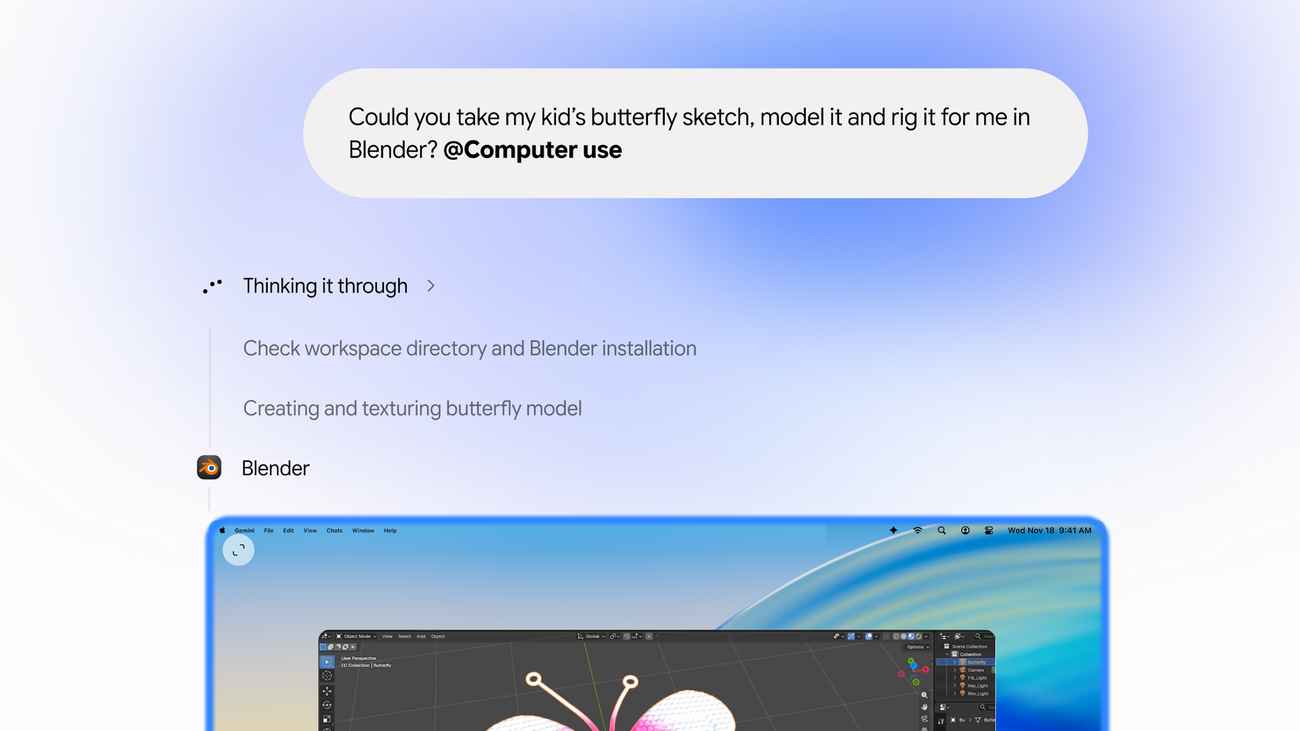
Computer use is a new capability in the Gemini app for Mac. Gemini does the clicking, typing and form filling across local files, desktop apps and the web.
How does it work?
Gemini operates inside an isolated background window and streams a live preview into the chat. Users pick which apps it may use, can pause at any point, and approve key actions.
Why does it matter?
Desktop agents usually take over the mouse and keyboard; this design lets you keep working. It reaches Google AI Plus, Pro and Ultra subscribers in the US.
Who is it for?
US Google AI subscribers on Apple Silicon Macs.
|
|
|
|
SECURITY
MAJOR
2026-11-20
OpenAI Combatting Adversarial Distillation — new API safeguards for GPT-6.2 reasoning
OpenAI says its GPT-6.2 models now hide their reasoning far better from copycat training.
What is it?
OpenAI lists the safeguards it added so GPT-6.2 Astra and Sol reasoning cannot be harvested to train rival models. They include classifiers, adversarial training and API changes.
How does it work?
Protected reasoning is tied to the conversation that produced it: if an earlier message is edited, the reasoning after it is dropped. Older model families are blocked from reading it.
Why does it matter?
OpenAI reports extraction attacks falling from 54.0% to 0.2%. Developers should keep the message prefix unchanged in long agent runs.
Who is it for?
API developers and AI security teams.
|
|
|
|
SECURITY
MAJOR
2026-11-20
Signal blocks Siri AI and Gemini — screenshots off by default to stop AI agents
Signal turns screenshot blocking on by default so OS-level AI agents cannot read or store its chats.
What is it?
On iOS 27 a new "Block Siri AI" setting, on by default, stops screenshots inside Signal. On Android, Screen security switches on when an AI assistant tries to read the screen.
How does it work?
It reuses the screenshot-blocking trick Signal turned on for Windows 11 to stop Microsoft Recall. On Android, Signal watches for AI screen access since screenshot attempts are hard to detect.
Why does it matter?
Agents like Siri AI and Gemini Intelligence can pull end-to-end encrypted messages out of Signal. Signal admits the fix is incomplete: macOS has no supported API for it.
Who is it for?
Signal users, mobile app developers and teams building OS-level AI agents.
|
|
|
All releases at ai-tldr.dev
Simple explanations • No jargon • Updated daily
|
|