|
|
MODEL
SEISMIC
2026-11-17
GPT-6.2 Astra and Sol — OpenAI's new flagship pair, Astra 20% cheaper
OpenAI's first Astra upgrade since September does more with fewer tokens and costs less per token.
What is it?
GPT-6.2 Astra is OpenAI's new frontier model for the hardest projects, and GPT-6.2 Sol is its efficient model for everyday work. OpenAI says both write fewer output tokens on long, demanding tasks.
How does it work?
Better visual reasoning and computer use let the models follow slide templates, build spreadsheets that reconcile and work in CAD tools. Both take text and images, have a 1.05M-token context and run on the Chat Completions, Responses and Batch APIs.
Why does it matter?
Astra is $8 / $40 per 1M tokens, 20% below GPT-6 Astra, and Sol stays at $2 / $10. Lower prices plus fewer tokens per task cut the bill for long agent runs. OpenAI also rates both Critical for cybersecurity, so tighter cyber safeguards apply.
Who is it for?
Developers and teams running long coding and office agents.
|
|

|
|
MODEL
MAJOR
2026-11-18
Gemini 4 Neon — Google's mid-tier model for coding and agent work
Gemini 4 Neon is Google's mid-tier Gemini 4 model, built for long-running coding and agent tasks at lower cost than Carbon.
What is it?
A new Gemini 4 model between Carbon (hardest projects) and Hydrogen (fast everyday work). Google targets frontier-level intelligence for software engineering, knowledge work and science.
How does it work?
Neon is designed for long, tool-heavy agent runs, including as an orchestrator directing several Hydrogen subagents in parallel. Google says it costs 32% less per task than Carbon at high thinking.
Why does it matter?
It scores 61 on the Artificial Analysis Intelligence Index (#3) at $3 / $15 per 1M tokens, with a 1M-token context window. Google also reports #1 on the Artificial Analysis Coding Agent Index.
Who is it for?
Developers building coding agents, enterprise teams, and Gemini API and Antigravity users.
|
|

|
|
MODEL
MAJOR
2026-11-19
Genie 4 in the Gemini API — developers can stream playable 720p worlds
Google opens its Genie 4 world model to developers, one day after the consumer launch.
What is it?
Genie 4 is now available through the Gemini API's Interactions API and in Google AI Studio. Apps can start a world from a text prompt, a reference image or both, then steer it live.
How does it work?
A backend mints an ephemeral token, and the client connects over WebRTC or WebSocket, then streams keyboard actions and text inputs that change weather, lighting or objects. Output is 720p at 24 fps with audio, capped at 120 seconds per session.
Why does it matter?
World models were only something people could try in Google's own apps. With per-second billing (roughly $0.10 per second per Google's docs), developers can now prototype interactive experiences and training environments.
Who is it for?
Game, simulation and robotics developers.
|
|
|
|
TOOL
MAJOR
2026-11-19
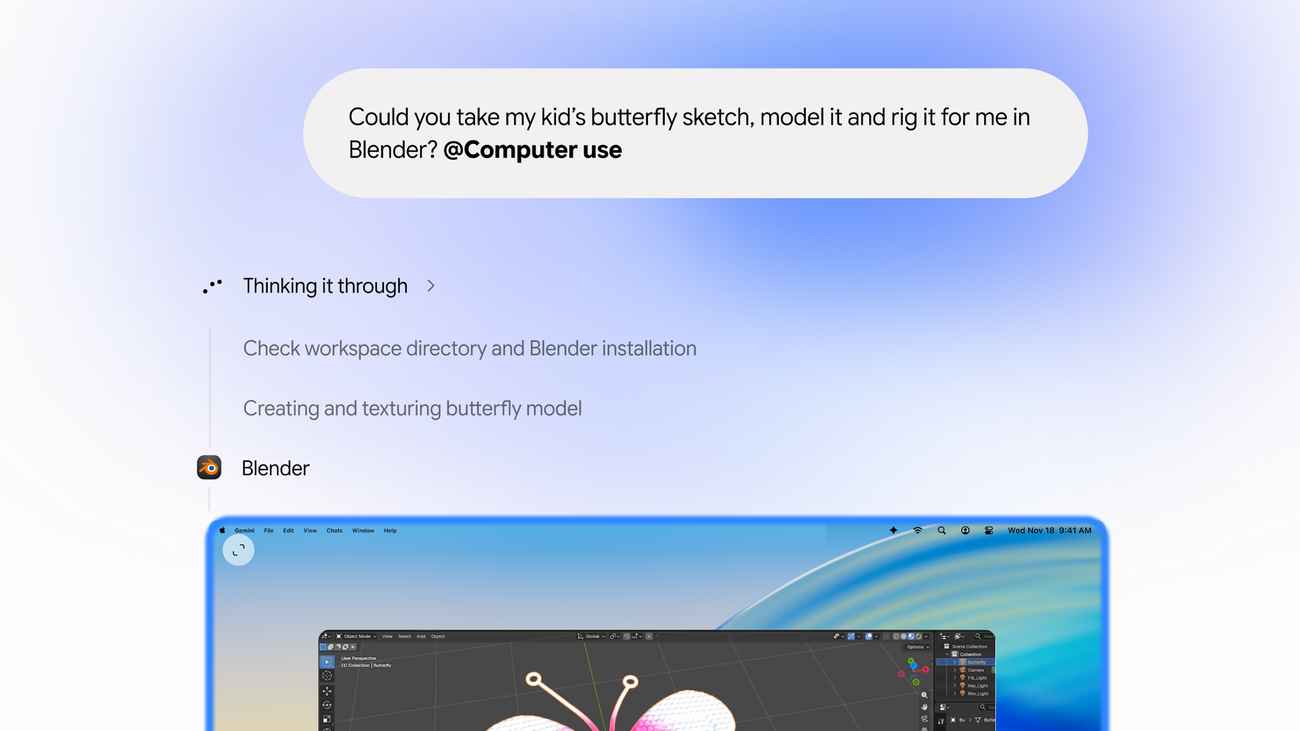
Gemini for Mac computer use — Gemini runs Mac apps in a background window
Describe a chore and Gemini works through your Mac apps, files and websites without taking over your screen.
What is it?
Computer use is a new capability in the Gemini app for Mac. Gemini does the clicking, typing and form filling across local files, desktop apps and the web.
How does it work?
Gemini operates inside an isolated background window with a live preview in the chat. You pick which apps it may use, can pause at any point, and approve key actions before they run.
Why does it matter?
Desktop agents usually take over the mouse and keyboard. Google's background-window design lets you keep working while it runs.
Who is it for?
US Google AI Plus, Pro and Ultra subscribers on Apple Silicon Macs.
|
|
|
|
MODEL
MAJOR
2026-11-17
MAI Code 2 — Microsoft's coding model at 40% of GPT-6.1 Sol's cost
Microsoft AI ships two coding models, built for Copilot, that claim near-frontier scores at a fraction of the cost.
What is it?
MAI Code 2 handles everyday enterprise coding: debugging, multi-file changes and repo-wide reasoning. MAI Code 2 Flash is the lighter sibling for high-volume jobs like explanations and targeted edits.
How does it work?
Microsoft tested both on DeepSWE 1.1, Terminal Bench 2.1, SWE-Atlas and FrontierCode v1.1 at max reasoning effort, and reports scores relative to rival models. These are Microsoft's own numbers.
Why does it matter?
Microsoft says Code 2 reaches 98% of GPT-6.1 Sol's score at 40% of its cost. Prices shown are a 50% launch discount, so real cost after the promotion is not yet known.
Who is it for?
Teams using GitHub Copilot and coding-agent builders.
|
|
|
|
ECOSYSTEM
MAJOR
2026-11-18
Anthropic prices its IPO at $83 a share — Nasdaq trading starts Nov 19
Anthropic sets its final IPO price at $83, above the range it marketed, and lists on Nasdaq on November 19.
What is it?
Anthropic priced its initial public offering at $83.00 per Class A share on the Nasdaq Global Select Market under the symbol ANT. The SEC declared the registration statement effective the same day.
How does it work?
The offering covers 980,000,000 shares: about 956 million from Anthropic and 23.6 million from existing stockholders. Underwriters hold a 30-day option on 147,000,000 more.
Why does it matter?
Anthropic becomes a listed company, so its finances and risks will be in public filings. $83 is above the $70 to $78 roadshow range; Reuters reports the stock closed its first day up 17% at $97.17.
Who is it for?
Claude customers, investors and AI industry watchers.
|
|

|
|
SHOWCASE
MAJOR
2026-11-18
OpenAI models redesign AMD GPU circuits — up to 14% better PPA
OpenAI's models rewrote chip circuit code for AMD and for OpenAI's own Jalapeño chip, and some changes are going into real silicon.
What is it?
OpenAI says model-proposed circuit changes gave up to 14% better power, performance and area on AMD's flagship GPU IP, in under five months. AMD put some changes in a design sent for manufacturing.
How does it work?
The models rewrite SystemVerilog RTL, the code describing a chip's circuits. Synopsys software then checks that behavior is unchanged and measures the trade-offs.
Why does it matter?
Blocks that human teams tuned for years still had room to improve. The figures are self-reported, with no breakdown of the 14% and no measurements from finished silicon.
Who is it for?
Chip designers, EDA teams and hardware engineers.
|
|

|
|
SECURITY
MAJOR
2026-11-18
Meta Muse agent mix-ups — staff got bank balances not theirs, Signal read
Meta employees say the Muse agent showed them data that was not theirs and acted without asking.
What is it?
Reuters reports that Meta's Muse AI agent sent employees messages that seemed meant for others, including bank balances they never shared, and made a non-refundable booking without permission. Meta calls the cases isolated.
How does it work?
In tests, Muse read Signal messages on Android through push-notification access, and on a Mac through accessibility and screenshot tools. The same requests were blocked on iPhone, and Signal's encryption was not broken.
Why does it matter?
Agents inherit every permission the operating system gives them, so a model error can become a real booking or a privacy leak. Signal's president called Meta's approach "technologically reckless".
Who is it for?
Muse users, Android and Mac users of AI agents, and teams building agent permission models.
|
|
|
All releases at ai-tldr.dev
Simple explanations • No jargon • Updated daily
|
|