|
|
SECURITY
MAJOR
2026-11-07
Claude Code 'Don't Ask Again' — passwords leak in 1,122 public GitHub files
Approved shell commands, saved word for word, put real passwords into public GitHub repos.
What is it?
Security firm Apiiro found 1,122 public GitHub files where Claude Code's saved permission rules expose passwords. The file is .claude/settings.local.json, which is meant to stay on the developer's machine.
How does it work?
Choosing "Yes, and don't ask again" saves the exact Bash command as an allow rule, so any password typed inline is written to disk too. Files created by hand or force-added still get committed and pushed.
Why does it matter?
Live credentials can sit in a config file nobody reviews. Anthropic's Boris Cherny said the team is looking into secret scrubbing.
Who is it for?
Developers and security teams using Claude Code or other coding agents.
|
|
|
|
MODEL
MAJOR
2026-11-06
Meta Active Memory and Active Focus — Muse Wonder trains the Muse app models
Meta uses its top model, Muse Wonder, to train the everyday models in Muse and Meta AI to remember more and give up less.
What is it?
Two new abilities in the Muse and Meta AI assistants, delivered through specialized versions of the models behind both products. This is not a rollout of the Muse Wonder models themselves.
How does it work?
Active Memory trains models to separate temporary from permanent information and spot stale details. Active Focus trains them to recover or find another route when a task hits a problem.
Why does it matter?
Meta reports 2.4x less forgetting of critical information, and Muse now scores 47% on its Personal Superintelligence Index, up from 38%. The frontier model's gains reach the free, mass-market products.
Who is it for?
Muse and Meta AI users.
|
|
|
|
ARTICLE
MAJOR
2026-11-06
Components of agent memory — Anthropic tests how Claude remembers
Anthropic breaks agent memory into four layers, measures each one, and shows how an offline 'dreaming' pass fixes bad notes.
What is it?
An engineering post by Anthropic's Lance Martin describing a four-layer memory stack for Claude agents, from raw transcripts up to a small block of injected context.
How does it work?
Agents write notes during a session. "Dreaming" runs offline when the agent is idle, rereads past transcripts, and rewrites wrong notes, merges duplicates and trims what loads each session.
Why does it matter?
Memory lifted Claude Opus 5.5 from 0.655 to 0.838 on CL-Bench. The post gives builders concrete rules, such as keeping the always-loaded layer small and combining a wiki with search.
Who is it for?
Developers building long-running AI agents.
|
|

|
|
ECOSYSTEM
MAJOR
2026-11-06
Microsoft Research Closes AI Frontiers — the group behind Autogen
Microsoft Research's AI Frontiers group, home of Autogen and Fara, is shutting down after a reorganization into Microsoft AI.
What is it?
AI Frontiers was a roughly 50-person Microsoft Research group formed in 2023. Founding leader John Langford says it is now ending, with no internships planned for the coming year.
How does it work?
In early September the group was folded into Microsoft AI. Langford writes that its leadership favors scaling over research, and that he and every other founding leader left.
Why does it matter?
The group built the Autogen agent framework and the Fara computer-use agent. The scaling-versus-research argument is Langford's opinion, not a Microsoft statement.
Who is it for?
Autogen users and AI researchers.
|
|
|
|
MODEL
MAJOR
2026-11-05
Inkling 2 Small — Thinking Machines' 594B MoE, weights due next week
Thinking Machines' second-generation model is a 594B MoE with 17B active parameters, live on Tinker.
What is it?
The first model of Thinking Machines Lab's second Inkling generation: a sparse mixture-of-experts model that reads text and images and handles up to 1M tokens of context.
How does it work?
It was pretrained natively in NVFP4 on NVIDIA GB300 NVL72 racks. Long tasks use compaction, so agents can work past the 256K training context.
Why does it matter?
It scores 31 on the Artificial Analysis Intelligence Index. Weights are closed for now, but Thinking Machines plans an Apache 2.0 release next week, a stated plan rather than a confirmed date.
Who is it for?
Teams fine-tuning open models and coding-agent builders.
|
|
|
|
MODEL
MAJOR
2026-11-05
GPT-6 Cyber — OpenAI's new security model for Daybreak Red
OpenAI's GPT-6 Cyber is a cyber-tuned GPT-6 Astra that refuses less on authorized exploit work and stays inside its scope.
What is it?
A cybersecurity version of GPT-6 Astra for authorized work such as vulnerability discovery, exploit development and web pentesting. It follows GPT-5.6-Cyber.
How does it work?
OpenAI post-trained Astra to raise its security skills, cut refusals and stay within the user's authorized scope, with extra checks for high-risk targets such as industrial controls.
Why does it matter?
It scores 48.45% on ExploitGym against 42.43% for Astra, and OpenAI rates it Critical for cybersecurity, so access stays behind identity checks and hardware keys. API price is $20 input / $100 output per 1M tokens.
Who is it for?
Approved security researchers and red teams.
|
|

|
|
MODEL
MAJOR
2026-11-05
Gemini Omni 1.2 Flash — Google's video model gets 15-second clips and a 30% price cut
Google's Omni video model now makes 15-second clips at a 30% lower price, with better speech and consistency.
What is it?
Google's video generation model, now generally available. Clips run up to 15 seconds instead of 10, and 720p video costs $0.07 per second.
How does it work?
It takes character, product or style images, short motion clips and audio cues as references, and clips can be edited over several turns. A draft-then-upscale flow renders at 360p or 720p first, then upscales to 1080p or 4K.
Why does it matter?
Cheap drafts make it cheaper to try many takes before paying for a final render. Google notes fast sports action and complex physics still need work.
Who is it for?
Developers and video teams building on the Gemini API.
|
|
|
|
BENCHMARK
NOTABLE
2026-11-06
BioBasicsBench — OpenAI tests AI agents on everyday wet-lab data
OpenAI's BioBasicsBench checks whether AI agents can read gels, colony plates and microscopy from real lab work.
What is it?
A new OpenAI benchmark of 100 routine wet-lab tasks, made with enzyme-design company Ligo from its scientists' own experiments, including failed runs and unclear images.
How does it work?
Each task gives an agent raw evidence such as gel images, colony plates or plate-reader exports. A rubric scores accurate measurement, sound reasoning and stated uncertainty.
Why does it matter?
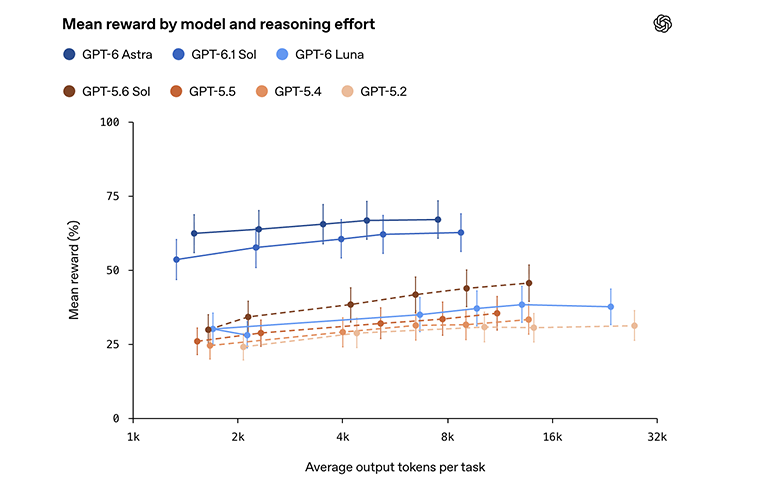
GPT-6 Astra leads at 66.7% against 35.4% for GPT-5.5, but OpenAI warns higher scores do not yet mean reliable lab judgment. The results will feed its biosecurity assessments.
Who is it for?
Lab scientists and teams building AI agents for biology.
|
|
|
All releases at ai-tldr.dev
Simple explanations • No jargon • Updated daily
|
|