|
|
MODEL
MAJOR
2026-11-06
Meta Active Memory and Active Focus — Muse Wonder trains the Muse app models
Meta uses its top model, Muse Wonder, to train the everyday models in Muse and Meta AI to remember more and give up less.
What is it?
Active Memory and Active Focus are two new abilities in the Muse and Meta AI assistants. They come from specialized versions of the models behind both products, trained using Muse Wonder, not from a rollout of Muse Wonder itself.
How does it work?
For Active Memory, Meta trained the models to tell temporary information from permanent information and to spot stale details. For Active Focus, training covered real-world bottlenecks, so the assistant can recover or find another route when a task hits a problem.
Why does it matter?
Meta reports a 2.4x drop in forgetting critical information, and Muse now scores 47% on its Personal Superintelligence Index, up from 38%. The frontier model's gains now reach the mass-market products.
Who is it for?
Muse and Meta AI users.
|
|

|
|
ARTICLE
MAJOR
2026-11-06
Components of agent memory — Anthropic tests how Claude remembers
Anthropic breaks agent memory into four layers, measures each one, and shows how an offline 'dreaming' pass fixes bad notes.
What is it?
An engineering post by Anthropic's Lance Martin describing a four-layer memory stack for Claude agents, from raw transcripts up to a small block of injected context. It is measured on CL-Bench, a Pokémon Red run and wiki-building tests.
How does it work?
Agents write notes during a session. 'Dreaming' then runs offline: it reads past transcripts and memory, rewrites wrong notes, merges duplicates and trims what loads into every session.
Why does it matter?
Memory lifted Claude Opus 5.5 on CL-Bench from 0.655 to 0.838. The post also gives builders concrete rules, such as keeping the always-loaded layer small because one wrong note spreads to every session.
Who is it for?
Developers building long-running AI agents.
|
|
|
|
RESOURCE
MAJOR
2026-11-05
METR on Anthropic — AI may have doubled the pace of Claude's progress
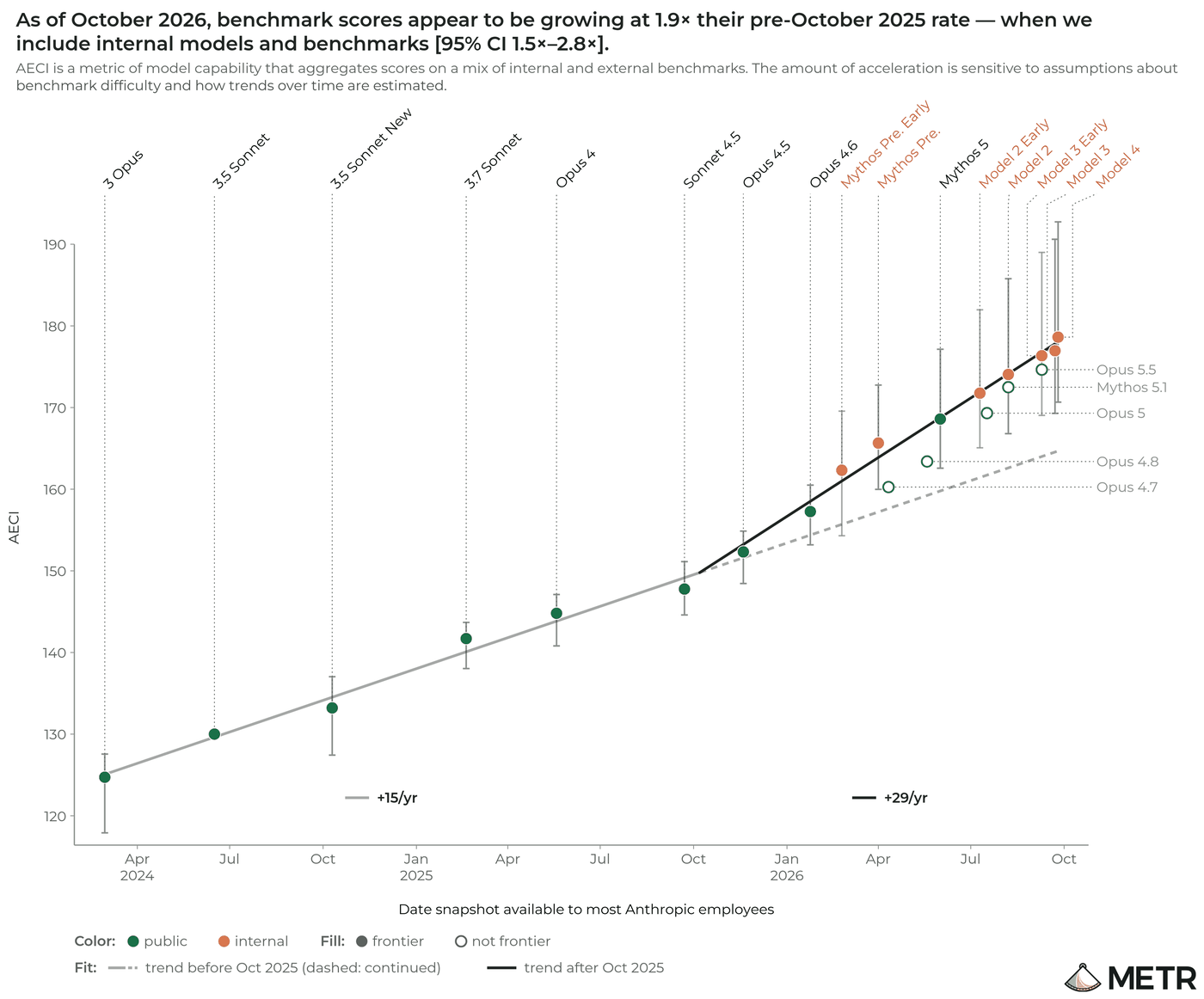
An outside evaluator finds Anthropic's AI progress has sped up about 2x, much of it from using its own AI.
What is it?
METR's independent, high-access assessment, run from August 12 to October 29, 2026. It concludes Anthropic is likely improving capabilities at around twice its March 2024 to October 2025 rate, with a plausible range of 1.3x to 3x.
How does it work?
METR used internal benchmark scores, AECI, training-compute data, headcount, surveys and about 15 staff interviews. A trend fit with a breakpoint in October 2025 gives a 1.9x acceleration. METR had no query access to unreleased models.
Why does it matter?
It is the first outside estimate of AI R&D acceleration at a frontier lab, and METR guesses about 80% of the speed-up comes from AI. Anthropic redacted most of the key evidence, so readers must rely on METR's judgment.
Who is it for?
AI safety researchers, policy makers and anyone tracking frontier-lab risk.
|
|
|
|
MODEL
MAJOR
2026-11-05
Inkling 2 Small — Thinking Machines' 594B MoE, weights due next week
Thinking Machines' second-generation model is a 594B MoE with 17B active parameters, live on Tinker.
What is it?
The first model of Thinking Machines Lab's second Inkling generation: a sparse mixture-of-experts transformer with 594B total and 17B active parameters. It reads text and images, supports variable reasoning effort and handles up to 1M tokens of context.
How does it work?
It was pretrained natively in NVFP4 on NVIDIA GB300 NVL72 racks. Long tasks use compaction, so agents can work past the 256K training context.
Why does it matter?
It scores 31 on the Artificial Analysis Intelligence Index. Weights are closed for now, but Thinking Machines says Apache 2.0 weights follow next week after safety testing, a stated plan rather than a confirmed date.
Who is it for?
Teams fine-tuning open models and coding-agent builders.
|
|
|
|
MODEL
MAJOR
2026-11-05
GPT-6 Cyber — OpenAI's new security model for Daybreak Red
OpenAI's GPT-6 Cyber is a cyber-tuned GPT-6 Astra that refuses less on authorized exploit work and stays inside its scope.
What is it?
A cybersecurity version of GPT-6 Astra for authorized work such as vulnerability discovery, exploit development and web pentesting. It scores 48.45% on ExploitGym against 42.43% for Astra.
How does it work?
OpenAI post-trained Astra to raise security skills, cut refusals and keep within the user's authorized scope. Extra checks cover high-risk targets such as industrial controls and election systems, plus cyber-specific monitoring.
Why does it matter?
OpenAI rates it Critical for cybersecurity, so access sits behind identity checks, hardware keys and IP allowlists. It is priced at $20 input and $100 output per 1M tokens.
Who is it for?
Approved security researchers and red teams.
|
|

|
|
MODEL
MAJOR
2026-11-05
Gemini Omni 1.2 Flash — Google's video model gets 15-second clips and a 30% price cut
Google's Omni video model now makes 15-second clips at a 30% lower price, with better speech and consistency.
What is it?
Google's video generation model, now generally available. Clips run up to 15 seconds instead of 10, and 720p video costs $0.07 per second, 30% less than Omni 1.1.
How does it work?
It takes character, product or style images, short motion clips and audio cues as references, and lets users refine a clip over several turns. A draft-then-upscale flow renders at 360p or 720p first, then upscales to 1080p or 4K.
Why does it matter?
Lower per-second cost and cheap drafts make it cheaper to try many takes before paying for a final render. It is available in the Gemini API, Vertex AI, Flow, Google Vids and Google Ads.
Who is it for?
Developers and video teams building on the Gemini API.
|
|

|
|
TOOL
MAJOR
2026-11-05
Mistral Studio managed agents — agents, apps and workflows ship to Studio
Mistral turns Studio into a place to build, deploy, trace and test agents and apps on Mistral Large 4.
What is it?
Managed agents are the headline: multi-step agents with sandboxes, subagents, skills, tools and MCP connectors. The release also adds a workflow builder, hosted apps, a managed search index, datasets and evaluations, mostly in public preview.
How does it work?
Developers write agents in Python with the mistralai-agents SDK, test with agents chat, then ship with agents serve (self-hosted) or agents deploy (Mistral-hosted, resumes after crashes).
Why does it matter?
Traces, datasets and evaluation scores now live next to the agents, and companies that must keep data in-house can run the stack in a VPC or on-premises.
Who is it for?
Enterprise developers building agents on Mistral models.
|
|
|
All releases at ai-tldr.dev
Simple explanations • No jargon • Updated daily
|
|