|
|
MODEL
MAJOR
2026-11-04
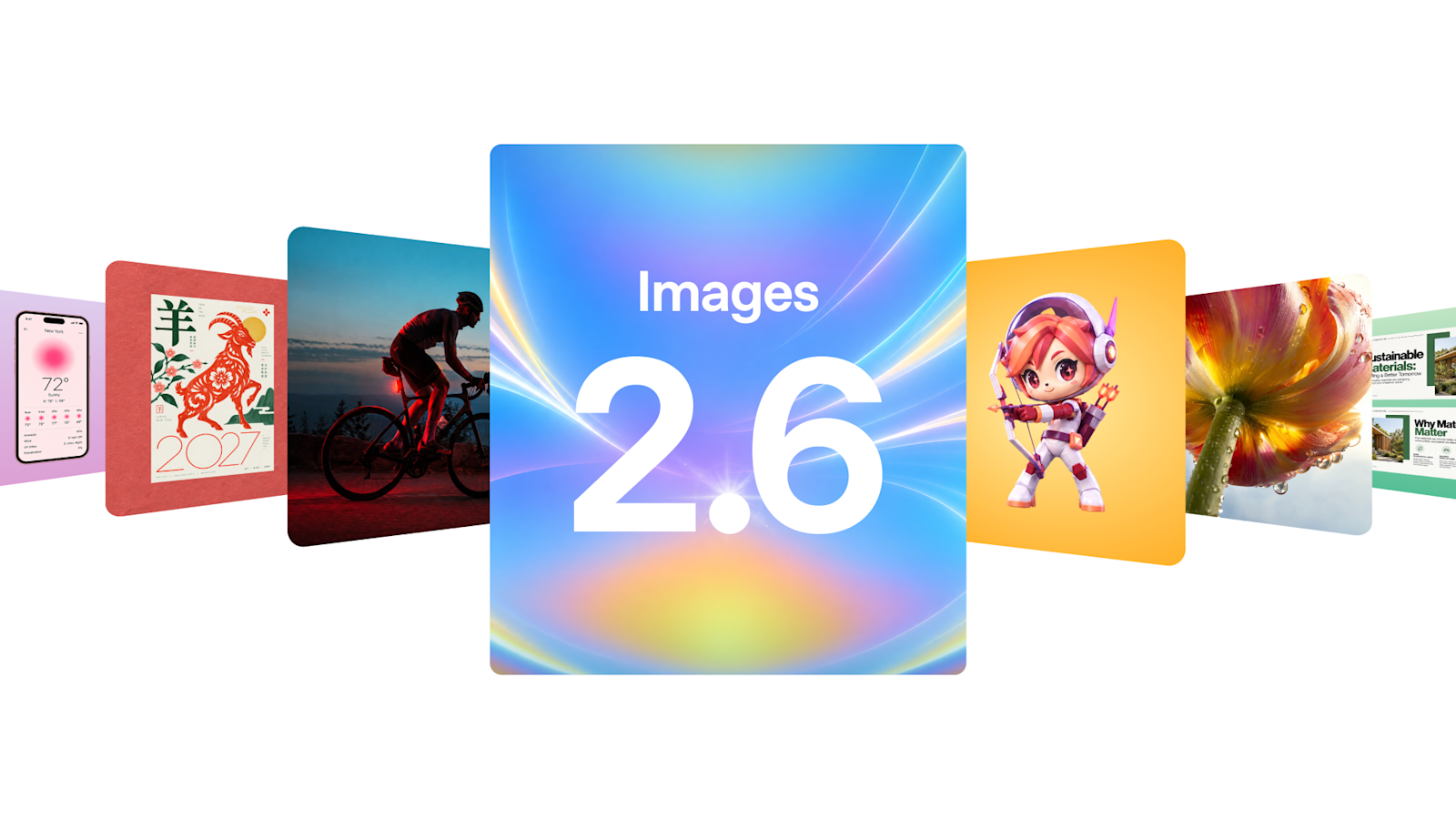
Images 2.6 — OpenAI's image model now makes GIFs and SVGs, 50% faster
OpenAI's Images 2.6 adds motion: sketch a character, get a looping GIF, in ChatGPT or through the API.
What is it?
Images 2.6 is OpenAI's new image generation model. Its headline addition is animated GIFs, plus SVG export and generation that OpenAI says is 50% faster.
How does it work?
Two API models ship: GPT-Image-2.6 Flare for fast iteration and Sunburst for detailed work. A new complexity setting (low, medium or high) controls how much the model plans before it draws.
Why does it matter?
GIF and SVG output remove an extra tool from common design jobs, and the complexity setting adds no fee. OpenAI says people now make 4 billion images a week.
Who is it for?
Designers, marketers and app developers.
|
|

|
|
SECURITY
MAJOR
2026-11-04
A thousand fewer paths to root — OpenAI agents find 948 Linux root exploits
OpenAI turned Linux kernel bug hunting into a pipeline: 2,308 findings in, 948 working root exploits and patches out.
What is it?
An OpenAI security report on an agent pipeline that audits the Linux kernel at scale. It reproduced 1,724 vulnerabilities and built 948 unique local privilege escalation exploits, reviewed by humans before reporting.
How does it work?
Scout agents pick audit targets, analyst agents scan them, and triage agents prove each bug in a VM. Exploit agents then test the strongest candidates, and a final stage writes patches.
Why does it matter?
The full run cost about $1.2M in API credits, roughly $359 per successful exploit. OpenAI's advice: rescan old code as models improve, and keep systems patched.
Who is it for?
Kernel maintainers, security teams and AppSec researchers.
|
|

|
|
MODEL
MAJOR
2026-11-04
Hunyuan Hy4 — Tencent's full release adds vision and computer use
Tencent's Hy4 leaves preview with image understanding and the ability to operate apps, on a 1M-token context.
What is it?
Hunyuan Hy4 adds vision and computer use to Tencent's flagship model, which shipped as an open-weight preview in August. The final model is hosted now; weights and a system card come later.
How does it work?
Tencent scaled up pre-training and post-training, with targeted work on Blender, CAD, multi-app workflows and game engines. It reads fine image detail and works across command-line and graphical interfaces.
Why does it matter?
Developers get vision and agent use on a 1M-token context at a low price; OpenRouter lists $0.417 input and $1.251 output per million tokens. Tencent admits a gap to top closed models on research math and long-horizon coding.
Who is it for?
Developers building agents on low-cost long-context models.
|
|

|
|
MODEL
MAJOR
2026-11-04
Ripple-65B Preview — open-weight 65B coding model from Ricursive
Ricursive's first public model is a 65B dense, Apache-2.0 model built for agentic coding.
What is it?
An open-weight, instruction-tuned language model from Ricursive Intelligence, with weights on Hugging Face under Apache 2.0. Ricursive calls it the U.S. open-weight state of the art on agentic coding.
How does it work?
A dense Transformer with 80 layers, pretrained on 12T tokens and post-trained with SFT and RL aimed at agentic coding. Context reaches 1M tokens.
Why does it matter?
Ricursive reports 80.5 on Terminal-Bench 2.1, ahead of much larger open models, but the numbers are self-reported. Commenters note the lead is small and a dense 65B runs slower locally than MoE rivals.
Who is it for?
Teams that want U.S.-made open weights for coding agents.
|
|
|
|
PAPER
MAJOR
2026-11-04
Vault particles with Claude — Anthropic solves a bacterial vault structure
Claude helped a small Anthropic lab team find, build and image a giant protein shell no one had seen in bacteria.
What is it?
Vaults are large, hollow protein shells whose job is still unknown. Anthropic's biology team used Claude to solve the first 3D structure of one from a prokaryote: a 96-copy shell from a bacteriophage.
How does it work?
Claude searched about 15 billion predicted proteins, designed DNA for candidates and ran the RELION cryo-EM software in a multi-agent harness. Seven of 15 tested proteins formed vault-like particles.
Why does it matter?
It shows an AI model doing hands-on parts of a structural biology project in under four months, while Anthropic is candid about Claude's errors, which cost about two weeks.
Who is it for?
Structural biologists, protein engineers and AI-for-science researchers.
|
|

|
|
MODEL
MAJOR
2026-11-02
Kimi K3.1 Pro open weights — Moonshot's 2.8T model lands on Hugging Face
Moonshot keeps its promise: the full Kimi K3.1 Pro weights are now public on Hugging Face.
What is it?
A 2.8T-parameter Mixture-of-Experts model with 104B parameters active per token, a 1M-token context and text plus image input, released as moonshotai/Kimi-K3.1-Pro.
How does it work?
Each token picks 16 of 896 experts across 93 layers, mixing Kimi Delta Attention with Gated DSA layers. Quantization-aware training ships the weights in MXFP4.
Why does it matter?
By Moonshot's own numbers, self-hosters can now run a model close to Claude Opus 5.5 on agentic coding and tool use. The MIT-style license adds extra terms only for large model-as-a-service providers.
Who is it for?
Teams self-hosting frontier open models.
|
|

|
|
ECOSYSTEM
MAJOR
2026-11-04
OpenAI to acquire Pierre Computer — Code Storage is coming to Codex
OpenAI is buying the team behind Code Storage to give Codex its own Git-based home for code.
What is it?
OpenAI will acquire Pierre Computer, maker of the hosted Git service Code Storage and the open-source Trees and Diffs libraries that Codex already uses. Terms were not disclosed.
How does it work?
Code Storage gives platforms clone, push and fetch endpoints with TypeScript, Python and Go SDKs, and syncs with GitHub, GitLab and Bitbucket. OpenAI plans to fold these features into Codex.
Why does it matter?
Codex users get a hint of source control built into the agent app itself. Existing customers can keep using the service, and the open-source projects stay open.
Who is it for?
Codex users and platforms that store AI-generated code.
|
|

|
|
REPO
MAJOR
2026-11-03
agent-desktop 1.1 — Vercel Labs' computer-use CLI for AI agents
A command-line tool that lets any AI agent see and click native desktop apps, without matching pixels.
What is it?
Vercel Labs' computer-use CLI and C library. Version 1.1.0 fixes Windows overlay crashes, reaches the macOS Dock and menu bar, and topped GitHub trending with 2,275 new stars in a day.
How does it work?
It reads each app through the OS accessibility APIs and returns JSON with a ref for every actionable element. The agent clicks or types on a ref, then takes a new snapshot to check the result.
Why does it matter?
Many desktop apps have no API, and pixel-based computer use is slow and fragile. About 60 commands work the same on macOS, Windows and Linux, though apps with no accessibility tree stay invisible.
Who is it for?
Developers building agents that operate desktop apps.
|
|
|
All releases at ai-tldr.dev
Simple explanations • No jargon • Updated daily
|
|